


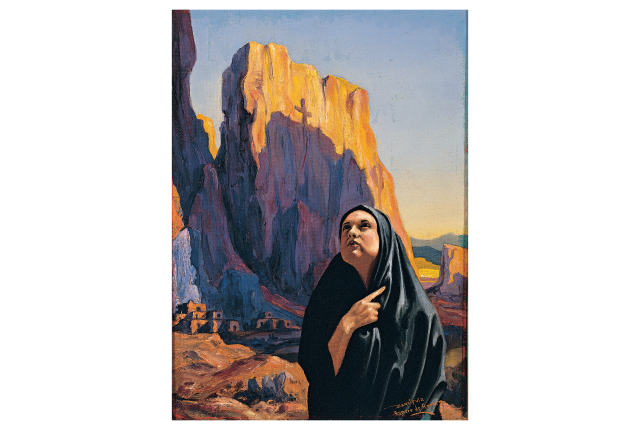
THE RICH BLUES and heavenly golds of New Mexico’s landscape were beloved by 20th-century figurative painters. They paid less attention to the region’s mystical purples, found in uncanny valleys, shadowy peaks, and remote ridges where people have dwelled for many centuries. Esquípula Romero de Romero’s The Black Shawl (1933) is a regal exception. In a corner of the New Mexico Museum of Art, in Santa Fe, the tabloid-size painting’s young woman (based on Romero de Romero’s daughter, Esther) stands near an ancient pueblo, clutching the titular rebozo and engulfed by orchid-colored shadows that reveal a Calvary cross. On an impressively small scale, the work boldly proclaims the mysteries of faith in the Land of Enchantment. Created as a study for New Mexico Magazine’s July 1933 cover, The Black Shawl graced the cover five more times over the next two years to save on production costs during the Great Depression; rare copies of those vintage issues are priced at more than $250. “His colors breathed life,” says Josette Elias, who fondly remembers her great-great uncle Esquípula (1889–1975) as a Salvador Dalí–esque bohemian who liked to ride his Indian Motorcycle fast through northern villages. Acquired by the museum in 1999, the work also depicts a massive outcropping that resembles Cabezon Peak, near where the artist was born in the now-ghost town of Cabezon. Curator Katie Doyle is especially partial to the painting’s size: “It’s like a window that you get to look inside and experience everything that was put into this work, the layered histories that are quite literally in the rocks behind her.”
See The Black Shawl on the second floor of the Plaza Building of the New Mexico Museum of Art, Santa Fe.