


WHILE THE SKY still just hints at dawn, people line up at the Chaco Culture National Historical Park Visitor Center, waiting for the gates to open on what, for many, will be a once-in-a-lifetime view. The show is the sunrise itself. Just a few minutes after 6 a.m. on the summer solstice, the sun crests the mesa and beams in through a window in Casa Rinconada’s great kiva, pouring amber light into a stone niche. The sun seems to settle there for a few minutes, then moves on.
At the spring and autumn equinoxes, the sun rises through windows on either side of the entrance to Casa Rinconada’s great kiva. The largest kiva in the canyon, the circular structure stands alone on a small rise.
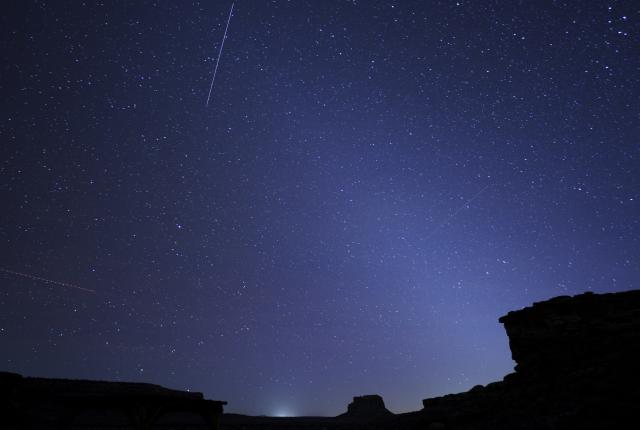
Chacoan people clearly had their eyes on the skies. In numerous instances, building walls at great houses, kivas, and other cultural sites align with cosmic cycles, including sunrises and moonrises. Rock art also records what are understood to be celestial events. All those traces are still visible, but so, too, is a night sky that ranks among the darkest in the country, making for vibrant star-viewing.
“It’s a humbling experience,” says Nathan Hatfield, supervisory park ranger for interpretation for Chaco Culture National Historical Park, who has been attending these events for 10 years. “For a lot of people, it’s a reminder that we’re part of something much bigger.”

Pueblo Bonito at Chaco Culture National Historical Park lit by moonlight. Photograph by Wayne Suggs.
DARK MATTERS
In keeping with the long human history of watching the sky and marking the positions of the sun and moon, Chaco Culture National Historical Park offers night sky events twice monthly from May to October. Night sky viewing events at the International Dark Sky Park are often hosted by the Albuquerque Astronomical Society and generally include indoor lectures before heading to the park’s small observatory to view constellations, planets, star clusters, or nebulae. September brings an astronomy festival with lectures from astronomers and the telescope open for viewing. “If the sky is clear, and if the moon is not out, you’re going to see just an amazing show,” Hatfield says.
ROCK STARS
The legendary sun dagger, a spiral petroglyph on top of Fajada Butte that’s pierced by a blade of sunlight at midday on the solstice, is closed to visitors, but other petroglyphs also reflect Chacoan astronomy. On a boulder near the visitor center, a petroglyph shows an orb ringed with squiggly lines that’s generally seen as depicting the corona coming off the perimeter of the sun during a total eclipse—one of which was known to have occurred in the 1000s. A pictograph near the Peñasco Blanco great house looks like a reddish starburst and is thought to record a supernova that was visible in the daytime sky in 1054, around the time the structure was under construction.
“I’m sure there were prominent individuals who were dedicated skywatchers and observers and documenters of what was going on up there,” Hatfield says. “They were farmers, and if you’re a farmer you’ve got to keep track of the seasons, and observing the sky was one of the ways of doing that.”
SUMMER SOLSTICE & MORE
On June 21, gates open around 5 a.m. A ranger guides attendees to view the sunrise alignment. For winter solstice and other events, visit nmmag.us/chaco-events.
QUIET REFLECTION
In the stillness of today, the sounds of the past are alive.
Visitors to Chaco Culture National Historical Park often remark on the deep quiet. “It really has those wilderness qualities, without being a designated wilderness,” says Denise Robertson, the park’s superintendent.
While visitors now value that silence, Chacoans would have experienced the canyon filled with the noise of construction often underway, people working, livestock around, and even musical instruments. “During Chaco’s heyday,” she notes, “it might not have been so quiet.”
That soundscape may also have played a key part in connecting the many communities in the greater Chacoan landscape. In 2024, anthropology professor Ruth Van Dyke found that the blare of a conch shell trumpet—17 of which were found at Chaco—would have been heard from one to the next among five Chacoan communities on the Colorado Plateau. That audible reach, she says, may have helped maintain social cohesion among distant communities. Van Dyke also wonders if the distance that sound traveled might be a way to find other, as-yet-unknown communities spread over the landscape, adding to the current count of hundreds.
“It would have been a neat way to call people together,” she says. “[Like] ringing the church bell back in medieval times.”