SUSAN HUDSON, AN ARTIST AND lifelong quilter, wants you to know she is an activist. Quilting and fighting for social justice might not seem to readily go together, but in Quilted Survivance, a current exhibition at the Millicent Rogers Museum, in Taos, they are perfectly compatible.
One of Hudson’s pictorial quilts, Standing Strong in the Face of Genocide, features four panels depicting a young Native man. Using ornate fabric, appliqué, beadwork, and leatherwork, Hudson takes the viewer through a harrowing series of events. In the first panel, the young man is dressed in traditional clothing, holding his sacred feathers and instruments. In the second image, he is shot, with blood gushing from his body. In the third, he slumps over, red trailing behind him on the wall. In the final panel, the young man has disappeared—there are no traces of him, his clothing, or his blood left behind, only his story written in Hudson’s cursive.
Susan Hudson, co-founder of the Navajo Quilt Project, at the Millicent Rogers Museum.
“I wanted to honor the stories of those brave children that stood up for their beliefs,” Hudson says about those who did not survive Native boarding schools.
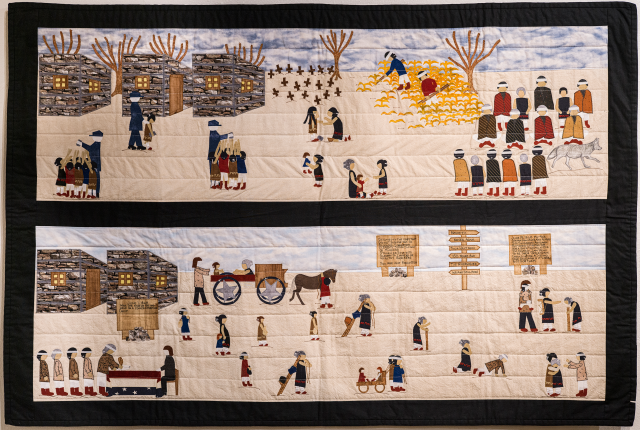
These are not your grandmother’s quilts. They are detailed, creative historical logs of genocide, forced removal, and family origins based on rape—and they are bittersweet, beautiful, and critical to understanding American history and its impact on Indigenous people. Quilted Survivance features Hudson’s storytelling quilts, and her work with the Navajo Quilt Project (NQP), a community-based quilt-making organization based on the Navajo Nation. The exhibition showcases 45 works by Hudson and other members of the project, including Priscilla Bancroft, Roselyn Johnson, Autumn Goodluck, Virginia Henry, Kyle Begay, Moraes Begay, Roberta Roberts, Brandon Roberts, Earnest Smith, Jay Curtis, Shaun Thomas, Nancy Curtis, and Lily Hanabah Crotty (Hudson’s granddaughter).
In 2024, Hudson became a National Endowment for the Arts (NEA) Heritage Fellow for her work. “The government gave me this award because I make quilts showing what the government did—the atrocities toward our people,” she says.
Susan Hudson greets exhibition visitors.
Hudson is a busy woman who is deeply committed to her people. In addition to her job as a Bureau of Indian Affairs administrative officer, for which she drives 115 miles round-trip from her home in Sheep Springs, New Mexico, to Ignacio, Colorado, Hudson makes award-winning quilts for art markets throughout the year that range from Santa Fe to Indianapolis. In 2016, Hudson co-founded the Navajo Quilt Project with the goal of creating multigenerational connections and fostering storytelling through quilting. Based out of Sheep Springs and servicing many areas of the Navajo Reservation, the nonprofit receives and distributes fabric donations and hosts quilting workshops at reservation chapter houses. It has even served as the conduit for donated treadle (pedal-powered) sewing machines to Navajo residents who want to sew but don’t have electricity at home.
The youngest member is seven, while the oldest is 84. “How we know [the age range] is because we were having a discussion on who eats first,” Hudson says with a laugh.
Co-curators Annie Drysdale and Claire Pelaez Motsinger, who is also curator and interim executive director of the Millicent Rogers Museum, immediately saw the power of the truth-telling that characterizes Hudson’s work. Drysdale and Pelaez Motsinger know each other from the University of Denver’s graduate art history program, where they both earned master’s degrees in museum studies. Drysdale’s culminating thesis focuses on Indigenizing museum methodologies and making the exhibition development process more communal and collaborative with artists.
Susan Hudson’s 2025 "Whispers of Survivors."
“It’s about relationship and respect and reciprocity—and understanding that our relationship with Susan does not end when the show closes, that this is an ongoing effort together,” Drysdale says.
Quilted Survivance insists on breaking the mold in every way, both in content and process. Although the museum celebrates its 70th anniversary in 2026, this is its first quilt exhibition. “Quilts are associated for many people with comfort, with home, with this tactile, soft quality,” Pelaez Motsinger says. “The ‘survivance’ is firm, and firm in a historical, spiritual, academic, intellectual sense—that’s something that we’re bringing together here. Hopefully the museum can be that actor to really force the public to understand something that is already existing without their knowledge but perhaps can better them by understanding.”
Drysdale and Pelaez Motsinger wanted to walk the collaborative talk in their exhibition development approach. Hudson had full veto power in the project, which is unusual for an artist. But she was still hesitant when Drysdale approached her about a possible exhibition.
Priscilla Bancroft (second from right) with her family and "Blue Sky Buffalo, 2021–2025."
“These are my ancestors’ voices, and if it wasn’t the way I wanted, it was going to be a no-go,” Hudson says. “I wanted to involve the Navajo Quilt Project because I think they should be acknowledged for all their hard work. It’s just not [all] me.”
The project evolved. While it centers Hudson and her accomplishments, including the prestigious NEA Heritage Fellow award, Quilted Survivance makes room for works by other Navajo Quilt Project members. Her success in involving more community artists catalyzes change in terms of what makes its way into an exhibition and what stories are told. “Susan is the one who is doing a lot of work so that her community gets that kind of recognition,” Pelaez Motsinger says. “That deserves recognition in itself.”
The museum exhibition doesn’t shy away from the heavy topics in Hudson’s work. One of her quilts, Whispers of Survivors, features eight panels showing the experience of a young woman who is raped at boarding school, gives birth to her child, is forced to give the baby up for adoption, wonders where it is the rest of her life, and eventually finds solidarity in that experience within her community.
Co-curators Annie Drysdale (left) and Claire Pelaez Motsinger in front of a Susan Hudson quilt.
“We’re not censoring any of the images or any of the storytelling from any of the pieces whatsoever, even though themes of violence, sexual violence, genocide—all the big ones are present,” Pelaez Motsinger says. “We don’t avoid it in the label text, and we don’t avoid it in the objects chosen.” The curators have also chosen to include opportunities for self-education, like QR codes that lead viewers to resources about relevant topics, such as the movement for awareness of Missing and Murdered Indigenous Relatives.
Even the fact that quilting is not a traditional art form for Navajo people figures into the exhibition’s messaging. Hudson describes how she learned to sew and quilt from her mother, who was forced to learn at boarding school. After being stolen from their homes and families and put in government-run boarding schools, Native children were taught such skills, which were deemed to make them more civilized. Throughout her life and career, Hudson has turned what can be seen as a method of oppression into a mode of expression for herself and her people.
“I’m reclaiming the stories of my ancestors and my mother,” she says. “I’m giving voice to the voiceless.”
Susan Hudson’s 2024 "Standing Strong in the Face of Genocide."
QUILTED SURVIVANCE
Through February 1
Millicent Rogers Museum, 1504 Millicent Rogers Road, Taos; 575-758-2462.