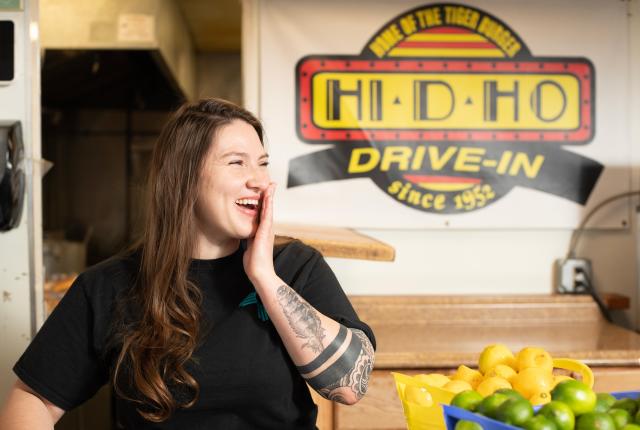
TO ORDER A WORLD-FAMOUS TIGER Burger—or anything else—from Alamogordo’s Hi-D-Ho Drive In, you simply flash your headlights. They’ve done it this way since 1952. You push the button or twist the dial a few times until your automobile flickers. Out comes the carhop.
The food is, as they proclaim on the trifold paper menu, not fast but good. And so you wait. You play some Waylon Jennings. You get out and talk to neighbors, distant cousins, old flames. You half-heartedly shoo at flocks of pigeons that have landed here since ’52 because, like your own family, the birds have passed down the knowledge that at the Hi-D-Ho, there will always be a friendly face from which you can snatch a thick golden fry.
Think of all the flickering autos these pigeons have witnessed. The Cadillac Eldorados, Corvette Stingrays, and Chevy Impalas. In the driver’s seat, you struggle to grip soft buns that barely stabilize 10 ounces of juicy beef smashed into two perfect patties, piled high with lettuce, tomato, a dash of mustard, and all that diced green chile with American cheese oozing through. They double-wrap the burger in paper, but this Tiger cannot be contained. Thick cuts of onion spring-load the thing, and you must devour it before the car’s interior is stained. Maybe this is magic, you think, this spot where we pilgrimage as our ancestors did to gather in machines and flicker briefly until we are, at last, satiated.
from left
Cars have cruised the drive-in since 1952. The Tiger Burger is a Hi-D-Ho classic.
Maybe I’m too nostalgic about Hi-D-Ho. My grandparents got married at the family ranch just down the highway from the drive-in the year the restaurant opened. It’s fun to imagine that somewhere in the ancestral tree that leads to me was a honeymoon bite of the town’s first, and still best, green chile cheeseburger. But technically there’s never been a GCCB on the menu. You’ve got to ask for green chile on the Tiger Burger, named for the high school mascot.
Anyway, there are other things you’ve got to try if you want the real hometown magic. Red enchiladas, for instance—add ground beef and an egg. I order those crispy fries too, so I can sop up red chile from the bottom of the tray.
When I was young, nearly every week there was an “Enchilada Dinner” to support this or that religious charity or some sports team trying to hire a bus. It was dozens of gallons of red chile doled out on thousands of corn tortillas. Anybody could put on an Enchilada Dinner, but the ones we never missed were when Hi-D-Ho teamed up with Alfredo’s and Margo’s, our town’s two best restaurants in the 1990s.
Amanda Ortiz at the grill.
My family, who were kind of strict about their Protestant faith, would find themselves rushing to support all sorts of Catholic charities when this trifecta of enchilada supremacy put on a fundraiser dinner. Although Alfredo’s and Margo’s are long gone, Hi-D-Ho remains, and I order those enchiladas because they taste like perfect charity. Goodness of the heart has the gentlest spice to it. The slow-cooked beans fortify the soul.
In high school, I had an extended dalliance with Hi-D-Ho’s fajita burrito. They grill the veggies so the peppers stay crisp while the onions get so soft they almost melt into the flour tortilla, itself slightly charred. We teens would park just a hundred yards away at the corporately lit Sonic Drive-In, where there was more room to cruise our hand-me-down Buicks. But if we wanted any sustenance, we walked over to Hi-D-Ho, where lights around the awning were never too bright. That’s why Hi-D-Ho was also where you went hoping to smooch—and why the gentlemanly wrap of the fajita burrito beat the mess of a Tiger Burger.
from left
Andrea McKinley takes an order. Try the refreshing cherry limeade.
Before I was around, the drive-in was briefly called Mac’s Hi-D-Ho and then Beaver’s Hi-D-Ho. In the seventies, there was a period of pizza experimentation that nobody mentions anymore. For much of the sixties, Hi-D-Ho was so central to life in Alamogordo that it basically became one of the cardinal directions. You didn’t go south of town, you went “down by the Hi-D-Ho.” Even other restaurants advertised their location in the newspaper by stating their proximity to the drive-in. “Turn at the Hi-D-Ho” was a surefire way to get wherever you were headed, plus a reminder that you could stop to enjoy a milkshake or malt or Lemon Squeeze, a huge cup of shaved ice with about six lemons squeezed into it.
These days, under Mika Myers, whose family has owned Hi-D-Ho since 1979 (and worked there even longer: her grandmother was a carhop at age 14), the drive-in is a time machine—worn some and held together with tinkering, but still magic.
You can kind of tell that in November 1956, the awning of the drive-in was taken out by a wayward driver. Or that in ’57, a Cadillac got bent around the iconic sign. Folks remember how those three young boys, in October of ’55, managed to break in and steal all the ice cream. They’ll point to the space where the jukebox roared until it was vandalized in ’83.
Charles Zamora with his 1962 Chevy Bel Air.
I can see where we parked and sipped cherry limeades after Grandaddy’s funeral in 2011, or where we got out and ate in our church clothes after we buried Grandmommy, after 96 good years and 67 years after she was married at the ranch and maybe had that honeymoon GCCB.
It’s like the old soul of our town, this drive-in, and it’s about more than the GCCB. But things are perilous now. The two-lane road my grandparents came down after their wedding is now a six-lane boulevard, and all up and down it are corporately lit chain restaurants. On my last visit, I could see two Sonic Drive-Ins from the Hi-D-Ho. A new Sonic was being built across from the old one, which, despite being half the age of Hi-D-Ho, was already out of style.
I recently discovered that one of the drive-in’s specialty burgers has been on the menu since the 1950s—the Luigi. One beef patty. Grilled onions. Two cheeses: Parmesan and American. Extra ketchup. Such a burger sounds like an abomination to any New Mexican. But if my grandparents did stop at the drive-in on their wedding day, this is the one they might have had. And so, I flickered, and then came the Luigi. I’d never had it before. But it tasted like I knew it would, like Hi-D-Ho always does, like home.
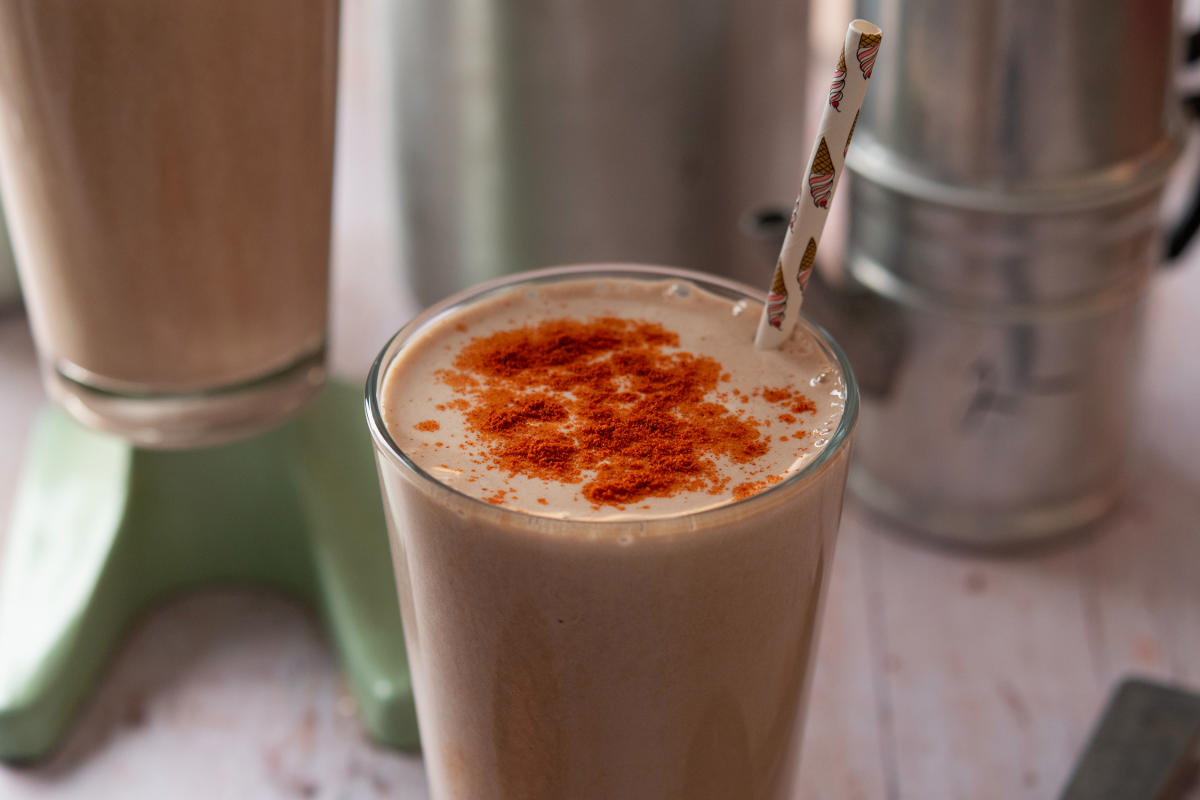
RED CHILE MOCHA MILKSHAKE
This recipe is inspired by the Owl Cafe, in Albuquerque, which celebrates its 40th anniversary this year. The owl-shaped, retro-style diner’s specialty New Mexico Shake spices up the classic chocolate dessert with a touch of New Mexico red chile powder. The addition of local coffee gives this version some bittersweet depth. “The chile with chocolate reminds me of a mole from Mexico,” says co-owner Corey Moulton, who grew up eating at the Owl and purchased it with his business partner, Matthew Bernabe, in 2024. “When we heard the property was becoming available, we wanted to make sure it stayed the same,” he says. “It’s an iconic place for Albuquerque, and we’re excited to continue its legacy—hopefully for another 40 years.”
- 1 teaspoon mild New Mexico red chile powder, plus more for dusting
- 1 cup strong coffee, freshly brewed (New Mexico Piñon Coffee gives a nutty twist)
- 3 cups vanilla ice cream (we like Heidi’s or Taos Cow), more as needed
- ¼ cup milk, more as needed
- 1 tablespoon sugar
- 1 pinch sea salt
- 3 tablespoons chocolate syrup
- Whipped cream (optional)
MAkes 2 large or 4 small shakes
1. In a small bowl, whisk 1 teaspoon red chile powder with warm coffee until smooth (this softens the spice and prevents grit). Refrigerate until completely chilled.
2. Let ice cream soften slightly on counter. In a blender, combine coffee mixture, milk, sugar, and salt, and blend briefly to dissolve sugar. Add the ice cream and syrup and pulse until smooth and thick. (If too thin, add a little more ice cream; if too thick add a splash of milk. Blend
again.)
3. Pour shake into chilled glasses. Top with whipped cream, if using, and an additional sprinkle of chile powder, to taste.