EARLY ON A SPRING SATURDAY, mourning doves coo and the air smells like roasting coffee as the Farmers’ and Crafts Market of Las Cruces begins to hum under the sunshine. Spanning seven blocks of the historic downtown, this stretch of Main Street becomes a bustling thoroughfare of customers—plus their strollers, wagons, and dogs. Iced lavender oat latte from Mija Coffee’s takeout window in hand, I take in the scene: booths crowded with neon-orange carrot bouquets, clutches of jeweled beets, and potted seedlings to go; makers selling handmade goods, from bizcochitos to silver jewelry; lines forming at food trucks and boba tea stands; and buskers singing mariachi or bowing pop songs on cello.
More than a place to shop, the market is a living snapshot of southern New Mexico’s agricultural engine—where one of the state’s most fertile regions shows off a range well beyond the chile and pecans it’s known for; and where growers, makers, and neighbors meet week after week, year-round.
Market-goers shop local on Main Street on Saturdays and at the Plaza de Las Cruces on Wednesdays.
Founded in 1971, the Farmers’ and Crafts Market has grown into a Mesilla Valley institution. American Farmland Trust named it the top farmers’ market in the country in 2011, and New Mexico’s best for the past four years. Scale and variety are part of the draw. The mammoth market is held each Saturday and Wednesday and hosts up to 200 vendors during peak seasons.
“Everything is handmade or grown by the vendors,” says market manager Karin Bradshaw. “There’s no resale, and it’s strictly from New Mexico.” Just as special, she adds, are the relationships between sellers and regulars. “Our customers love us,” Bradshaw says. “Everybody knows everybody. There’s an atmosphere you feel when you walk through—it’s family, it’s comfortable.”
I start my market crawl near its southern end, stopping first at Grace’s Garden stand. “Any jujubes?” a customer asks grower Grace Foster. “Not until September,” Foster replies, before talking up her current offerings: spicy daikon greens, baggies full of bean sprouts, and a woven basket overflowing with sunchokes—a type of tuber, also called Jerusalem artichokes, which Foster harvests in November and usually sells out of by April or May.
Farmer Grace Foster weighs sunchokes at Grace’s Garden stand.
Originally from Hong Kong, Foster moved to the United States 40 years ago, first settling in California before making her way to Las Cruces, where she studied horticulture at New Mexico State University. Her first forays into growing jujubes were exercises in trial and error. She started by transplanting unwanted jujube trees from a neighbor’s yard but killed the first batch before realizing the trees needed full sun. “I learned everything from zero,” she says.
Next door, Larry Lopez of Farm & Fiddle arranges bunches of tall, purple-green asparagus. He says he comes to the market mostly for the experience. “Do I make a lot of money doing this? No,” he offers. “But very few things in life are profitable in that sense.”
Across the way, Francisco Estrada covers a card table with cartons of white and brown eggs. Growing up in Mexico, he says, he had friends whose families raised chickens, but he always lived in town, where they weren’t allowed. Estrada finally fulfilled his childhood dream in 2020, when he bought chicks and started raising his own flock. A police officer in his non-market life, today is his first day selling eggs from his 74 hens. “I’ll be here Wednesdays and Saturdays,” he tells a curious passerby.
Farther down the block, Bodhi Farms catches my eye with buckets of flowers set out for make-your-own bouquets—the salmon- and melon-colored snapdragons are especially pretty. Run by Micki and Kurt Pittsenbargar and their six children, the stand offers seasonal blooms throughout the year, including sunflowers in unusual shades, like deep red, hardy dahlias; frilly, long-lasting lisianthus; and fall marigolds perfect for Día de los Muertos.
Santana Garcia serenades shoppers.
“During Covid, we started a small garden and found out that the whole family loved it,” Micki says. They began by selling surplus vegetables at the market before their flowers proved immensely popular. The family’s land, given to Micki by her grandmother, is also home to a lavender farm. Using permaculture techniques and methods, including not tilling, they’re slowly rehabilitating the soil, careful not to disturb its “nematodes and microbia,” Micki explains. “It stays where it needs to and keeps everything healthy.”
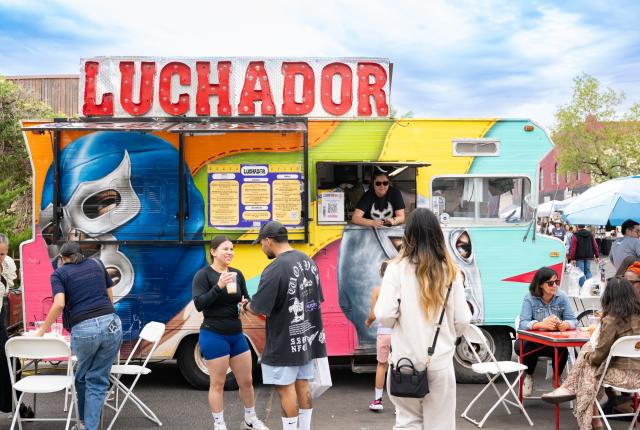
As late morning tips into midday, the market is in full swing, and people are getting hungry. I wander over to the brightly painted, wrestling-themed Luchador Food Truck, where owner Ivan Saenz takes orders and greets regulars. Saenz graduated from NMSU with a degree in hotel, restaurant, and tourism management but grew tired of corporate jobs. He and his wife, Sandra, have run Luchador for 13 years and are especially proud of the award-winning green chile cheeseburgers, with a signature luchador mask charred onto the bun. When he started the business, Saenz told his children, “I’m not rich and can’t give you guys money, but I can show you how to start a business.” He helped them set up an aguas frescas table in front of the truck. Now in their twenties, they still run the enterprise.
Larry Lopez of Farm & Fiddle.
For a lighter snack, I follow the toasty scent of caramelizing sugar to Southwest Kettle Korn. When Brian Peterson and his wife, Esther, first moved from the Pacific Northwest to Las Cruces 25 years ago, they were surprised not to find any kettle corn stands, which were common in their former home—so they decided to fill the gap themselves. “For us, it’s being connected to the community,” Brian says. “Week in and week out, we’re checking in: How did the surgery go? How was the wedding?”
Southwest Kettle Korn’s flavors lean distinctly New Mexican, such as red and green chile, sourced from Hatch, or bizcochito—one of several flavors developed at customers’ suggestions and fine-tuned with their input. (It took a long time to get the anise levels just right.) The kettle corn is so popular that it’s traveled to every continent except Antarctica, Brian says.
That kind of success story is exactly what the market is designed to nurture. “We’re a place where someone with an idea and a dream can easily take that first step without serious financial outlay,” says Bradshaw.
As I leave the booth and turn to watch the flow of people, I’m struck by how much care went into the asparagus, eggs, cosmos, and kettle corn I’m carrying home. It’s that spunky sense of DIY, tempered by community-minded principles, that defines the market. Market secretary and organic vegetable vendor Josh Switzer puts it simply: “It’s all about creating something that will sustain someone else. Feeding your tribe—that’s the whole point.”
Adele Oliveira’s Santa Fe Farmers’ Market mainstays include snappy Ground Stone Farm carrots and fluffy Mini Falls Farm ranunculus.

SWEET AND SPICY KETTLE CORN
At the Farmers’ and Crafts Market of Las Cruces, the long line for Southwest Kettle Korn says it all: Sweet, salty, and dusted with New Mexico chile powder, this snack hits every craving. “We’ve got a mixed marriage,” owner Brian Peterson says of his wife and business partner, Esther. “I like green chile, and she prefers red.” To re-create it at home, Peterson says the key is to keep the kernels moving. “It’s easy to burn in hot oil,” he explains. Skip the spoon—the splattering oil makes stirring unsafe—and keep the pot covered, shaking it steadily instead. For the best texture, use the dense mushroom variety of popcorn kernels rather than butterfly. Southwest Kettle Korn uses Hatch chile powder from Grajeda Farms, but your favorite New Mexico red or green chile powder (or spice blend) works too. And scaling up is simple: Peterson says, “It’s always two parts corn to one part sugar.”
- ¼ cup vegetable oil (or any neutral, high-smoke-point oil)
- ½ cup mushroom popcorn kernels
- ¼ cup granulated sugar
- Salt to taste
- 2 teaspoons (or to taste) New Mexico red or green chile powder
Makes about 10 cups
1. In a large pot over medium heat, warm the oil. Test that it’s ready by adding a couple of kernels; when they pop, carefully stir in the remaining kernels and sugar.
2. Cover and, using oven mitts or kitchen towels, shake the pot constantly to prevent burning. When popping has slowed to 2–3 seconds between pops, remove from heat and continue shaking until popping stops.
3. Sprinkle with salt and chile powder and toss to coat. Store in a tight container at room temperature for up to one week.