FOR NEW MEXICO STATE historian Rob Martínez, the Land of Enchantment is a place where the past animates the present and culture thrives. The Albuquerque native and former high school teacher’s family has Spanish, Mexican, Pueblo, and Genízaro roots going back centuries. So he understands better than most that there’s more to New Mexico’s nickname than the soaring mountains, vast deserts, craggy canyons, and spectacular sunsets.
“Travelers to New Mexico can have an incredibly unique experience through encounters with ancient Puebloan, Navajo, Apache, and Comanche peoples; cultures rooted in Spain, Mexico, and here in New Mexico; as well as an American influence that includes Black explorers and settlers, ranchers, and business people going back to the 1500s,” explains Martínez, who started reading books about the state at age 15 and earned a master’s degree in history from the University of New Mexico. “There’s cowboy culture, science, industry, and amazingly beautiful landscapes.”
Zuni Pueblo’s Anshe Ko'hanna Dance Group performs at the Indian Pueblo Cultural Center.
Photograph by NMTD.
Martínez comes from a family of musicians—including his father, who played in mariachi bands and wrote Mexican corridos about historical events—and he has performed onstage for more than 40 years. “New Mexico is the only place, not only in the United States but in the world, where you can find an experience that transports you through many cultures and multiple periods of history,” Martínez says.
While those experiences can take many forms, the Indian Pueblo Cultural Center (IPCC), in Albuquerque, can be a great place to start. Since its founding in 1976, IPCC has provided a gateway to the state’s 19 pueblos. Located on an 11-acre campus, it includes a museum with a collection of more than 5,000 pieces, the Indian Pueblo Kitchen restaurant, an entrepreneur complex, and the Pueblo-owned Avanyu Plaza shopping center.
“The Indian Pueblo Cultural Center offers visitors a direct and meaningful way to experience Pueblo histories, artistic traditions, contemporary life, and culinary experiences that are shared through Pueblo perspectives,” says executive director Arianna Chavez (San Felipe).
This year, in celebration of IPCC’s 50th anniversary, the museum hosts the Grounded in Clay: The Spirit of Pueblo Pottery traveling exhibition. In addition, a special exhibition highlights IPCC’s history through 50 objects that demonstrate its significance as a gathering place to celebrate Pueblo culture and arts. “It continues to serve as an enduring institution of pride, education, and cultural stewardship for Pueblo communities,” Chavez says.
For those feeling inspired for a deeper connection, IPCC’s adobe building is modeled on the ancient D-shaped Pueblo Bonito great house at Chaco Culture National Historical Park. Just a three-hour road trip, the site was at the center of the Ancestral Puebloan world between 850 and 1250, with an intricate system of roads, multistory dwellings, art, places of worship, and astronomical tools.
Chaco’s influence can be found throughout the Southwest with communities sharing similar characteristics: impressive great houses centering a collection of smaller dwellings, multistory buildings with intricate stonework, enclosed kivas, and even roads. Nearby examples include Salmon Ruins, near Bloomfield, and Aztec Ruins National Monument, in Aztec, which includes Chacoan structures that feature well-preserved stone walls and original wood beams.
Find bultos and retablos at Traditional Spanish Market in Santa Fe.
Photograph courtesy of Traditional Spanish Market.
In addition, Acoma Pueblo’s Sky City perches atop a sheer-walled sandstone bluff and represents one of the oldest continuously inhabited communities in North America. The Sky City Cultural Center and Haak'u Museum offers exhibitions and tours for a deeper understanding of this thriving community.
Similarly, the magnificent Taos Pueblo, renowned for its meticulously maintained 1,000-year-old adobe homes and exquisite handcrafted art, welcomes visitors for tours on most Saturdays and Sundays throughout the year.
Gallup has served as a site of trade and community for Navajo, Hopi, and Zuni people well before the arrival of the railroad and iconic Route 66. Decked out in fresh murals for the Mother Road’s centennial, the town has dozens of trading posts filled with original artworks. Or visit on a Saturday for the Gallup 9th Street Flea Market, when more than 500 artisans gather for one of the largest Native American markets in the country. Smaller versions happen in places like Shiprock and throughout the Navajo Nation.
Each summer, Santa Fe becomes a center for art and culture as the host of the International Folk Art Market (July 9–12), Traditional Spanish Market and Contemporary Hispanic Market (July 25–26), and Santa Fe Indian Market (August 15–16).
While the Traditional Spanish Market marks 100 years of honoring and preserving Hispanic art, culture, and history in 2026, the adjacent Contemporary Hispanic Market has been giving painters, weavers, sculptors, ceramicists, and furniture makers who don’t fit neatly into the more traditional guidelines a space for 40 years. “You could decorate your home every month for an entire year with something different from our market,” says Contemporary Hispanic Market president Ramona Vigil-Eastwood.
See sheep and other livestock at the New Mexico Farm and Ranch Heritage Museum in Las Cruces.
Photograph by John McCauley.
As the country’s largest Native market, Santa Fe Indian Market brings together more than 1,000 artists representing over 200 Tribal Nations for a weekend of fine art, fashion, film, performances, and community celebration grounded in tradition and culture. Now in its 104th year, the market features juried Native artists from across the country, representing a wide range of mediums, including painting, sculpture, pottery, jewelry, and textiles.
The gathering has grown to such an extent that satellite markets and events have become must-visits of their own, including the Pathways Indigenous Festival (August 14–16) at Buffalo Thunder Resort & Casino, in Pojoaque, and the Free Indian Market, in Santa Fe’s Federal Park (August 15–16).
The nation’s oldest capital city makes it easy to get a solid grounding in the state’s history, art, and culture at the New Mexico History Museum, New Mexico Museum of Art, Georgia O’Keeffe Museum, Museum of International Folk Art, Museum of Indian Arts and Culture, Nuevo Mexicano Heritage Arts Museum, and Wheelwright Museum of the American Indian.
In Las Cruces, the New Mexico Farm & Ranch Heritage Museum tells the story of the state’s agricultural history through interactive exhibits, demonstrations, oral histories, and even a working ranch complete with cattle, sheep, and ponies. “Agriculture has a long and storied history in New Mexico, dating back to some of the earliest known Indigenous farmers,” says Alison Penn, the museum’s public relations specialist. “It affects every aspect of our lives, from the clothes we wear to the food we eat.”
That rich earthbound history has an otherworldly component, too. A seed taken on a NASA mission that orbited the moon landed at the museum, where it has grown into a loblolly pine seedling.
Yet another cultural gem sparkles just a few miles away on the Historic Old Mesilla Plaza. As one of eight New Mexico Historic Sites, the newly renovated and reopened Taylor-Mesilla Historic Site comprises the home and two storefronts belonging to the late J. Paul Taylor and Mary Daniels Taylor that provide an enthralling glimpse into New Mexico’s colorful borderlands story. After absorbing some local lore at the visitor center, guests can tour the Taylor home, which features an extraordinary collection of Spanish Colonial, Mexican, and New Mexican artwork and textiles.
No cultural expedition of New Mexico is complete without contemplating the role that religious faith has played for centuries. Just across Old Mesilla Plaza, the Basilica of San Albino was established in 1851 by the Mexican government, making it one of the oldest parishes in the Mesilla Valley.
Basilica of San Albino anchors Old Mesilla Plaza.
Photograph by NMTD.
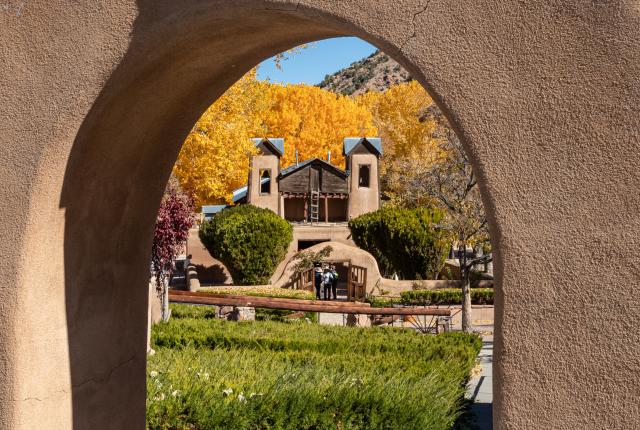
But San Albino is a youngster compared to such icons as El Santuario de Chimayó, famous for its “holy dirt” and the thousands of pilgrims who make the trek there on Good Friday, or the 250-year-old San José de Gracia church in nearby Las Trampas. Both are national historic landmarks widely considered among New Mexico’s best-preserved examples of Spanish Colonial architecture.
There are still more options to feed the soul and ignite the imagination: St. Joseph Apache Mission Church on the Mescalero Apache Reservation, where Native drummers perform as part of Mass observed in their own language; San Juan Bautista Church on the Ohkay Owingeh Pueblo north of Santa Fe that each Sunday fills the sanctuary with some 1,200 people; and San Felipe de Neri Church, one of the oldest surviving buildings in Albuquerque, that anchors the city’s downtown plaza.
For the first-time visitor or the seasoned traveler, New Mexico offers cultural marvels that are every bit as spectacular as its magnificent landscapes. From the pueblos to the plazas, the markets to the museums, the landscapes to the landmarks, the Land of Enchantment delivers unmatched experiences that could be called encounters of the enchanting kind.