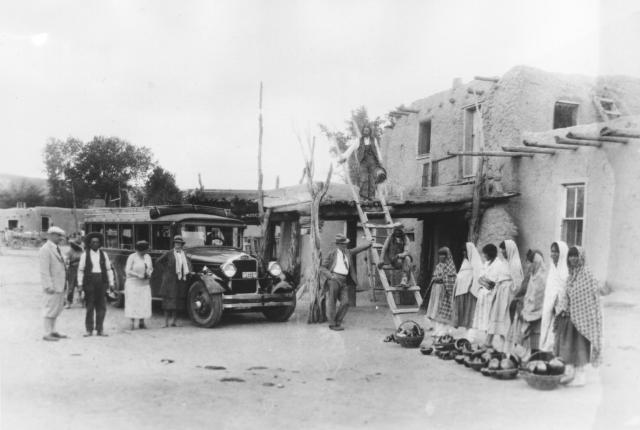
Indian Detours bus at Santa Clara Pueblo, circa 1926. (Above)
One hundred years after the start of the Harvey Indian Detours, which changed Southwest tourism, a staged image of a Packard passenger sedan at Santa Clara Pueblo calls to Hannah Abelbeck. “It’s a really salient moment of transition,” says Abelbeck, curator of photographs and archival collections at the New Mexico History Museum’s Palace of the Governors Photo Archives, in Santa Fe. “It connects to these stories about how New Mexico is sold and promoted, the desire of New Mexicans to participate and benefit from this economic activity, to explain to outsiders what is special or unique about us. This is a particularly important story for the pueblos, who were the enticement of the Indian Detours.”
Victor Higgins’s Aspens, oil on canvas, 1932.
In the annals of art history, a bona fide heist is a surefire way to grab headlines. Victor Higgins, one of the earliest Taos Society artists and an original board member of the Harwood Museum, was an exceptional modernist whose 1932 painting Aspens depicts northern New Mexico. “I love the way he’s captured that sense of being in the New Mexico mountains but in really accurate brush strokes,” says Juniper Leherissey, executive director of the Harwood. The piece famously caught the attention of art thieves Rita and Jerry Alter of Cliff, who stole the painting from the Taos museum in 1985. Aspens was returned last year after a nearly four-decade-long disappearance.
Mimbres clay pottery, circa 900–1300.
Originating from broader Mogollon culture in southwestern New Mexico, Mimbres pottery is widely revered for its precise geometric patterning and mineral-rich pigmentation, resulting in bold and bright pieces. “The Mimbres Indians would chew the end of a reed or small stick until the bristles were thin enough to make these thin, repetitive lines,” says Peggy Bishop, president of the Deming Luna Mimbres Museum, in Deming. “I can’t imagine the time it took and the steady hand to create such a repeating design.”
A 1930s pine trastero by an uncredited Hispano artist.
The Gallup New Deal Art Virtual Museum highlights New Mexico works from the New Deal era and the Works Progress Administration on a mostly digital platform. For gallupARTS executive director Rose Eason, one of the most special New Deal items is a historic furniture piece, currently on display at the Octavia Fellin Public Library, in Gallup. The Spanish Colonial–style trastero, a beautifully carved wooden cabinet, blends Hispano and Native influences. “It shows the artist really engaging with traditions and helping evolve them,” Eason says. “It really represents this place and the confluence of cultures.”
Joe Feddersen’s (Colville) Highway with HOV Lane.
Tatiana Lomahaftewa-Singer (Hopi/Choctaw), curator of collections at the Institute of American Indian Arts (IAIA) Museum of Contemporary Native Arts, in Santa Fe, is continually drawn to a piece by multimedia artist and sculptor Joe Feddersen (Colville). The small waxed-twine linen basket uses the decorative iconography of everyday U.S. highway signage. “He’s looking at these different modern-day motifs from an Indigenous lens,” says Lomahaftewa-Singer. The iconic diamond and repeated lane lines do seem timeless. “A Native person would recognize that [pattern] right away, because we’ve had that in our regalia,” she says of the work, which is slated for an upcoming show focused on new acquisitions.