


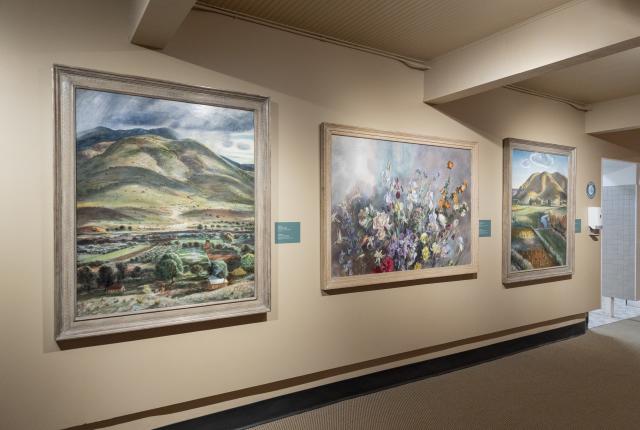
WHEN A FLASH FLOOD tore through downtown Roswell in October 2024, water surged into the Roswell Museum with terrifying speed. Muddy currents rose to nearly six feet, rushing down the hallways of a historic building founded in 1937 as a New Deal–era Federal Art Center. The flood ripped paintings from walls and left tens of thousands of artifacts submerged beneath debris-choked water.
“Museums are built around preservation. That’s what we do,” says museum director Caroline Brooks. “But very few institutions ever face preservation on this scale.” Known for its collections of Southwestern art, WPA-era works, Native American and Western artifacts, and paintings by artists including Peter Hurd and Henriette Wyeth, the museum holds one of southeastern New Mexico’s most important repositories of cultural history.
As the floodwaters receded, they left behind a thick, adhesive silt that coated nearly every surface. Even objects that were spared direct flooding endured punishing humidity levels. Volunteers and museum staff evacuated roughly 12,000 objects, with some waterlogged paintings, historic textiles, and archives loaded onto refrigerated trucks and sent to the Conservation Center outside Chicago, where specialists raced to stabilize them before mold could set in.
A year and a half later, Brooks reports that nearly half of the museum’s collection remains in Chicago undergoing conservation treatment, while the rest is cared for by staff working from a temporary location in Roswell. Every object in the museum was affected in some way, Brooks says, but despite years of work ahead and a projected conservation cost of $7 million, she remains optimistic. “The support we received afterward showed how strongly our community believes in us and how much they want us here,” Brooks says. “In preserving damaged artworks, we’re also preserving the stories attached to them.” The museum foundation is currently accepting donations at rmacfoundation.com.