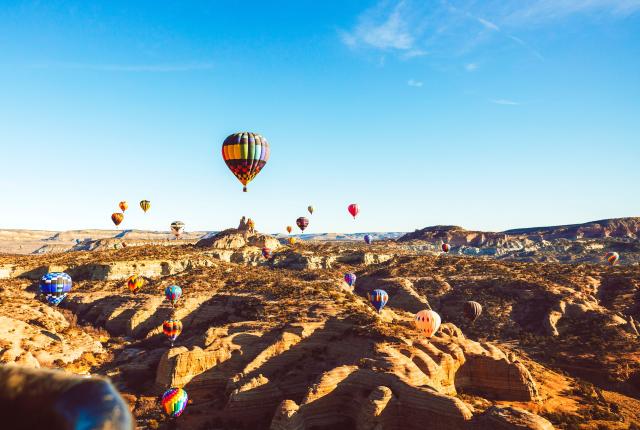
FROM THE SKY at last year’s Red Rock Balloon Rally, the contours of Gallup make a stunning kind of sense. When it’s rising over the city’s eastern side just past dawn, a hot-air balloon turns out to be a great vantage for decoding the epic geology that defines this landscape.
Miles of massive red cliffs, formed from sand compressed during the Jurassic period, surround our small basket, their vibrant hues glimmering orange and gold in the new sunlight. The rocks demand attention, even among the kaleidoscope of balloons drifting above us. But when Marissa Myers, pilot coordinator for the 43rd annual rally last December, who’s steering our craft, points out the iconic spires of the Church Rock formation—what the Diné call Navajo Church—my gaze is fixed elsewhere.
I’m looking at the immense north-to-south hogback, also called the Nutria monocline, that erupted from the Earth’s crust more than 50 million years ago. There’s a gap in that long, jagged ridge where transcontinental traffic, via I-40, Amtrak, and the freight Burlington Northern Santa Fe Railway, passes through the small city of Gallup—at least 90 trains and 20,000 east-west interstate travelers in a single day, it’s estimated.
Keeshaw and Jude Candelaria have helped bring free concerts to downtown Gallup.
For a moment, I consider the individuals who have flowed through that natural opening in the landscape over the last few millennia: the first Indigenous people, soldiers, Navajo families making the Long Walk to Bosque Redondo and back, stagecoach drivers, railroad builders, coal miners, and the first tourists to hit the Mother Road when Route 66 was set down in Gallup a century ago.
As former Gallup mayor Bob Rosebrough writes of the gap in the hogback: “It is a conduit of history, where nature has conspired to create a collision of cultures and people.”
Some also called it the heart of the Wild West, where Indigenous people found that the railroad offered a promising new art market. Gallup’s origins are indelibly tied to trains. Founded in 1881, the city was named after a paymaster for the Atlantic and Pacific Railroad; people began slinging the phrase “going to Gallup” to mean more than picking up a paycheck. Its border-town-with-fantastic-trading-posts reputation is earned by its proximity to the Navajo, Hopi, Zuni, and Laguna reservations, whose residents more than double Gallup’s population of 20,000 on weekends when it’s time to shop and go out to eat.
On West Coal Avenue, art lovers enjoy the scene at the monthly Gallup Arts Crawl.
This diverse place of near-constant freight train noise contains a lot of lore—so much that in the early 1960s, Minnesotan Bob Dylan used to say he was from Gallup. By the time the city was shouted out in the 1946 hit as a place to “(Get Your Kicks on) Route 66,” Gallup had been home to generations of coal miners, mostly from Mexico and eastern and central Europe. It was also the preferred hangout of a gaggle of moviemakers and stars who filmed Westerns nearby and continued to use the 1936 El Rancho Hotel as their home base through Hollywood’s Golden Age.
The distinctions go on: The Gallup Inter-Tribal Indian Ceremonial, established in 1922 to attract visitors with annual demonstrations of Native ceremonies, arts, and crafts, is the oldest Indigenous art show in the United States. And the Red Rock Balloon Rally has become the second-largest hot-air-balloon rally in the country, behind the Albuquerque International Balloon Fiesta. Gallup is also known as America’s Most Patriotic Small Town, an honor bestowed by Rand McNally for its deep-seated respect for local veterans, including Medal of Honor recipient Hershey Miyamura and many Navajo Code Talkers.
The welcoming lobby of El Rancho Hotel.
BUT WHAT DOES “GOING TO GALLUP” mean these days, beyond the balloons, the trading posts, and the historic El Rancho Hotel? Many visitors have been reluctant for years to scratch the surface of a Gallup stay beyond gassing up and grabbing a meal because of the town’s reputation for crumbling buildings, an ongoing plague of addiction, and a high crime rate.
But over the past year, on my repeat visits in all four seasons, the city has revealed itself—much like the secret room in the lobby at El Rancho, which is accessible only by a certain book in the bookcase—to have the sweetest neon heart of anyplace on Historic Route 66. It’s rich in people: a pool of talented artists, teachers, curators, and business owners who have created small but thriving shopping, dining, music, and outdoor recreation scenes. This impressive cohort of community-minded residents continues to show up for Gallup, and their efforts are shining through.
After the balloon rally, I hit the Gallup 9th Street Flea Market. Even on a chilly December morning, it’s clear that the lifeblood of Gallup’s commerce is here. Although I’m one of just a handful of obvious tourists, everyone seems to be doing a brisk business. Among the stalls of Navajo iced tea, frybread burgers, and corn stew, you can also find Filipino food, Caribbean jerk chicken, Pueblo prune pies, and a teenage kid playing Smiths covers on an amped electric guitar.
The ranch-style lodge’s classic neon.
I wander the aisles of tables set out by vendors, locating treasures: a Blue Bird Flour sack apron, an inlay turquoise ring, a hypnotic still-life painting of a can of Spam. It’s a good time—I can tell that most of the people swirling around me come here nearly every weekend—and when I later overhear someone call the flea market the largest ongoing Native art market in the country, I’m not surprised.
The annual Christmas parade later that day draws more tourists. Some are taking the Downtown Mural Walking Tour, which details the more than two dozen depictions of Gallup’s culture and history around the town center. (Don’t miss the sweeping Code Talkers mural by Be Sargent on Second Street.) But the parade is still a charmingly small-town affair, where I glimpse both Santa riding on the Gallup Lions Club float and a person dressed as Krampus skulking on the sidewalk behind him. The juxtaposition seems to aptly balance the local ratio of darkness to light, and everyone in attendance is in good spirits.
Art123 Gallery shows artists on the rise.
ANOTHER DOWNTOWN CROWD IS EVEN MORE amped a few months later, when gallupARTS executive director Rose Eason unveils one of Gallup’s best-kept secrets. On the last weekend in March, hundreds of people troop into the historic McKinley County Courthouse, where the official Gallup New Deal Art Virtual Museum is kicking off with a series of tours, panels, and a concert by jazz musician Delbert Anderson at El Morro Theatre.
The strikingly well-preserved Pueblo Revival courthouse, itself a project of Gallup’s New Deal Art Center, has been closed to the public for years. It houses 19 pieces of art from the influential center’s years of operation (1939–1943), including murals, tile work, light fixtures, and furniture, many of which were donated by the artists for a future museum. In the defunct old courtroom, Lloyd Moylan’s extraordinary 1940 History of the Gallup Region mural stretches in 10-foot panels across the artist’s depictions of people and events over the ages. “The most creative thing he did is that each corner makes a turning point in history,” Eason says to an awed tour group, “so that each wall defines a major epoch.”
“There’s an openness to collaborating and just getting things done here that I think is one of our greatest strengths,” Eason tells me later over lunch, describing her eight-year journey to helping gallupARTS sponsor, raise funds, and open the virtual museum. It’s accessible via QR codes on the works, which are scattered around at least five locations in Gallup, that link to well-researched artwork descriptions on the museum website. In-person tours of otherwise closed spaces that house the collection are also now available to the public on select days.
The Gallup 9th Street Flea Market happens rain or shine.
The tours have thus far involved “a good mix of local folks and tourists—and so many people who are Gallupians and have lived here a long time,” Eason says. “Maybe they’ve been in the courtroom, but they’ve never given a second thought to the mural. So that’s been really special, to help our community members understand an aspect of their history.”
Eason introduces me to another local who is helping others to absorb the region’s past: Teri Frazier (Laguna-Hopi/Chippewa), a born-and-raised Gallupian who directs the George Galanis Multicultural Center on Route 66. At the center, which boasts a new glow-in-the-dark theater and mural in honor of the Mother Road’s 100th anniversary, Frazier has organized recent exhibitions on Navajo Code Talkers and Edward S. Curtis’s photographs of Native people, which include an image the famed photographer took of one of Frazier’s ancestors.
Frazier, who has also put in decades of work helping to coordinate performances at the annual Inter-Tribal Indian Ceremonial, says some locals’ recent reactions to the center’s shows have included tears. “Maybe this is the first time they’ve seen a museum-quality exhibit in their hometown that really showcases things they feel are important,” she says.
Camberline Tsosie (top) and her grandmother Virgina Becenti sell frybread at the market.
A STROLL THROUGH GALLUP’S HISTORIC downtown, with its giant turn-of-the-century railroad-town storefronts, underscores the continuing importance of its distinguished artistic economy.
At the Weaving in Beauty gallery, owner Mary Walker hosts classes in Navajo-style weaving every Saturday, as well as occasional virtual sessions for a global audience. She’s entertaining a group of textile artists from all over the country when I pop in one summer day during the Ceremonial. Inside the calm storefront, a diverse group of women are weaving to a country music soundtrack. Judy Clinton from Des Moines, Iowa, tells me it’s her 14th year of coming to Gallup each August to brush up on her technique with strangers who have become good friends.
Across Coal Avenue, the vast City Electric Shoe Shop was opened by an Italian immigrant in 1924 and remains in the family. In a move that represents the strong cross-pollination of Native arts with Gallup businesspeople, the City Electric in 2006 became the only wholesale producer of moccasins under the iconic Taos Moccasin name, which they continue to manufacture and sell. The shoe shop and trading post, like Silver Dust Trading Company a block away, is also a prime source of art materials for regional makers.
“Our town is built on art,” says Coye Balok, whose Kestrel Leather is on Route 66 in the former Kitchen’s Opera House building. “Obviously coal and lumber funded it 120 years ago, but art is what carries this city. There is so much creativity in this little area.” While we chat in a corner of his tin-ceilinged shop, a local artisan walks in to offer Balok a wholesale deal on a group of carved wooden spoons to feature among the store’s selection of handcrafted goods. Balok takes him up on it, and I make a mental note to come back after the spoons get priced.
Richardson's Trading Post is a must-stop.
GallupARTS’s Art123 gallery is the thrumming creative center of this scene, where rotating monthly shows featuring local talent are the centerpiece of every second Saturday’s Gallup Arts Crawl. Next door, the nonprofit’s 30-square-foot LOOM Indigenous Art Gallery is visible 24 hours a day to passersby and curated by an all-Native council that includes Diné artist Eric-Paul Riege and Diné/Zuni artist Orlando Walker.
“The size and shape of the space is almost like a loom,” Walker explains of the gallery name, “a great space for local artists to come in here and tell their stories.” Local musicians also feel welcome at Juggernaut Music, a one-of-a-kind musical instrument retailer, performance venue, and recording studio downtown that offers repairs and lessons and is central to a music scene that includes metal and hip-hop.
That expanding scene is hosted in part by Jude and Keeshaw Candelaria, the husband-and-wife team behind Zia Sound, and Michael Bulloch, executive director of Gallup MainStreet Arts & Cultural District. Via the nonprofit, the trio of promoters was awarded a five-year grant with the Levitt AMP Concert Series to mount free outdoor performances every Saturday night in the Courthouse Plaza during the summer. “Our whole point is to use underutilized areas [in Gallup] and bring them back to life,” says Keeshaw, who is of Diné ancestry. “The courthouse wasn’t really being used.”
The Gallup Coffee Company is housed in a former bank.
One of the perks of the partnership with the Levitt Foundation has been the exposure Gallup has gotten to touring bands who might not otherwise have stopped. “Terrance Simien and the Zydeco Experience have come the last two years,” Bulloch says of the Grammy-winning musicians, who were so drawn to the area’s recreation possibilities that they decided to take a band vacation there last year. “We took them to the flea market and made them food,” Keeshaw says.
One of the most consistent draws of Gallup is its mom-and-pop dining scene, which includes gateway New Mexican classics like Jerry’s Cafe, Earl’s Family Restaurant, Genaro’s, Sandra’s Place, and the Route 66 Railway Cafe, where many eastbound travelers get their first heaping portions of red and green, breakfast burritos, and frybread burgers. And though the city has never been known as a gourmet destination, that might be changing with the entree of 305 Fire, a sleekly designed wood-fired oven pizzeria with an emphasis on heritage grain sourdough, seasonal ingredients, and patio performances that’s become a hotspot after only a year on the scene.
A margherita pizza from 305 Fire.
After I taste an incredible mutton-and-squash pizza during Ceremonial in August, I ask owners Jenny and Chuck Van Drunen, along with chef Collier Kempton, where their commitment to add a spark to Gallup’s dining scene began. It starts a lengthy, rewarding conversation that gets to the crux of why outsiders continue to fall for—and want to promote—Gallup’s surprisingly sweet center.
“I think the reason why people love Gallup is because we have a disproportionate amount per capita of really amazing people here, but we also have a disproportionate number of problems and issues, tragedy and trauma,” says Kempton, a local homeowner who is raising a family. “I think Gallup attracts a certain kind of people who want—I don’t know if it’s adventure, or a little more rawness and depth to existence.”
The pizzeria has porch and back patio dining.
THE BOTTOM LINE IS THAT GALLUP VISITORS can expect a warm welcome, and nowhere is that more apparent than during the famed night parade at this summer’s Ceremonial. Families begin setting up chairs, awnings, and pop-up stands selling arts, crafts, and refreshments in the early afternoon for the 7 p.m. parade.
I park back in the Chihuahuita neighborhood, the historic domain of Mexican coal miners, and make my way up to West Coal Avenue to watch the lineup of performers from tribes from across the country. Finding just a small spot on the sidewalk, I settle in for a truly enjoyable two-hour display of cultural pride that’s put on for an audience of mostly fellow Natives. True to form, the hometown crowd reserves their heartiest cheers for those who are just passing through—the flashy Azteca Dancers, who incorporate indigenous Mexican drumming and regalia, and the captivating White Mountain Apache, both from neighboring Arizona.
Managing Editor Molly Boyle would like to thank Marissa Myers and Bill Lee for the balloon ride and Bob Rosebrough for his excellent memoir about Gallup, A Place of Thin Veil (Rio Nuevo Publishers, 2022).
The restored El Morro Theatre, built in 1928, has an old-time ticket booth and a new digital marquee.
A PERFECT DAY IN GALLUP
Locals tell us their favorite spots to take visitors.
EAT. Orlando Walker of LOOM Indigenous Art Gallery recommends a start at Earl’s Family Restaurant “to see all the different vendors that come in to sell their wares”—his go-to is an omelet or biscuits and gravy. Gallup Coffee Company, a downtown mainstay, is headquartered in an airy former bank. 305 Fire co-owner Jenny Van Drunen likes Oasis Mediterranean Restaurant, Jerry’s Cafe, or Grandpa’s Grill, where you can watch burgers get fired over charcoal. Gallup MainStreet’s Keeshaw Candelaria says, “Take your kids to CHA’AHH! Milk Tea Café—that’s the best place I’ve ever had boba!” She also recommends pho at Pho W’ Me. 305 Fire chef Collier Kempton says his next seasonal pizza special is a fresh fig and prosciutto pie finished with balsamic vinegar mixed with a dashi reduction.
SHOP AND SEE. All Gallupians interviewed recommend the Gallup 9th Street Flea Market, open Fridays and Saturdays. “I’d take anyone to Richardson Trading Post, work the mojo, and go in the rug room there,” says 305 Fire co-owner Chuck Van Drunen, who also suggests a stop at the George Galanis Multicultural Center. The Visit Gallup website offers three separate mural walking tours, and the Downtown Mural Walking Tour takes you past Art123 Gallery and several historic trading posts. On Route 66, take the teens to Enchantment Skate Shop and Dalone Skateboards, just across the street from the Gallup Skate Park, and hit up Kestrel Leather for handmade small-batch leather goods and gifts. Check out the New Deal Art Virtual Museum along with tour info at gallupnewdealart.org.
HIKE OR BIKE. Kempton recommends both the 3-mile Pyramid Rock and the 2-mile Church Rock hiking trails at Red Rock Park, as well as the views of the city from the North Hogback Trail, part of the 22-mile High Desert Trail System. “Those three hikes, with the elevation, are world-class,” Kempton says. More than 50 miles of single-track mountain biking trails are carved around Gallup, headlined by the Zuni Mountains Trail System.
STAY. El Rancho Hotel & Motel is located on Route 66; find the lobby’s secret room.