ON A WEEKEND NIGHT on Central Avenue, Route 66 does not feel historic. It feels active.
Cars move slowly beneath old motel signs and storefront lights, an Impala rolling low, a Monte Carlo on wire wheels, a classic pickup carrying the last light in its chrome. Music thumps from open windows. People gather in parking lots and on sidewalks, leaning against fenders, talking, and watching the road.
As a documentary photographer, I have spent a lot of time capturing images along Central. What keeps attracting me is that the street still does what it was built to do. It carries cars—but it also carries culture.
That connection between cars and Route 66 runs deep. The road rose with the automobile and with the expanding promise of middle-class travel across the American West. Families set out in sedans and station wagons. Businesses learned to speak to motorists directly. Roadside motels had carports. Gas stations, diners, and drive-ins multiplied. Neon signs offered vacancy, food, and fuel. The road was practical, but it was also theatrical. It turned travel into an experience and helped reshape the towns along it.
Classic cars gather at Ortega’s Indian Market Continental Divide trading post, in Grants.
Photograph by Jen Judge.
In New Mexico, that history still feels especially visible. Geography matters. This is a place of long distances, open land, and big skies, where driving has always been part of daily life. Climate matters too. Dry air and sun have helped preserve old cars in a way less arid places often cannot. But just as important is culture. Here, cars have long meant more than utility. They carry memory, labor, style, family history, and pride.
The irony, of course, is that the same mobility that created Route 66 also helped undo it. As interstates expanded, efficiency won out over intimacy. Faster roads bypassed the old route. The steady rhythm of travelers fell away. Businesses closed. Signs dimmed. Motels emptied. In many states, Route 66 survives mostly as memory or branding. In New Mexico, the road still lives in use.
That is especially true in Albuquerque, where Route 66 is Central Avenue. Those 18 miles are still part of the city’s social life. I know that personally. My family’s first house was two blocks from Central, where my mother has owned a business for 45 years. So when I think about Route 66, I do not see it as a symbol behind glass. To me, it is a vibrant place.
But in talking with Lorenzo “House” Otero and Steve Garcia, two lifelong Duke City residents and pillars of the lowrider community, I came to fully understand the road as a lived experience. Central Avenue runs through their lives.
A lowrider gathering at Seventh and Central.
Photograph by Nathaniel Tetsuro Paolinelli.
“It was everything,” Otero tells me about downtown’s storefronts, lights, movie theaters, and movement. “It was like a whole other world.” Garcia remembers selling newspapers downtown as a boy and growing up in the ritual of cruising West Central.
Each man reveals a different side of those who still gather along the road. Otero has long helped defend and shape lowrider culture in public, pushing back against anti-cruising laws and the stigma attached to lowriders. Garcia builds cars, tows them, restores them, and keeps vehicles on the road. When he tells me, “I eat, sleep, and breathe cars,” it doesn’t sound like a figure of speech. It’s a description of how he lives.
Lowrider culture has become one of the clearest ways Route 66 continues to mean something in New Mexico. “Our version of Americana goes low and slow,” Otero says. On a road so pivotal to the mythology of American mobility, lowriders offer a different vision of what the automobile can mean: not speed, but presence; not anonymity, but identity; not passing through, but being seen.
A lowrider moving down Central changes the pace around it. People look up. They turn to watch. The street becomes communal for a moment.
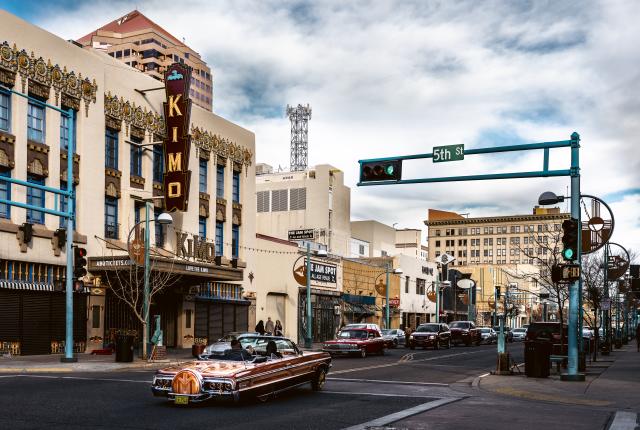
A lowrider cruises Central Avenue.
Photograph by Jen Judge.
Garcia speaks about cars with the intensity of someone whose whole life has been built around them. He views restoration as a kind of stewardship that gives cars “a new heart.” He wants kids on Central to see one and think, “One day I want a car like that.” Lowriding, in that sense, is also about transmission: keeping skills, tastes, and dreams alive long enough to be inherited.
The story is not only aesthetic. It is civic. “Before, the city didn’t want us around,” Otero tells me. “Now the city’s asking us.” Pushing back against assumptions required action: showing up to meetings, contesting ordinances, and insisting that lowriders be seen as part of the city’s cultural lifeblood.
That helps explain why Route 66 still feels alive here. It is not only the architecture or the history. It is the social world still forming around the road. On the same stretch of Central, you can see the remains of midcentury ambition and the living culture that still animates it: old signs, old motels, murals, lowriders, classic cars, families in parking lots, people watching traffic as if the traffic itself were the event. Elsewhere, Route 66 can feel frozen in nostalgia. In New Mexico, it still moves.
Read more: Get your motor running with delicious pit stops along Route 66 for every type of traveler.