ENTICING AROMAS OF PEPPERONI, fennel sausage, and oregano waft through the bright, airy dining room at Tony’s Pizzeria, where families and friends savor hearty pies fresh out of the woodburning oven. From the open kitchen comes another scent—the earthy perfume of red and green chile. It’s what draws me to this buzzy new eatery in Albuquerque’s Nob Hill: pizza brimming with the tastes of New Mexico.
“In Italian-American culture, they call them grandma pies,” says chef-owner Tony Nethery, describing the selection of Sicilian-inspired square pizzas on his menu. “I’m Mexican, so my square pies lean into New Mexican and Mexican flavors, and we call those Abuelitas.”
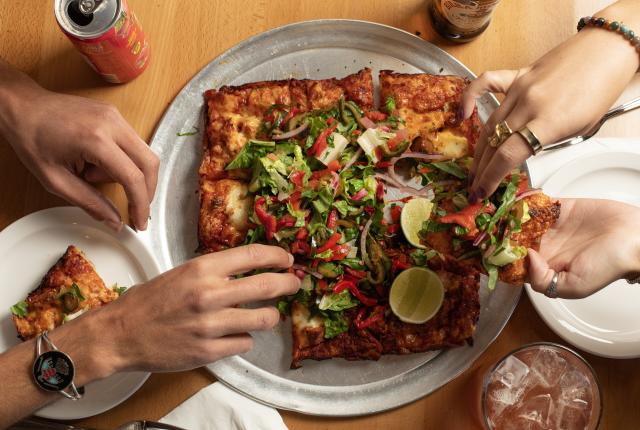
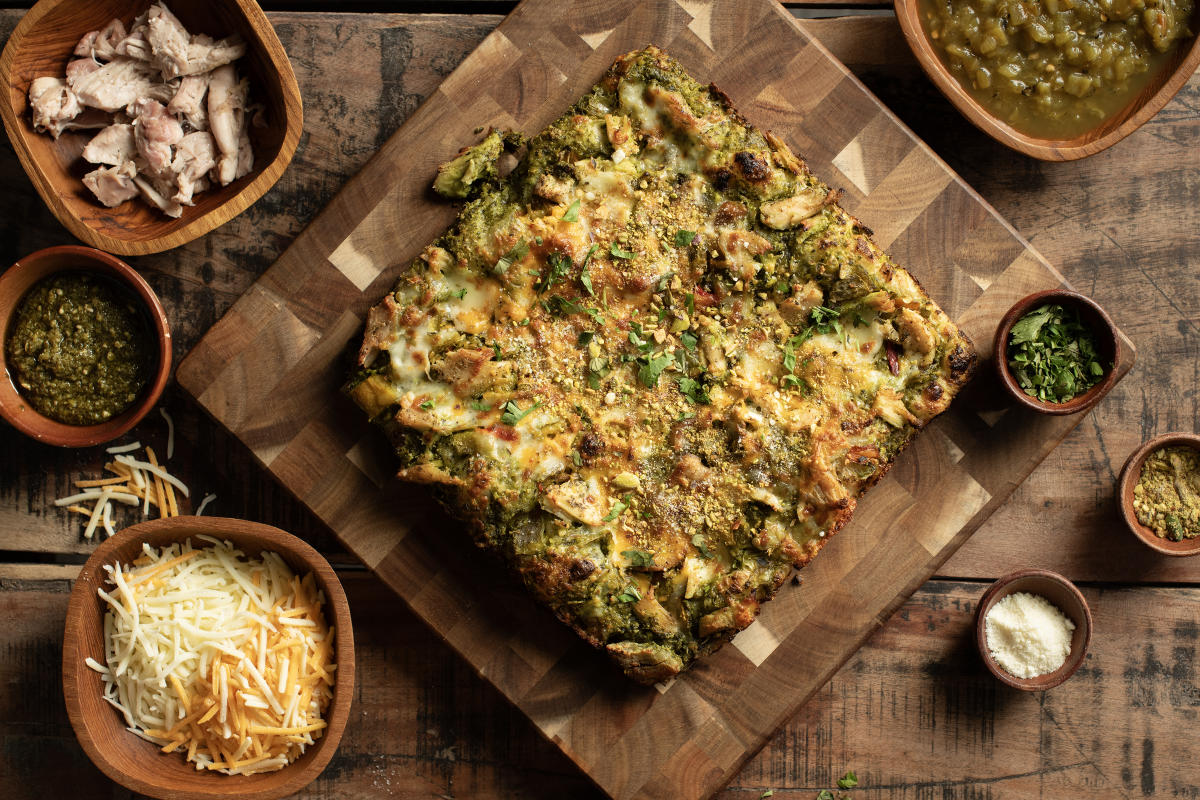
The toppings on Nethery’s seasonal Abuelita pizzas reflect local comfort food: carne adovada, green chile pesto and chicken, and Frito pie, layered with red chile beans, green chile, and corn chips. “We have a Huevos Rancheros Abuelita coming around the corner,” he says. “This is a New Mexico–style pizza.”
Tony’s Pizzeria chef-owner Tony Nethery, left, creates Sicilian-inspired square pies infused with New Mexico flavors.
But what does New Mexico pizza really mean? Elsewhere, regional pizza identities have an easy shorthand. New York means thin, foldable slices. Chicago signals deep dish. Hawaii conjures pineapple and ham. The Land of Enchantment, though, resists that kind of tidy definition. Does it mean pizza with green chile? A special crust? The oven it’s baked in? Or something less tangible? Across the state, chefs are answering that question in wildly different ways, turning New Mexico pizza into less of a uniform style and more of an ongoing conversation.
Nethery’s answer starts with technique. “I’m really pulling from my training, which is Italian—respecting the ingredients, methods, and recipes,” he says.
His crust comes from a “New York meets Philadelphia meets Neapolitan type of dough.” The New Mexico part is in the toppings. I taste a green chile pesto and chicken pie, relishing the heat of the chile, the tang of the piñon, and the sweet, nutty crunch of pistachios sprinkled on top. Baked in a square pan to a golden brown, the chewy, crispy crust holds it all together. The result is a cultural mélange, much like the state where he’s cooked for more than 30 years. “It’s a New Mexico state of mind,” he says. “There are so many cultures here.”
Co-owner Pratt Morales makes a blue corn pizza crust at Golden Crown Panaderia, in Albuquerque.
Across town, Golden Crown Panaderia stakes a claim to inventing the original New Mexico pizza, thanks to two specialty hand-tossed, thin crusts. One is made with roasted, milled blue corn that’s fermented into a layered dough. The other is crafted with chopped green chile that’s worked directly into the dough. People from around the world have made a pizza pilgrimage to this century-old rustic adobe near Old Town, where Golden Crown opened as a bakery in 1972 and expanded into pizza several decades later.
“What is a New Mexico–style pizza?” I ask co-owner Pratt Morales, as I dig into a blue corn–crusted Hawaiian pizza with green chile. “Is it the ingredients, the preparation, or a state of mind?”
“It’s all these things,” he answers, with the wisdom of a baker who’s nearly 90. “New Mexico food has a very unique flavor. We’ve got the same thing in our crust. The toppings are up to you, but the crust is New Mexican.”
Morales and his son, co-owner Christopher Morales, spent two years developing their crust recipes. “People always talk about New York–style, Chicago-style, I didn’t know about that,” he says. “My son and I decided to make New Mexico pizza crust using local ingredients, including many flours and grains.” Their blue corn crust recipe calls for no less than 20 ingredients, while the green chile dough requires 24. “We wanted a pizza crust that could be described in three words—nutritious, delicious, and beautiful.”
The Skillet’s Isaac Sandoval bakes horno pies.
Golden Crown is driven by its motto: Be a New Mexico Pizza. “Some people add a lot of garlic, some put cheese into the crust,” Morales says. “So everyone’s got their personality. Ours is New Mexico—it has to be enchanting so that when you taste it, it’s not any other pizza.”
At Rosey’s Pizza, in Carrizozo, the definition shifts again. “My wife and I were trying to figure out: Is there a New Mexico–style pizza?” says Jim Mack, who co-owns Rosey’s with his wife, Palla Duncan. “For us, it’s that we didn’t want our pizza to be like everybody else’s. We wanted to be what the people who live in this area want us to be.” Locals order pies like Rosey’s Kickass—a fiery blend of chorizo, Hatch green chile, and jalapeño—or the Hatch Green Chile Cheeseburger pizza, with mozzarella, sharp cheddar, seasoned beef, Hatch green chile, and diced tomato and onion.
“Sometimes I get a little irritated when we have people come here from New York who say, ‘This is good, but it’s just not New York pizza,’ ” Mack says. “And we’ll say, ‘Well, New York does a great job with New York pizza, but this is New Mexico.’ ”
In the original Las Vegas, Isaac Sandoval bakes pizzas in an adobe horno, a beehive-shaped outdoor oven used in New Mexico for centuries. “You get a smoky or campfire flavor,” says the chef and owner of the Skillet, who recently has been burning peach wood. “If you’re cooking with a fruit wood, that scent can translate to the pizza.”
Golden Crown’s Combination pizzas are topped with pepperoni, olives, onions, and green peppers.
At 700 degrees, his pizza bakes for three to five minutes with constant tending. “It’s a more active cooking process than using the electric pizza oven inside the restaurant, where all I have to do is pop in the pizza, set my timer, keep an eye on it, and it’s done in 10 minutes,” he adds. “With the horno, you’re more engaged, paying attention to the fire.”
Sandoval’s New York–style crust be-comes crispier, and slightly charred. “That bitterness of the char helps, because the tomato sauce is sweet,” he says. The char enhances the flavors of the toppings, as in the Skillet’s specialty pie with arugula, goat cheese, and red chile honey.
For Sandoval, New Mexico–style pizza is not just about ingredients or technique—it’s interpretation. “How are chefs using the ingredients of the culture to create something specific?” he asks. “That’s what’s great about New Mexico. We’ve been a mishmash of cultures for the last two hundred years, and we’re still a melting pot.”
Diners share a pie at Tony's Pizzeria in Albuquerque.
The next generation is already creating its own versions. “My daughter’s fourth-grade class came on a field trip recently, and we baked pizzas in the horno,” Sandoval says. “One little girl rolled up her pizza and said, ‘Look, I made a burrito!’ ”
It seems that New Mexico pizza may never settle into a single defining trait. While local ingredients are key, pizza makers are equally driven by their own creativity and the state’s rich blend of cultures and cuisines. No matter how you slice it, the style is still taking shape.
Santa Fe writer Lynn Cline grew up on the East Coast eating New York–style pizza. She says the innovative pies she sampled for this story were a delectable revelation.
“The Abuelitas [pizzas] are really impacted by the local, small restaurants that I eat at,” says Tony’s Pizzeria chef-owner Tony Nethery. He credits Albuquerque institutions Loyola’s Family Restaurant, Frontier Restaurant, and Duran Central Pharmacy as inspiration for the square pies he calls Abuelitas, including the green chile pesto and chicken pizza. “It’s comforting food, and I wanted it to be as influenced by New Mexico as it can.”
PIZZA DOUGH
- 1½ cups cold water
- 1 tablespoon olive oil
- ½ teaspoon active dry yeast
- 3½ cups all-purpose or bread flour
- 1 tablespoon kosher salt
TOPPING
- 2 tablespoons olive oil
- Green Chile Pesto (see recipe)
- ½ cup low-moisture mozzarella, sliced
- into rounds
- 1 four-ounce ball fresh mozzarella, sliced into rounds
- 12 ounces chicken breast, cooked
- (marinated in olive oil, salt, and pepper, then roasted or grilled) and diced
- Salt and pepper to taste
- Pinch of dried oregano
GREEN CHILE PESTO
- 1 cup green chile
- ½ cup fresh basil
- 1 clove garlic
- ¼ cup piñon nuts
- ½ cup grated Parmesan
- ½ cup olive oil or more as needed
- 1 tablespoon lime juice
- Salt to taste
- ½ cup cilantro
Makes 2 pies
PIZZA DOUGH
1. In a large mixing bowl, combine the water and oil. Add the yeast and stir to dissolve, then add in flour and mix until a shaggy dough forms.
2. Let dough rest for 20 minutes.
3. Sprinkle in salt and knead until smooth, about 5–6 minutes. Form a ball and return to the bowl, cover with plastic wrap.
4. Let dough ball ferment in the refrigerator for 24 hours.
5. Cut dough in half and let come to room temperature.
6. Roll both halves into balls and let them double in size, about 1 to 4 hours, depending on the time of year and the temperature in the house, set aside.
TOPPING
1. Preheat oven to 500° for an hour or so. In 2 square baking pans or cast-iron pans, rub 1 tablespoon olive oil in each.
2. Drop a dough ball into each pan and press out.
3. Let dough proof again for 20–30 minutes, then press out into the pan, trying to fill the whole pan.
4. Top each dough with pesto, cheeses, chicken, salt, pepper, and oregano.
5. Place pizzas in oven and bake for 8–10 minutes, or until crust is golden and cheese is melted and bubbling.
GREEN CHILE PESTO
Combine all ingredients in a blender (or use a mortar and pestle) until smooth and spreadable.