ON WHAT WAS ONCE a barren mesa on the eastern fringe of Albuquerque, hundreds of houses now sprawl. As the sun sinks in the sky on a spring weeknight, the sidewalk fills with the din of kids coming in for supper and the rumble of family cars slowly cruising homeward on broad, curved streets. This homey scene is the evidence of one man’s enduring vision for New Mexico, and if you look down in the Princess Jeanne neighborhood—and many others throughout the state—you might glimpse his signature in the sidewalk: a rounded bell, its clapper poised to strike.
Overlaying the bell are three words, rendered in all capitals: “Dale Bellamah Homes.” In Albuquerque, Santa Fe, Las Cruces, and Alamogordo, residential streets populated by low-sloped single-story houses also bear the Bellamah name. These street signs and sidewalks clue in passersby about this influential—though often overlooked—architect of New Mexico’s history.
A first-generation American from Veguita, Bellamah was responsible for the development of more than 13,000 homes in New Mexico. His economical houses—often called “cookie-cutter”—made homeownership accessible during the midcentury period of wealth and innovation that spanned roughly from 1950 to the early 1970s. But Bellamah didn’t stop with houses. He took a ready-made approach to building whole neighborhoods, constructing at least 17 in locales throughout the state. By replicating the same domestic landscapes in different cities, Bellamah created a shared and uniquely New Mexican experience for the working-class buyers he envisioned.
Susan Caristo waters the lawn of her home in the Princess Jeanne neighborhood.
Jerry Wallace, director of New Mexico State University’s public history program, grew up in the Bellamah Addition of Las Cruces. While doing postgraduate work at the University of New Mexico in Albuquerque several years ago, he came across the familiar name while researching a historic local shopping center. “I thought, Could this possibly be the same Bellamah?” he tells me from his office in Las Cruces. A little digging revealed that it was. “I knew there was something there. It doesn’t take long to discover what a big player in the midcentury movement Dale Bellamah was.”
Wallace followed the Bellamah trail deep into historical archives across the state, poring over more than 600 pages of newspaper articles and thousands of promotional flyers that advertised the Sunbelt’s balmy winters and new job opportunities in jazzy fonts embellished with atomic-era starbursts. He even found himself at the Doña Ana County coroner’s office, sifting through mislaid and mislabeled aerial maps that shed light on the achievements of a self-described “poor boy who was reared in the slums of Albuquerque” and went on to become a millionaire as the sixth-most-prolific home builder in the world.
Abdullah Bellamah, who later adopted the nickname Dale, was born to immigrant parents from Beirut, Lebanon, in a rural village south of Belén, now called Veguita. He spoke Arabic at home and was fluent in Spanish, too, learning English as a teenager when he dropped out of school to stock shelves and work the register at the family grocery store in Albuquerque’s Barelas neighborhood. He finished his high school diploma via correspondence and went on to attend the University of New Mexico, where he met his wife, Jeanne, the namesake of many of his projects. He served in the Army during World War II, returning to Albuquerque in 1945, a moment when the country—and the West in particular—was on the cusp of major change.
David Dewey works in the garden of the home he and his wife, Sarka, own in the Princess Jeanne development.
Buoyed by postwar economic growth, government defense investment, and its 300 annual days of sunshine, New Mexico became an incubator for the optimism of midcentury America. It was a time of rapid technological advancement, social change, and prosperity that redefined the American dream. Midcentury ambitions, thanks to an abundance of Federal Housing Administration and Veterans Affairs loans, took on the shape of home ownership, which included a front yard—ideally bigger than the neighbor’s—and a paved driveway to park a chrome-accented car. In New Mexico, it was Bellamah who underwrote this new American dream.
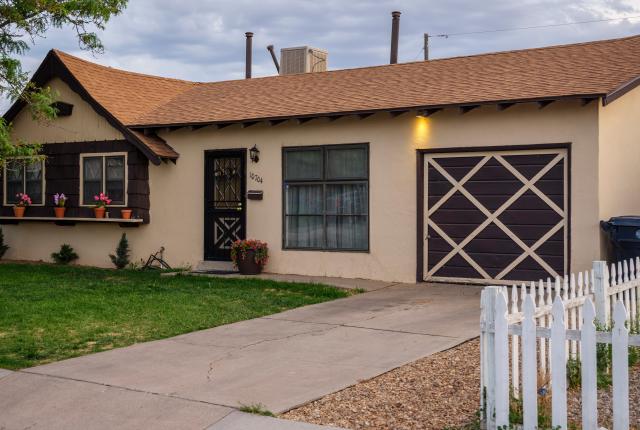
By and large, Bellamah homes are unassuming. Built with cinder block in a ranch style, they feature flat or slightly pitched shingled roofs, front windows cased in steel, a small raised front door porch, and a carport or garage as a nod to an increasingly auto-centric culture. Inside, buyers found rooms decked out in brand-name selling points like Formica countertops and Queen Mary showers. Bellamah developments often boasted community centers and amenities like tennis courts, bordered by curvilinear streets designed to slow traffic, instilling a sense of safety for playing children and watchful parents. “He wanted people to have a safe haven,” Bellamah’s great-niece Patty Boyle says of the popularity of her great-uncle’s developments. “[He wanted to create] a place where families lived side by side and grew. He really wanted to build a community—not just individual homes.”
Dale Bellamah in the 1950s.
Driven by an ambition to “make better homes, for more people, for less money,” as he told the Santa Fe New Mexican in 1960, Bellamah did create community for thousands. He built more than 7,500 homes in New Mexico during his lifetime and his company, Bellamah Corporation, built at least 7,500 more before shuttering in 1989. Today inhabitants’ sense of place is informed by his designs even as they actively adapt them, adding to and deepening the stories of these neighborhoods along the way.
“He was humble,” Boyle says, “and absolutely determined.” Since the Bellamahs couldn’t have children, Boyle and her siblings were treated as such by their great-aunt and great-uncle. That familial affection is evidenced by the short, twisting street in northeast Albuquerque, designed by Bellamah Corporation, that still bears Boyle and her mother’s first name.
Boyle recalls her great-uncle’s generosity with what his success afforded him. There were sun-bleached afternoons spent swimming in the Bellamahs’ pool—dug in the shape of that iconic bell logo stamped into the neighborhoods he built—while a transistor radio pumped the Monkees and Herman’s Hermits across the patio. After a dip, the family would cruise down Wyoming Boulevard, where Bellamah Corporation was headquartered, in a tail-finned Cadillac DeVille before Bellamah clocked in to work at 4 p.m. A night owl, he worked until midnight overseeing land purchases, plans for subdivisions, and the region-wide design and sale of his popular homes, essentially creating what Wallace calls a “one-stop shop for home buyers.”
An ad for Princess Jeanne Park.
Boyle was born in a Bellamah-designed home in Albuquerque’s Princess Jeanne Park (now known more succinctly as “Princess Jeanne”), a 1,600-home, 300-acre development replete with a community center, park, swimming pool, and land donated for two public schools. Bellamah completed the neighboring Princess Jeanne Shopping Center in 1964 to support the ballooning population of the city’s “most honored subdivision,” which garnered national awards and was even highlighted in a Smithsonian Museum exhibition about life in the 1950s.
Princess Jeanne, along with the Bellamah Addition in Las Cruces (developed in 1954 and 1952, respectively) established the exact neighborhood plan, or “plat,” that Bellamah would use in developments in Santa Fe, Hobbs, Alamogordo, Roswell, and across the Southwest. By re-creating the same neighborhood again and again, Bellamah conceived “shared experiences,” as Wallace puts it. “Not just across the entire state, but across generations,” he says. “Everybody lived in that neighborhood, so we shared the same New Mexican experience. Our stories connect over time and space.”
Boyle and Wallace both recall the luminous details of childhood moments—lived decades apart—that happened in that neighborhood. “I had my first kiss and smoked my first cigarette behind the Princess Jeanne Shopping Center,” Boyle laughs over the phone. Wallace describes neighborhood kids pedaling their bikes around the wide streets of the Bellamah Addition, gliding past the cinder-blocked exteriors and leggy aluminum carports of the nearly 300 Bellamah homes that made up their neighborhood.
from left
Patty Boyle and her mother, Patricia Bellamah Boyle, stand at the crossroads of Bellamah Avenue and Bellamah Court in Albuquerque; Jerry Wallace stands outside the Bellamah house where he grew up in Las
Cruces.
Given that the memories of so many New Mexicans are anchored to what Dale Bellamah built, I ask Wallace why Bellamah’s legacy feels overlooked when compared to other midcentury heavyweight builders such as Fred Mossman, Sam Hoffman, and Edward Snow. “Bellamah was smart,” Wallace says. “He knew the people experiencing the post–World War II American dream were working-class people. In order for them to enter the middle class, his homes needed to be affordable. To make them affordable was to make them pedestrian. He is overlooked because he largely built homes for the working class—and that’s who continues to live in the homes today.”
The consistent floor plans, with their small doorways and steel-encased windows, allow inspirational views of New Mexico’s vast skies. These are established tracts of cities that, in many cases, are still growing. Instead of being razed to make way for a shinier, taller future, Bellamah developments endure. More than monuments to a recent past, they are
living expressions of the resiliency of Bellamah’s vision.
Turquoise accents in Albuquerque.
Wallace suggests that the Bellamah Addition of Las Cruces, once largely inhabited by university workers and students, now embodies what cultural historian Daniel Arreola calls “the Mexican American Housescape.” A distinctly Southwestern representation of Mexican American identity, the neighborhood now displays low fences abutting the sidewalk, bright exterior house colors, wrought-iron gates and accents, and yard shrines. What Bellamah built continues to offer the scaffolding for the next story in a house’s—and a community’s—timeline.
Homes give memories a tangible form. Even as landscapes inevitably change and businesses come and go, dropping in on a Bellamah neighborhood simultaneously offers a return for those who once lived there. As Boyle says wistfully, “My heart will always call those subdivisions home.”
Their plans steer us toward the simple pleasures of neighborhood living—on the patio where Wallace’s grandfather worked on neighborhood cars, or in the wide streets where Boyle ran around with long-ago friends. These fixed walls, doorways, shopping centers, and streets circumscribe space, but as long as they exist, they will be open-ended sites for more childhoods, new memories, and fresh hopes and dreams.
A pair of houses with large front yards in Princess Jeanne.
BELLAMAH LIVES!
Check out these Dale Bellamah developments in New Mexico.
Evolving Identity: Bellamah Addition (1952), Las Cruces
Bounded by Lohman Avenue and Idaho Avenue on the north and south and Solano Drive and Triviz Drive on the east and west.
The Bellamah Addition is at the heart of several Bellamah-made developments in Las Cruces. This 300-home neighborhood, often referred to simply as “Bellamah,” offered a template that was used in future builds. The original Addition featured three basic home designs, though later outlying developments—the Bellamah Annex and Bellamah Manor (1954 and 1956)—introduced additional options. Today, the Bellamah Addition in particular has become an expression of the “Mexican American Housescape,” according to New Mexico State University’s Jerry Wallace, which is typified by low fences close to the sidewalk, brightly colored exteriors, and wrought-iron accents.
Crowning Achievement: Princess Jeanne Park (1954), Albuquerque
Bounded by Juan Tabo Boulevard NE and Eubank Boulevard NE on the east and west; Indian School Road NE and Lomas Boulevard NE on the north and south.
Princess Jeanne was named for Bellamah’s wife, and the honorific is a nod to his discovery that he was related to Lebanese royalty. This sprawling 1,600-home development in Albuquerque was Bellamah’s largest project. Designed to meet the housing needs of a population that more than doubled during the midcentury period, it made Bellamah a name not just in New Mexico, but across the United States. Billed as “wife-planned” homes, designs featured electric kitchen ranges with vented hoods, built-in garbage disposals, and of-the-moment products like linoleum and Formica. Better Homes and Gardens highlighted the designs as the model “home for all America.”
Form + Function: BLVD 2500 (1969), Albuquerque
2500 Carlisle Blvd. NE.
One of the last projects that Bellamah worked on before his death in 1972 was the Four Seasons Hotel, a knockout Spanish–Mediterranean-midcentury mash-up on the Albuquerque thoroughfare of Carlisle Boulevard and I-40. Now transformed into luxury apartments, the textured concrete facade’s clean lines were realized through a partnership with architect Jorge de la Torre and later expanded by legendary architectural firm Flatow & Moore.