


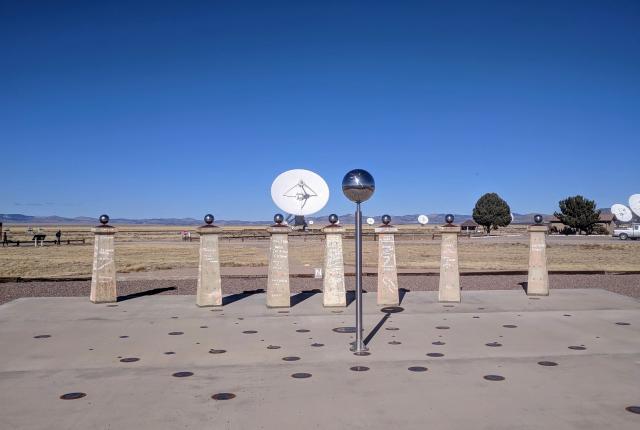
FOR ALL INTENTS AND PURPOSES, the Bracewell Radio Sundial near Magdalena functions like a clock. Ten metal piers, rescued from Australian engineer Ron Bracewell’s radio telescope at Stanford University, sit in the middle of a concrete slab and display the time of day based on how their shadows fall below. But the sundial also connects Very Large Array visitors to the skies in a way that doesn’t require a degree in astronomy to understand. “New Mexico is famous for its mysteries in the dark skies of the desert,” says Corrina Feldman, spokesperson for the National Radio Astronomy Observatory. “The sundial only adds more emphasis.”
Telling Time at the Very Large Array
At the Very Large Array near Magdalena, a working sundial incorporates historic piers from Ronald Bracewell's Standford radio observatory.
The Bracewell Radio Sundial brings astronomical history and shadow-based timekeeping together at the Very Large Array. Photograph courtesy of Wikimedia Commons/Dicklyon.