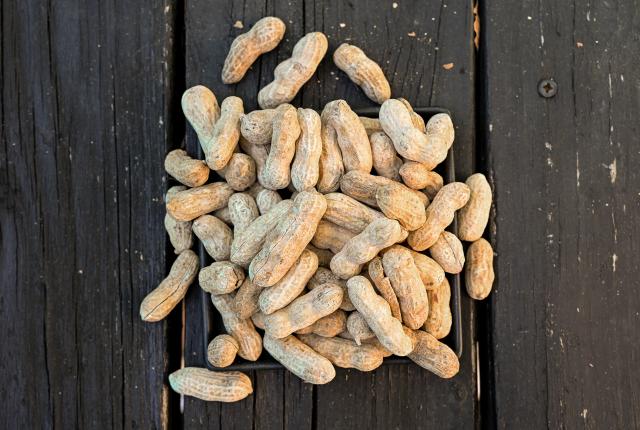
I CAN SEE TEXAS FROM where I am standing, in a tilled field near the eastern New Mexico state line. The crop was harvested a few weeks ago, and birds happily flit through the rows, picking at what’s left behind. I’ve heard that thousands of acres of peanuts still grow just across the horizon. But here in Portales, I’m crouched down, sifting through a scant few peanut plants in a short row. This is what remains of the crop that once helped define the local economy.
When I walk into the Peanut Valley Festival at the Roosevelt County Fairgrounds, always held in mid-October, I have visions of homemade peanut butter cookies paired with peanut butter ice cream, or maybe people wearing hats shaped like the Planters mascot, drinking small-batch peanut butter whiskey that was distilled for just such an occasion.
I find the fairgrounds hopping, full of local food and craft vendors arranged in tidy rows. Kids in little cowboy hats hold hands with their fathers as the band plays something vaguely country, while the smell of fall-off-the-bone ribs wafts from Coach J’s BBQ Shack food truck. It feels like the kind of small-town harvest festival that has anchored rural communities for generations. But something is missing.
On the outskirts of Portales, Richard Harden grows a small patch of seed peanuts for Hampton Farms.
I head to the Bethel Boer Farm Stand, expecting to see the festival’s namesake. “We stopped growing peanuts about 20 years ago,” says Suzi Visser, who now grows pumpkins, peppers, and squash with her husband, Chris, in Portales.
At the Remedy Rose booth, Jacque Jones tells a similar story. She grows flowers in nearby Clovis for tinctures, beauty products, and elderberry syrup kits, which she says help boost the immune system and ease flu symptoms—but no peanuts.
“Calf Slobber smells like the meringue on a lemon pie,” says Robert Payton, handing me an unlit candle from KnR Cowboy Candles, based in Clovis. Looking on-brand in a cowboy hat and boots, Payton sells hand-poured candles in scents called Horse Breath, Cowgirls’ Dream, and Church Picnic. They all smell pretty good. None smell like peanuts.
My nutty search is going nowhere. Even the aptly named country singer Mark Chesnutt, who was scheduled to headline the inaugural One Portales fest happening alongside Peanut Valley, canceled at the last minute.
from left
Jacob Lopez sells pumpkins at the festival. Attendees Jalyssa Martinez and her aunt Dorothy.
It doesn’t take long for Quaylene Parkey, executive director of the Roosevelt County Chamber of Commerce, to sense my confusion. The festival has changed over its 52 years, she explains. What began as a harvest festival has evolved into a broader community tradition. This year, it shares the fairgrounds with the new One Portales Music, Beer, Wine and Peanut Festival, a ticketed event with more peanuts in the name than I manage to find on the grounds.
So where have all the peanuts gone?
The first peanut crop in Portales is credited to farmer John M. Bradley, who planted Tennessee Red seed in 1914. The area’s light, sandy soil suited the crop: Peanut plants flower above ground, then send pegs into the earth, where the pods develop. Loose, well-drained soil allows those pegs to penetrate easily and gives pods space to grow.
The industry expanded during World War II, when demand surged after peanuts were added to military rations. After the war, Portales became known for Valencia peanuts, a small, sweet variety that became a favorite for eating out of the shell. Processing grew alongside the crop, including the opening of R.L. Borden’s Portales operation in 1956.
Then came a series of blows. In 2012, peanut butter produced by Portales-based Sunland Inc. was linked to a salmonella outbreak. The company soon filed for bankruptcy, and roughly a million jars of its peanut butter went to the Curry County landfill. Combined with the long-term decline of the Ogallala Aquifer—the groundwater source underpinning agriculture across eastern New Mexico—Portales peanut growing became a shell of its former self.
Hampton Farms hopper cars brim with peanuts.
Local farmers turned to dairy and other agricultural businesses, but Parkey says the changes are still unfolding. As producers contend with diminishing groundwater and changing economics, some operations that once grew larger are becoming smaller and nimbler. The festival has adapted too.
Among its roughly 130 vendors, only one sells peanuts—by design. Hampton Farms donates peanuts to the Portales Woman’s Club, which holds the exclusive right to sell them at the festival. It’s the club’s biggest fundraiser of the year.
As Parkey recalibrates my expectations for the event, we stand watching a man dressed like a lemon dance in front of a lemonade stand. I suggest that next year she at least get a dancing peanut. “I know exactly where to get one of those,” she says.
After a quick phone call from Parkey, I sit on the bleachers in the indoor arena with Alyssa Velasquez, operations manager for Hampton Farms, to get some perspective. “All of my farmers are basically West Texas, Texas Panhandle,” she says. “We’ve got thousands of acres planted. It’s just not in Roosevelt County.”
Pick up fresh peanut-topped doughnuts at My Time Donuts, in Portales.
The North Carolina–headquartered company still employs 76 people in Portales to dry, weigh, and grade peanuts at its facility behind the Roosevelt County Fairgrounds, drawing on the town’s infrastructure and generational know-how. Just over the fence, hopper cars sit brimming with peanuts waiting to be graded. Although none were grown here, you can buy a bag or two at the Hampton Farms store across the street.
By the next day, I’ve accepted that finding Portales peanuts may require a little more work. I head to Runnerz Cantina. “I haven’t met a peanut farmer in 15 years,” says Chad Heflin, as he hands me the coldest beer he can find in a tub of ice behind the bar. Just outside, Randy Ornelas carries on his grandfather Joe’s longtime Portales restaurant, Joe’s Hacienda, from a taco truck in the parking lot. I settle in with three beef, bean, and rice tacos while a band inside works through a cover of Heart’s “Barracuda.”
So far, I’ve found cold beer, tasty tacos, live music, and plenty of evidence that Portales knows how to throw a festival. But still no peanut fields.
Eventually, Velasquez connects me with Richard Harden, who may be one of the last people still growing peanuts around Portales. Harden raises a small crop of seed peanuts for Hampton Farms, an intermediate step between experimental seed and commercial cultivars. It’s enough to bring me out to his field just shy of the Texas line, where we talk about the way it used to be.
clockwise from left
Quaylene Parkey, Phil and the Phil Goods, and Portales Ballet Folklórico make
the Peanut Valley Festival fun for all.
“Every farm as far as you can see was in peanuts,” Harden says. His family farmed the legumes for generations, until they stopped. The sandy soil remains ideal. The climate still works. The missing ingredient, he explains, is water. “If the aquifer had held out, we’d still be growing peanuts and corn and everything else like we used to,” he says.
Portales may no longer grow enough peanuts to sustain the industry that once surrounded it. Yet every fall, the Peanut Valley Festival returns, celebrating the broader agricultural community that has long shaped this corner of eastern New Mexico. As Parkey puts it, “It’s a year’s worth of hard work realized in a few days.”
Clarke Condé enjoys adding peanuts to a bourbon and Coke after a long reporting trip.
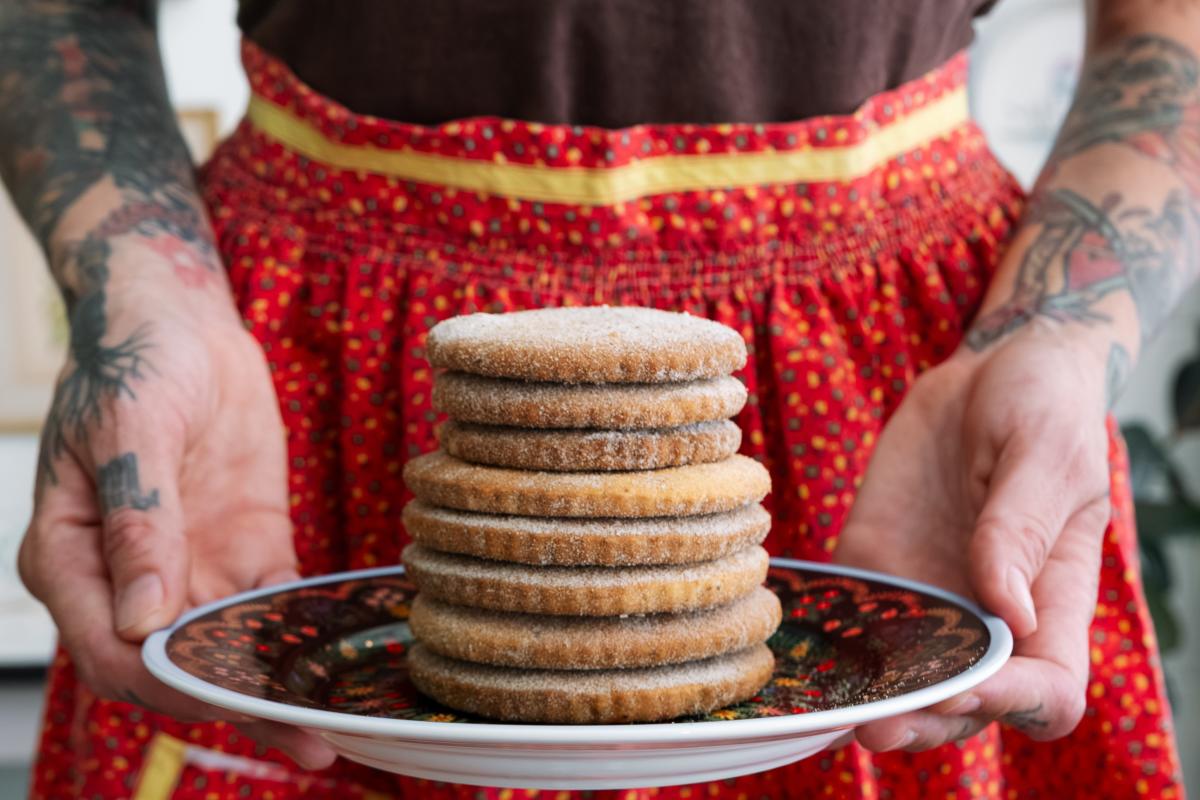
PEANUT BIZCOCHITOS WITH APPLE–GREEN CHILE CINNAMON SUGAR
There’s alchemy at work at Albuquerque’s Witching Flour Bakery, where Kelly Gee conjures unexpected flavor pairings in artfully crafted pastries—think nectarine-and-tomato panzanella Danishes or root-beer-float doughnuts. As the bakery celebrates three years in its Eubank Boulevard storefront this Halloween, Gee turned to a New Mexico classic for her fall menu. “I love bizcochitos,” she says of the anise-flavored cookie she reimagined with crunchy peanuts, peanut butter, and Apple–Green Chile Cinnamon Sugar. The result is a “nontraditional traditional” cookie that Gee hopes evokes “some autumn nostalgia” while honoring the beloved original.
- 1 cup lard or unsalted butter, softened
- ¾ cup plus 2 tablespoons granulated sugar
- Zest of half an orange
- 3 tablespoons peanut butter
- 1 large egg
- 3 cups all-purpose flour
- 2 teaspoons baking powder
- 1 tablespoon toasted aniseed, ground and sifted
- 1 teaspoon kosher salt
- ¾ cup roasted peanuts, coarsely chopped
- Apple–Green Chile Cinnamon Sugar (see recipe below)
Apple–Green Chile Cinnamon Sugar
- 1 cup granulated sugar
- 1 teaspoon ground cinnamon
- 1 to 2 teaspoons green chile powder
- 1 tablespoon freeze-dried apple powder
- Pinch of salt
Makes 24 Cookies
1. In the bowl of a stand mixer fitted with the paddle attachment, cream the lard (or butter), sugar, orange zest, and peanut butter on medium-high speed until light and fluffy, 3–5 minutes.
2. Scrape down the sides and bottom of the bowl. Add the egg and beat until fully incorporated. Scrape the bowl again.
3. In a separate bowl, whisk together the flour, baking powder, aniseed, and salt. Sift the dry ingredients, then stir in the chopped peanuts.
4. Add the dry ingredients to the wet ingredients with the mixer on low speed. Once incorporated, increase the speed to medium and mix for 30 seconds.
5. Turn the dough onto a sheet of parchment paper. Top with a second sheet of parchment and roll the dough to about ¼ inch thick. Transfer to a sheet pan and refrigerate until firm, about 30 minutes.
6. Heat the oven to 325°. Line baking sheets with parchment paper.
7. Remove the chilled dough from the refrigerator and cut out cookies with a 2-inch round cookie cutter. Transfer to the prepared baking sheets, spacing them about 1 inch apart. Gather the scraps, reroll the dough, chill if needed, and continue cutting until all the dough has been used.
8. Bake for about 12 minutes, or until the edges are lightly golden.
9. Let the cookies cool for 1–2 minutes, then, while still warm, gently toss them in the Apple–Green Chile Cinnamon Sugar to coat. Cool completely before serving or storing.
Apple–Green Chile Cinnamon Sugar
In a shallow bowl, combine sugar, cinnamon, green chile powder, freeze-dried apple powder, and salt. Mix well.
Note: Finishing sugar proportions can be adjusted to taste; Gee prefers to “measure with my heart.”