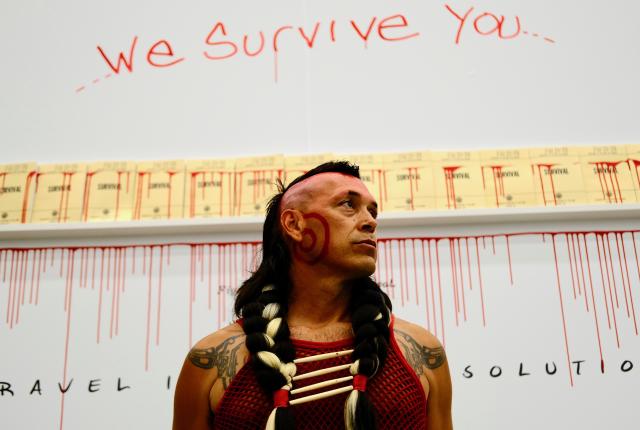
MAYBE YOU’VE SEEN classic army field manuals at military surplus stores or kept one close while you served. Or perhaps you dusted one off while browsing through a veteran relative’s things, intrigued by its potentially lifesaving advice and comforted by its simple, midcentury illustrations.
So it was for artist Cannupa Hanska Luger, whose father carried the FM 21-76 Survival field manual while serving in the Vietnam War. Yet in perusing the guide, Luger was surprised at how many Indigenous teachings it contained. “It feels like Indigenous knowledge recontextualized,” says the sculptural, performance, and video artist. The realization inspired SURVIVA: A Future Ancestral Field Guide, a book that is both an homage to the military survival guide and a subversion of it. “I was like, I think I need to claim this book back,” he says. SURVIVA earned a 2026 PEN America Literary Award.
SURVIVA’s simple illustrations.
Photograph courtesy of the artist/Jackson Krule.
A driving force of the Indigenous Futurism movement, Luger builds from real Indigenous wisdom of the land and applies it as a tool for survival in an apocalyptic future world. The original field manual’s basic aesthetic reminded him of the government-supplied commodity foods he grew up with on the Standing Rock Indian Reservation in North Dakota. “They were federally subsidized food stuffs, all canned,” he says. “But the logos were in the same vein, like Helvetica, simple drawings, no flash, no color.”
Other connections were more literal. In a guide on booby traps, the word “SURVIVAL” on the cover was used as a mnemonic device to dole out advice: Size up the situation. Undue haste makes waste. Remember where you are. “The A in survival was ‘Act like the natives,’ ” he says. “What came to my awareness was how much of this basic knowledge of survival I was taught by my aunts and uncles as just general knowledge around the environment.”
The field-guide-like cover.
Photograph courtesy of the artist/Jackson Krule.
In a process that’s both additive and reductive, SURVIVA opens with a reprinted page from the original manual but blacks out everything on the page except the first line—“1. Purpose and Scope”—and a few words near the bottom, “your wits. This is the major lesson in survival. Remember that.” The redaction process inverts the erasure of the Native voices who informed those early military field guides and undermines the wider cultural norms of appropriation.
Meanwhile, Luger co-opts the original guide’s drawings of an anonymous military figure into an Indigenous man with a long braid, whose reclamation of his Indigenous identity is not just about survival but about culture and presence. As his knowledge grows throughout the book, the mostly black-and-white illustrations give way to red being the dominant color of the final pages.
“The book is a way to tell these stories and embed it in a place that can survive a fire, can survive a holocaust, and can survive a genocide,” Luger says, imagining the character at the threshold of a cultural renaissance. “He’s developing beyond the cataclysm and desperation of pure survival and is now moving into the methodology that is ‘surviva.’ ”