


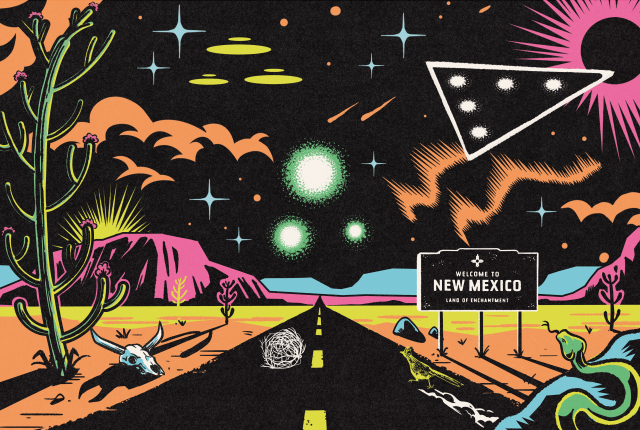
NO OTHER CARS SHARED the road as I drove I-25 south on a frigid January night in 2023. I fiddled with the heater, trying to clear the condensation from my windshield so I could better peer into the pitch-black desert between Santa Fe and Albuquerque. Then the haunting opening notes of Blaze Foley’s “The Moonlight Song” came on the radio, prompting me to glance skyward—just as the light appeared.
Several miles above the horizon, an impossibly bright, lime-green orb materialized without warning, then plunged straight toward the earth, its brilliance resembling a rescue flare more than a shooting star. Years earlier, in Oregon, I had witnessed a green meteor—a bolide—streak across the night sky with a long, tapered tail. This was different: rounder, greener, and eerily vivid. It seemed less like something entering from space than an object already suspended over the desert before vanishing somewhere beyond Zia Pueblo.
Once home, a quick Google search for “green fireballs” returned surprising results. What I’d seen closely matched reports from New Mexico spanning nearly eight decades.
The mystery began in late 1948, when airline pilots, military personnel, scientists, and civilians started reporting brilliant emerald objects in the state’s skies, many near Los Alamos, Sandia, and other sensitive military installations. The sightings became serious enough that the Air Force, the FBI, and the Atomic Energy Commission gathered with some of the nation’s leading scientists for a classified conference at Los Alamos in February 1949 to discuss the phenomenon. The transcript of that meeting—only recently made available through newly declassified government UFO records—captures a time when one of New Mexico’s enduring legends was still an active national-security question.
“Nothing like this, to my knowledge, has ever been observed in the case of meteorite drops.”
“Nothing like this, to my knowledge, has ever been observed in the case of meteorite drops,” testified University of New Mexico astronomer Lincoln LaPaz. The meteor expert had investigated dozens of reports, including one fireball he personally observed, which displayed unusual traits: It was silent, yellow-green, had no train, traveled in a straight, horizontal path, and “appeared in full intensity instantly.”
No one ever solved the mystery. Today, astronomers chalk the green fireballs up to unusually bright, metal-rich bolides, while historians point to Cold War anxieties that invited more exotic explanations—secret weapons, Soviet devices, flying saucers. Yet sightings continue.
Maybe that’s because New Mexico has always had a penchant for attracting the unusual.
“Our weirdness isn’t just a marketing gimmick,” says Darren Raspa, historian for the Air Force Research Laboratory at Kirtland Air Force Base. “It’s a highly documented historical byproduct.”
Much of our strangeness starts with geography. Vast deserts, isolated basins, high elevations, and clear skies lend themselves to everything from ancient astronomy to classified weapons research. “Nowhere else on Earth can you stand on the ruins of a thousand-year-old cliff dwelling at Bandelier and, at the same time, look across the canyon to see the smoke of a top-secret detonation facility at Los Alamos,” Raspa says. When you need to covertly build a bomb the world has never seen or “crash test a high-altitude space balloon”—Raspa’s official line on the Roswell Incident—“you don’t do it in Maryland. You do it in New Mexico.”

Travelers of NM 14 near Madrid should be on the lookout for possible cow abductions (or at least signs of them). Photograph courtesy of Unsplash/John Fowler.
The secrecy surrounding such work has helped unexplained tales flourish. “A closed door invites a ghost story,” Raspa says. “But our actual history is far more fascinating than the folklore.”
The same wide-open spaces that made the state ideal for classified research also gave generations of creative minds room to experiment. Artists chased the desert light. Spiritual seekers came looking for transcendence. Outsiders arrived to let their freak flags fly. Somewhere along the way, New Mexico earned a reputation as a place where the unconventional feels right at home. “New Mexico gives you the physical and mental space to act differently without the fear of being deemed too strange,” Raspa says. “The desert doesn’t judge eccentricity; it absorbs it.”
The result is a state where ghost stories animate historic hotels and gypsum sands; giant chile peppers and cobblestone rattlesnakes become roadside pilgrimages; and surreal landscapes appear as otherworldly as the aliens said to visit them. Even our art seems to arrive through a portal to another dimension.
I still don’t know what I saw in the sky that winter night. But living in New Mexico has taught me to embrace the unknown and lean into the bizarre.
So if you happen to be driving a lonely stretch of highway after dark in the Land of Enchantment, don’t be surprised if things get a little strange.