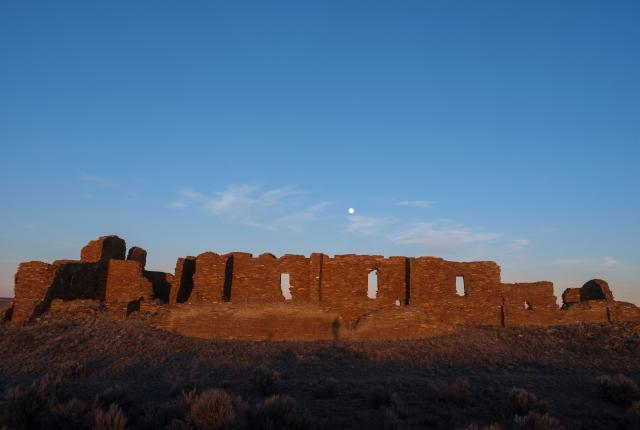
Aligning structures with celestial events influenced architecture at Chaco Culture National Historical Park.
THE SUN IS JUST STARTING to bake through crisp morning air as Jon Ghahate strides to the overlook to Fajada Butte, the pillar of rock near Chaco Culture National Historical Park’s entrance. Light silhouettes the boulder and small promontory atop the bluff where the famous sun dagger spiral petroglyph has been sliced by the sunlight every summer solstice for a thousand years. When he gives tours of Chaco Canyon, he starts here to emphasize both the small details he thinks visitors often miss and the larger view he hopes they take home.
With family ties to both Zuni and Laguna pueblos, Ghahate is among those who count themselves as descendants of the people who built the structures at Chaco Culture National Historical Park. “It is not a ruin. It is not a park,” Ghahate says. “It’s the beginning of who we are as a human society.”
In the petroglyphs, buildings, and roads, he sees the presence of people making everyday decisions that echo those we might face. Creating art in idle hours. Seeking time away from everyday irritations. Changes in construction style that follow from a shift in builders, like a home remodeling project today might see with a change in contractors. Ghahate, a longtime educator who works now for Crow Canyon Archaeological Center, in Colorado, pairs empirical information with a deep sense of this place as a root for living cultures.
A picture window from inside Pueblo Pintado.
“There are times when science theories collaborate with traditional narratives, there are times when they merge and support one another, and there are times when they don’t,” Ghahate says. “Neither one of them invalidates the other. It’s just, we haven’t found what it is yet that connects them together.”
For the Indigenous people whose ancestors were among those living in Chaco between 850 and 1250, much of what puzzles researchers and outsiders about the place is no mystery to them. Yet even after about 175 years of non-Native people being interested in Chaco and its meanings, scholars still land on a wide range of interpretations. New research continues to improve the understanding of Chaco’s meanings, uses, and influence on the wider region. Some of those studies are also bringing glimpses of the experiences and values of these Ancestral Puebloans into view in ways that visitors now can contemplate and share. But Chaco is still, and will likely remain, a place for making peace with the unknown.
“The great thing about Chaco and all these kinds of Indigenous spaces is, ‘I don’t know,’ and how freeing of an approach that is. That I don’t know everything, nor is it appropriate for me to know everything, because it’s not for me to know,” says Denise Robertson, superintendent of Chaco Culture National Historical Park and Aztec Ruins National Monument. “The people who do know, maybe the Indigenous communities, I believe that they have a much better understanding of the dynamics of the place than I do, and I appreciate that at this point in my career and my life. I don’t feel like I need to have answers to everything.”
Pueblo Bonito had up to 800 rooms.
FOR NEW MEXICO’S 19 PUEBLOS, Hopi, and other tribes, Chaco remains alive. The place is not “abandoned” because it is still inhabited by their ancestors. They preserve Chaco’s history through songs, prayers, and dances and, as Robertson is careful to note, visit the canyon with very different reasons and a different relationship to a place that remains relevant to cultural practices.
For three centuries beginning around 850, Ancestral Puebloans built and added on to great houses—the grouped buildings with plazas and circular kivas—in the central canyon and nearby mesas. Evidence of traded goods from afar, a continuity of construction style across the Southwest, and similar pottery all affirm connections throughout the region. But Chaco’s great houses stood out for their ostentation, specifically the enormous Chetro Ketl and Pueblo Bonito, which had up to 800 rooms, perhaps stacked five stories high.
“Totally epic on the landscape,” Robertson says. “Very purposefully here, I believe, to make a statement, but again, I don’t necessarily know what that statement is or was.”
As Ghahate shows me through Pueblo Bonito, he calls out the details. One wall was built precisely to align with sunset on the equinox. The visible nubs of support beams are trees felled in the Chuska or Zuni mountains or Mount Taylor and carried dozens of miles without the help of horses or wheels. He notes the construction differences from older to newer rooms in the great house, how intricately chinked the most recent walls were, and how the walls taper to the top, built with the future stories they would hold in mind.
“This was a place of what I consider to be opulence.”
—Park superintendent Denise Robertson
“The thing about Chaco is, it’s been studied to death, but what we actually know is very minimal,” says Phillip Tuwaletstiwa (Hopi), who has studied Chaco and even discovered through DNA testing that his ancestry traces back to those Ancestral Puebloans. “We don’t know what the religion was. We don’t know how they governed. We don’t know what language they spoke. We don’t know how they were organized socially. Those are the fundamental questions.”
Visitors today often remark on the austere environment. How did people live with so little rain, so little water? The barriers to visitation, like the jostling dirt road to the park and the absence of a cell signal, add to that wonder, Robertson says. But she points to a story told in the objects left behind as evidence these people were thriving. Remnants of macaw feathers, turquoise, and cacao in unique cylindrical jars attest to a trade network that reached the Pacific Ocean and into Central America, as well as to things (some physical, some less tangible) of equal value Chaco must have had to offer in exchange. Chacoans crafted ornate textiles and footwear, made jewelry, and wove reed mats, stripping away part of the bark to create a black-and-white pattern.
“If you are part of a community that’s just getting by, you are not stitching striped reed mats,” Robertson says. “This was a place of what I consider to be opulence.”
Chaco Culture National Historical Park Superintendent Denise Robertson.
Life in Chaco likely dazzled, but the approach to these structures was also carefully orchestrated. Ruth Van Dyke, an anthropology professor at the State University of New York at Binghamton, has traveled the former Chaco roads to communities where the view was engineered so the buildings bloomed onto the landscape.
“There was so much thought put into the emotional experience you would have of the place, what your first view of it would be like and what you could see from there,” she says. “Buildings weren’t just containers to hold stuff. They were part of the fabric of the earth and of your life.”
But why?
“It is not a ruin. It is not a park. It’s the beginning of who we are as a human society.”
—Educator Jon Ghahate
Just the construction of Pueblo Bonito would have required extensive labor: quarrying of stone, hauling water and mixing mortar, carrying trees. A network of roads around the great houses are implausibly wide for foot travel, often including up to 30 feet of earth that was cleared of rocks and packed down. The buildings also demonstrate architectural planning to express aesthetics, cosmological relationships, and political power. Enough social organization existed to feed those laborers. Enough knowledge was accumulated to record the moon through an 18.6-year cycle across the sky and build by it.
What would have drawn people to invest that level of effort remains largely beyond our understanding, according to Robert Weiner, an archaeologist and post-doctoral fellow at Dartmouth College. “Clearly it worked for a few hundred years. It brought people some meaning,” he says. “Why these novel political and religious formations? What is it about them that captivates entire societies and inspires people to change how they’re living?”
Taken to a more personal level, he asks: “What is it that brings you that sense of meaning and inspiration? What would inspire you to dig a 30-foot-wide road?”
A view to Fajada Butte.
EVEN AS RESEARCHERS BRING NEW technology to map the roads and identify cultural sites scattered across a landscape the size of Ireland, those traces of Chacoan life are increasingly at risk. Oil and gas companies have been drilling into the San Juan Basin just north of Chaco Culture National Historical Park, establishing drilling pads and roads that pueblo leaders are concerned will impact the sacred place.
The All Pueblo Council of Governors and other Indigenous voices have called to limit that development in a 10-mile buffer zone around Chaco Culture National Historical Park. Established in 2023, the buffer zone halts new oil and gas drilling leases on federal land, but the Trump administration has announced plans to reverse that decision. “Any attempt to reopen these lands would place irreplaceable cultural resources at risk and undermine the federal trust responsibility to our people,” said Pueblo of Acoma Governor Charles Riley in a press statement.
Made up of a checkerboard of private, public, and tribal lands, the buffer zone also overlays land and mineral rights privately held by Navajo individuals. Current leadership of the Navajo Nation has argued that the buffer zone blocks some 5,600 Navajo allottees from future economic opportunities.
Paul Reed, a preservation archaeologist with nonprofit Archaeology Southwest who worked on the documentary Protecting Chaco’s 10-Mile Zone, estimates that the buffer contains at least 4,000 cultural sites. “They’re sites and landscapes that matter in this larger context of understanding what was going on in the area around Chaco,” he says.
Educator Jon Ghahate (Laguna/Zuni) gives tours at Chaco, pairing traditional and scientific narratives.
Oil and gas companies, he argues, would be leasing marginally productive ground. Federal law bans simply bulldozing sites, but some have been lost or damaged because faint signs of roads or a community were missed or ignored. In one case, at Pierre’s Site, along the Chaco Great North Road, a pump jack clanks away a quarter mile from thousand-year-old stone walls.
“Imagine how a Zuni person or a Hopi person or an Acoma person or any Native person feels going out there,” Van Dyke says. “They want to connect with their ancestors and think about the people that lived there and how they were going about their day and what their lives were like, and you can’t do that when you have drilling rigs all around you. What’s being lost is information, certainly, but also just that fabric of a sense of place is being lost.”
In Pueblo Bonito, Ghahate points out two corner windows that catch blue squares of sky. Near the solstices, the sun shines through those windows onto the room’s stone walls.
“Hopefully, in the year 3,000, humans will be here to witness the same event, because it’s been here that long,” Ghahate says. “That’s our connection, as human beings, to the people who lived here.”