The City Different puts on a unique gathering for book lovers every May, adding a marquee event to the festival season. As the Santa Fe International Literary Festival enters its fourth year, readers and writers gather to celebrate storytelling in a very special place.
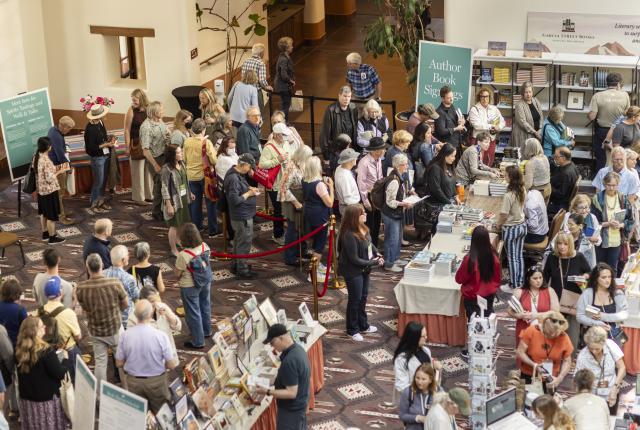
Audience members line up for author signings at the official 2024 festival bookstore pop-up by Garcia Street Books.
“... a sweep of red carnelian-coloured hills lying at the foot of the mountains came into view; they curved like two arms about a depression in the plain; and in that depression, was Santa Fé, at last! A thin, wavering adobe town ... a green plaza ... at one end a church with two earthen towers that rose high above the flatness.”
—Willa Cather, Death Comes for the Archbishop (1927)
LITTLE HAS CHANGEDsince Willa Cather’s rendering of Santa Fe nearly a hundred years ago. The evening’s tangerine light still catches low rooftops, the Plaza still stands crisp and green underfoot, and writers still come to put the mountain town’s high desert grandeur into words. In this decade, the long-enduring art of the word in the City Different has culminated in a very special kind of annual celebration: the Santa Fe International Literary Festival (SFILF).
The festival puts New Mexico and its storytelling legacy squarely on the literary map. Since 2023, it has taken place annually in the Santa Fe Community Convention Center on the third weekend of May, drawing around 20,000 attendees. Founders Clare Hertel, Mark Bryant, and Carmella Padilla developed the festival’s framework to celebrate acclaimed literature in an intimate setting with beloved authors from the Land of Enchantment and beyond. This year’s lineup includes such luminaries as Judy Blume, Ada Limón, James McBride, and Ocean Vuong, and spotlights New Mexico–based writers such as Brandon Hobson and Priyanka Kumar.
“This is a watershed moment for us,” says Santa Fe–based author Deborah Jackson Taffa, whose 2024 memoir, Whiskey Tender, was a National Book Award finalist. Having served as both a headliner and a moderator in years past, Taffa says the festival has garnered serious attention from the literary community in just a short time. “When I see very prominent authors, they’re like, ‘I’m hearing a lot of buzz about the Santa Fe International Literary Festival. I would love to be invited.’ ”
Los Radiators play the convention center courtyard at the 2025 fest.
The city’s newest marquee event has managed to build a reputation of contradictions not often found in an international festival of its caliber. While held in a relatively small venue, it offers boldface names alongside cozy conversations on an event schedule that’s brimming with gravitas and timely topics, along with unconventional programming like train rides, art tours, and historical field trips. Then there’s the classic charm of Santa Fe itself—an iconic artistic and cultural crossroads of 90,000 that holds the title of oldest capital city in the United States.
All these factors contribute to an event that is annually sought after by writers and readers alike. Taffa recalls when a microphone quit working last year during a conversation between authors William deBuys and Terry Tempest Williams. “They moved down to the ground to sit cross-legged next to each other on the floor so they could share the microphone,” she says. “The warmth that you could feel in the room when they did that was palpable.”
Hobson, a Las Cruces–based author of six books who teaches at New Mexico State University, will be interviewed by Taffa at this year’s festival. A Cherokee tribal citizen hailing originally from Oklahoma, he’s excited to come north to the capital for the event: “I just think Santa Fe is such a magical place,” says Hobson, whose The Devil Is a Southpawdebutedin October.
Santa Fe authors Jenn Shapland (left) and Jamie Figueroa talk on stage at the 2024 festival.
Part of the magic is deeply rooted in New Mexico’s storytelling tradition. Rudolfo Anaya, born in Pastura, was an early writer of the Chicano literature movement who wrote more than 40 books, most notably the beloved Land of Enchantment classic Bless Me, Ultima. George R.R. Martin, author of the A Song of Ice and Fire book series, is a longtime Santa Fe resident whose patronage has bolstered the city’s arts and entertainment venues.
The newest United States poet laureate is Arthur Sze, another Santa Fean. Before retiring, Sze was a professor of creative writing at the Institute of American Indian Arts, which has turned out stars like Layli Long Soldier, Tommy Orange, and Jake Skeets. The college’s graduate creative writing program, where Taffa is director and Hobson is a teacher, has further bolstered Santa Fe as a stronghold of literary excellence.
Several writers in this year’s lineup either have personal connections to New Mexico or they simply feel that special allure the Land of Enchantment seems to hold for artists. Ada Limón’s poem “Miracle Fish” references the world-famous Santuario de Chimayó, for example:
“Once in a small chapel in Chimayo, New Mexico, I knelt in the dirt because I thought that’s what you were supposed to do. That was before I learned to harness that upward motion inside me, before I nested my head in the blood of my body. There was a sign and it said, This earth is blessed. Do not play in it.”
The Writing on the Rails day trip takes writers through a high desert sunset.
Photograph by Kate Russell.
“I think of New Mexico as such a creative center,” says Limón, the 24th U.S. poet laureate and a MacArthur Fellow. “It feels like it’s sacred in many different ways.” Limón, who spent time in Albuquerque after graduating from her creative writing program at New York University, adds, “I feel like my real writing life started to bud in New Mexico.”
Limón is also keen on the intimate nature of the festival’s events. The author conversations are interview-based—matching one featured author with another writer who plays the role of interviewer—making each event one of a kind, unlike other festivals where authors give a standard reading or are placed on a panel with a moderator. This intentional approach fosters empathetic and curiosity-centered discussions.
At this year’s festival, Limón is in conversation with Jake Skeets, the current Navajo Nation poet laureate. His first collection, Eyes Bottle Dark with a Mouthful of Flowers, won a litany of awards, and his new book, Horses, was released in April. “I think that’s a beautiful way to approach an event like this: to be in partnership with a fellow writer, a fellow creative soul, and feel like you’re supported,” Limón says.
The festival also offers intentional community impact. Last year, SFILF received nonprofit status to expand statewide efforts for students, families, and teachers to access the festival. Each year, the organization provides free tickets to specific author conversations. This year, they gave out the most ever: around 2,000 tickets, including to tutors at Reading Quest, a Santa Fe nonprofit, and schools like Cochiti Elementary, Navajo Technical University, and Taos High School.
The festival also fosters direct engagement between authors and the local community. Last year, AP English students from Santa Fe’s Capital High School got to meet with Amy Tan. Taffa and Hampton Sides, another Santa Fe–based bestselling nonfiction writer, met with five Albuquerque high school teachers for a private conversation about what books to teach. Megan Mulry, executive director of SFILF, has taken community engagement a step further: “It’s part of the agreement that when you come here,” she says, “you meet with a community group.”
Carmella Padilla reflects on her hope for the festival she co-founded—both when it started and as it continues—to foster not only the love for literature, but the warmth visitors and locals alike can enjoy in the city. “It’s about everybody feeling like they are home here in Santa Fe. I say that as somebody who grew up here with multiple generations from New Mexico,” Padilla says. “I feel very proud of this place—it extends itself and embraces people.”
As she speaks, she holds both hands to her heart and looks off at the place she’s known her whole life. Literary superstars are all well and good, but Padilla is more interested in giving patrons of the festival a chance to experience a very specific feeling. “I personally want people to come here and experience the depth and the thoughtfulness and the openness,” she adds. “And there’s no better way to do that than through sharing stories. Whether it’s stories of New Mexico or of the world, they’re ultimately universal, because people can relate to the human experience.”
Santana Shortyis a freelance writer who loves to read in the afternoon light at Iconik Red coffee shop with a mocha in hand.
During the fest weekend itself, Morning Meditations are respectively led by acclaimed Santa Fe writers (and Buddhists) Henry Shukman and Roshi Joan Halifax. Each evening at 5 p.m., free public receptions take place in the convention center courtyard for book lovers to socialize and enjoy music and refreshments by local establishments. The weekend culminates in a conversation with Judy Blume on Sunday evening. For tickets and a full lineup, head to sfinternationallitfest.org.