


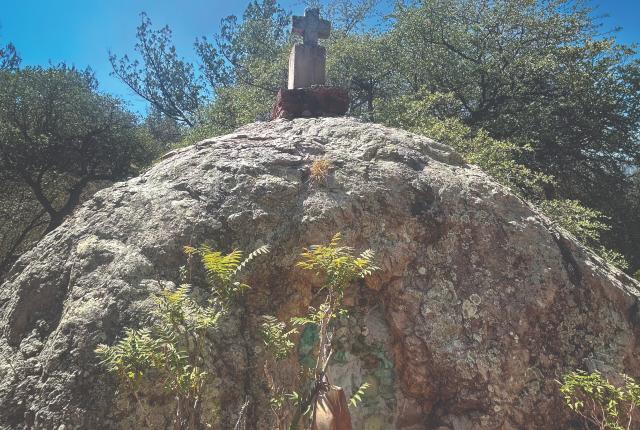
BESIDE THE TRICKLING WATERS of Mineral Creek in the Gila National Forest, a man’s body has rested inside a massive granite boulder since 1880. The odd gravesite reveals the stakes of the yearlong conflict known as Victorio’s War. On April 29, 1880, mine operator and former Army Sergeant James C. Cooney and two other men rode to their deaths in the Mogollon Mountains. They’d been headed to warn settlers that Warm Springs Apache chief Victorio, along with a band of Chiricahua Apache tribal members, had killed three people at the Cooney silver mine the night before. On the way, Cooney’s group visited the home of young Agnes Meader, who recalled a chilling detail in a 1937 interview: “After several hours the horses returned riderless with blood on them.” Near where the bodies were found, Cooney’s brother Michael and friends dynamited a hole in a 12-foot-high boulder, then entombed Sergeant Cooney’s remains in the sepulchre, sealing it with ore from the mine. Two Cooney children were added to the tomb in the ensuing years, and five other grave markers lie behind it with a plaque that tells the story. Ruben Q. Leyva, a visiting professor of Native American Studies at New Mexico State University and Chíhéne Ndé (Gila Apache) tribal member, understands each perspective of the conflict. “One was defending his homeland where he felt his ancestors had always been, and where he wanted to remain,” he says of Victorio’s mission. “You have these others who were defending the people who the United States had promised this prosperity.” The local landmark officially became part of the national forest in 2009, but as Leyva notes, there are no such markers for Apache casualties. “We have our own ways,” he says. “When we would bury someone, you would never know where they were.”
Pay Respects
Cooney’s Tomb and Cooney Cemetery are located about five miles east of Alma, off Forest Road 701.