IN AN OTHERWISE EMPTY ROOM at SITE Santa Fe stands Fourth of July in Venice Fog. Against the crisp white walls of the gallery, the interior of the eight-by-six-foot glass box becomes legible: four inner panels, also glass, coated in vaporized minerals. At just a shade darker than their container, the panels make the piece challenge a person’s eyesight. It’s this misty center that articulates what viewers since the mid-1960s have experienced in Larry Bell’s art: The more you look, the more there is to see.
The sculpture is full of edges, yet its contours are almost lost to sight. It’s empty, but not quite. Like much of Bell’s canon, the 2018 piece is deceptively slick, its minimalism a conduit for a highly actuated sense of perception that feels almost mystical. The piece is one of several dozen presented in Larry Bell: Improvisations, a four-decade survey of Bell’s work opening this month at SITE Santa Fe. It’s also executive director Louis Grachos’s favorite. “He uses glass in the most subtle and beautiful ways to create these ethereal effects,” Grachos says. “There’s a lot of technical ability required to get these effects. It’s not a secretive process—but the process is also his magic.”
Larry Bell’s Pacific Red II provides an immersive art experience.
Photograph by Matthew Millman.
The exhibition is part of a recent burst of attention for Bell. At 86, he has been diligently making glass sculpture and installation art for 66 years, more than 50 of them in his Taos studio. Last September, he opened Improvisations in the Park at Madison Square Park in midtown Manhattan; meanwhile, in SoHo, the Judd Foundation showed a series of his two-dimensional collages in Larry Bell: Irresponsible Iridescence. Larry Bell: Improvisations first opened at the Phoenix Art Museum in 2024 before traveling to the San Antonio Museum of Art. It is set to finish its tour when it opens on October 16 in Santa Fe, where Bell also showed work over this past summer at Pie Projects Contemporary Art.
For all this fanfare, Bell is charmingly self-effacing. When we meet for a Zoom interview, he’s in his light-filled Taos office. With a signature fedora on his head and a pale peach shirt unbuttoned at the neck, he has the mien of a man on vacation. “I like to think of myself as celebrating my 66th year of unemployment,” he says with barely a hint of a smile.
Bell emerged into the art world in the mid-1960s alongside a loosely affiliated group of Southern California artists that included James Turrell, Helen Pashgian, Robert Irwin, and Bell’s fellow Taos transplant Ron Cooper. Frequently working with the medium of light itself to construct luminous objects from what were then considered alternative materials—resin, cast acrylic, plastic, and, in Bell’s case, glass—the group was dubbed the Light and Space movement.
Larry Bell in 2017 with “6 x 6 An Improvisation,” which features 30-plus glass panels.
Photograph courtesy of Alamy/Ukartpics.
In 1959, after two years at the California Institute of the Arts (then known as the Chouinard Art Institute), Bell dropped out and got a job as an art framer. There, he first became captivated with glass. “I was interested in how it behaved,” he says, “and how you didn’t really cut it, you broke it. You score it, make a mark on the surface, and then put pressure on that mark. The glass separates itself.”
The transmission, reflection, and absorption of light could be manipulated and made observable by working with this ubiquitous but overlooked material. “I was fascinated by the strange control that one has over breaking something,” Bell adds, before ending the summation: “And that’s my poetry about glass.” In 1965, when he debuted his work in a solo show at the storied Pace Gallery in New York, it sold out before it even opened.
As his star rose in the early 1970s, Bell began to split his time between Venice Beach, California, and Taos—two of “the great places of the world,” he declares. Both have a bohemian element, but the comparatively sleepy Taos offered what Los Angeles could never: “The ability to control my distractions,” as Bell puts it.
from left
The “Light Knot” series of coated Mylar hanging sculptures: “LK 6.24.16,” 2016. “SLK 8.15.13,” 2013.
Photographs by Paul O'Connor.
Removed from the social and urban frenzy of an area that, in the ’70s, was home to more than seven million, Bell made space—figurative and literal—for his experiments with glass in northern New Mexico. “A more environmental scale of work happens with the move to Taos,” observes Rachel Zebro, the originator of Larry Bell: Improvisations, who is also the Phoenix Art Museum’s curator of modern art. The cubes of the artist’s early glass work—some as small as two inches high—began to be traded for large diaphanous walls, often more than six feet tall. Frequently, Bell joined multiple works together, creating his own almost hallucinogenic architecture, stolid and dreamy all at once.
Bell is totally candid and yet difficult to pin down when he talks about his work. “The internal stuff has to do with the feelings generated by absorption, transmission, and reflection and what they mean to me, personally—but I don’t think I can get into that,” he says. “Why I make it is very different, I think, from why [an audience] might like it. Each and every person who sees something sees it from their very unique, personal viewpoint.” Yet he is remarkably consistent when he talks about the tenets that guide his practice: spontaneity, improvisation, intuition, and trust.
These aren’t necessarily the first words one thinks of when standing in front of one of the sleek glass sculptures that made Bell famous. But after Zebro witnessed the process of their creation, “I totally understand now what he means by improvisation and trust,” she says.
Larry Bell’s “Deconstructed Cube BGRSS,” 2022.
Photograph by Desiree Manville.
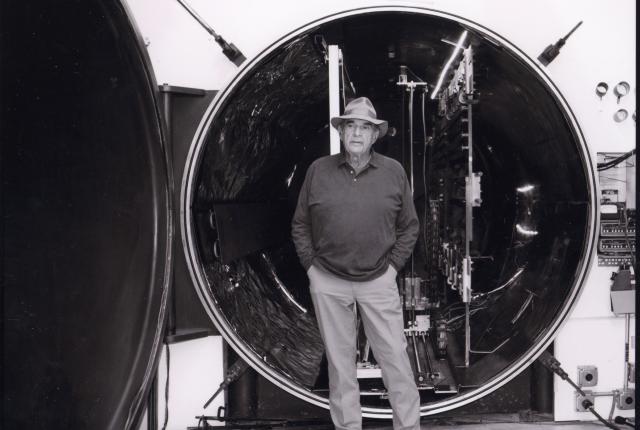
A central element of Bell’s Taos studio is the Tank, a 14-ton iron chamber where he deposits his glass planes. The Tank heats metals to the point of sublimation, turning them to gas, at which point they settle on the glass in a thin film with varying shades of opacity and iridescence. Watching Bell at work, as he peers into the Tank’s brilliantly lit interiors through a small window, Zebro had the sense that she was seeing an alchemist in his lab. While the elements coalesce in the humming machine, enlivened by jolts of electricity, he judges duration and the glass’s distance from the substrate, until the transformation is complete. Bell is completely self-taught in this technique, which is called vacuum deposition. “He really is relying on himself and his own intuition,” Zebro says. “There is no equation.”
During our conversation, Bell often describes his favorite pieces in Improvisations as “sensuous,” including The Time Machine. The experiential piece houses a sheet of infrared-filtering glass salvaged from Los Alamos National Laboratory, fixed in what Bell described as a “tabernacle”—a dark, oblong wooden frame with curving, half-moon legs. Two Bell-designed chairs are situated on either side of the glass. Because of the type of glass and its metal coating, when two people sit on either side, there is an optical split—half of the light returns to you, and half travels through to the other person.
from left
Larry Bell's “Solar Study 110,” 2024, and “Solar Study 112,” 2024.
Photographs by Desiree Manville.
“I call it The Time Machine because each person’s image is reflected 186,000 miles a second, the speed of light,” Bell explains. Functionally, The Time Machine is both a mirror and a window to the past. As you see yourself, you also see another as they were in a moment that has just barely passed. Time’s usual slow march becomes immediate, felt, and even visually palpable through the way Bell channels light. “There’s a sensuousness to that experience,” he says, “and that makes it a very powerful little room.”
Like all of Bell’s work, The Time Machine reorients viewers to the continually repeating mysteries of our lives—phenomena like light, time, and perception. Amidst it all, our own reflections are discernible in the glass too. Conveying that feeling—of being part of something bigger—was one of Zebro’s aspirations as she curated Larry Bell: Improvisations.
“It’s so much more than a piece of glass you can see yourself in. It’s the environment, your surroundings, the people there,” she says. “Like Larry says, ‘Glass isn’t really the medium, it’s a means to an end.’ It’s what allows you to see the world outside.” Zebro then returns to that most familiar and profound point of origin, which, of course, is Bell’s most enduring collaborator. “It’s about the light that passes through.”
Maggie Grimason has been thinking and writing about the influence of light on New Mexico’s artists since 2015.