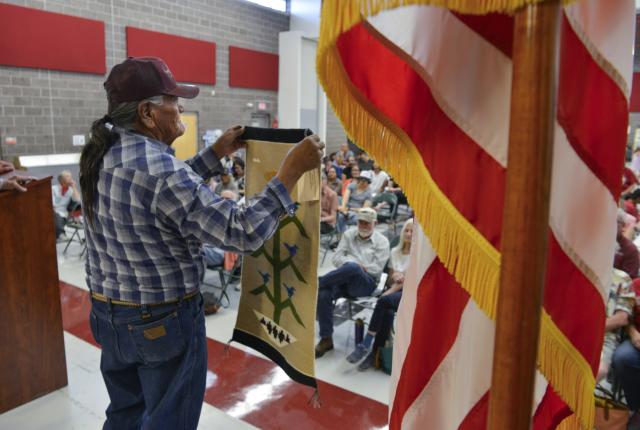
DELBERT AUTRY POINTS TO A potential buyer from the stage at the Crownpoint Navajo Rug Auction. A young man in the crowd just bid $1,200 for a dazzling three-by-five-foot Storm Pattern weaving, but he’s now shaking his head to pass up a counteroffer.
The auctioneer from Mountainair pauses, sizing up the customer, who came from Kansas and has never been to the Southwest before. Then Autry unleashes a staccato sales pitch: “Don’t-you lose-that rug, you’ll re-gret-it for the rest of your life! Cuz you’re young!”
The crowd chuckles, enjoying the show. The buyer obediently raises his paddle. After no counters materialize, Autry jabs the air once more before Crownpoint Chapter House president Rita Capitan bangs a gavel. “Thirteen-hundred, you got it. And you’ll never regret it.”
Bess Seschillie gets the proceedings started.
Buyer’s regret doesn’t seem to exist at the longest-running Navajo rug auction in existence, a lively and sometimes dramatic occasion that continues to unfold on the first Friday of each month in the Crownpoint Elementary School gymnasium. After all, like Autry and his longtime fellow auctioneer, Wayne Connell, who also hails from Mountainair, most of the crowd has traveled several hours to get to this renowned sale on the eastern edge of the Navajo Nation. Some had an even longer haul, arriving from places like Virginia and Germany.
Since 1964, high bidders at Crownpoint have taken home exquisite weavings from across more than 27,000 square miles of Dinétah, with price tags that can be less than a third of those found in a trading post or gallery. Operated by the Navajo Weavers Association of Crownpoint, the auction is a win-win for both artisan and customer, as weavers receive 85 percent of each sale and checks are issued on the spot. (A Santa Fe gallery might pay out less than half that sum.)
But the true takeaway for visitors to this school gym can be more ineffable, and more valuable, than a good deal. As you line up on the waxed floors for your purchase, there’s likely a chance to meet the woman who made the piece of art you’re now going to have forever, to say hello to her family, and to ask about the flock of Churro sheep they tend for the wool that made the rug you’re now clutching tightly to your chest like the soft treasure it is. For a few moments, as you learn where the artist is from and how many generations her family has been herding and weaving, you realize you’re at the receiving end of thousands of years of ancestral skills and stories.
Erwin Williams Jr. carries rugs to the auction floor.
SOME MILLENNIA AFTER SPIDER WOMAN (Na'ashjé'íí Asdzáá)—according to one Diné creation story—showed two women how to spin, dye, and weave sheep’s wool into rugs to sell to help their village survive the winter, the Crownpoint auction began enabling local weavers to earn more via a cooperative model. Crownpoint Chapter member and auction master of ceremonies Bess Seschillie says the first rug went for $3 at the inaugural sale organized by traders Lavonne and Bill Palmer and Pauline McCauley, an auction co-founder and former chairman who passed away in 2020.
As Native designs rose to the height of fashion during the Age of Aquarius, word spread among the bilagáana (what the Navajo call White people) about the bargains to be had in Crownpoint. By 1976, when writer Tony Hillerman profiled the auction for New Mexico Magazine, some nights saw “as many as 600 rugs, with the sale going on until the early morning hours.”
“Crownpoint really has been one of the only direct outlets for many Navajo weavers,” says fifth-generation trading post owner Jed Foutz, who owns Shiprock Santa Fe. “They could go direct to market, and it’s very central for most weavers all over the reservation.” The weavers’ fees collected by the association pay for the space and other community endeavors, including frequent food distribution and other resources and support for elders.
Rugs are tagged with weavers’ names and hometowns.
Around January 2020, 200 to 300 rugs were still heading out the door with buyers on good nights, Capitan says. Just a few months later, Covid-19 hit the Navajo Nation significantly harder than it did the rest of the world. “We lost a lot of our elder weavers,” says current Navajo Weavers Association treasurer Marcella Hale. During those hard times, she and her daughter traveled as far as Chinle, Arizona, to distribute food boxes and take rugs from any weavers who could benefit from a virtual auction. Still, when the in-person monthly event resumed in January 2023, Hale says, the number of artisans who regularly showed up to sell rugs had declined by about 50 percent.
At this year’s June auction, about 100 weavers line up in the hall outside the gymnasium starting at 4 p.m. Toting rugs in garbage bags and plastic tubs, they wait for Hale and her army of volunteers to examine and tag their creations. “When we inspect them, we make sure that there is no commercial yarn on any of those rugs,” Hale says. “The majority of the time, we get 100-percent-handmade woven wool rugs, and those all get displayed.”
Buyers inspect rugs before the auction begins.
Around 5 o’clock, rugs with tags showing each weaver’s name and provenance begin piling up on folding tables. Buyers methodically make their way around the displays, pulling out measuring tapes, murmuring over styles and patterns, repeating weavers’ names and hometowns, and speculating about opening bid prices. Younger patrons pull out cellphones and snap photos of rug patterns and auction numbers; older heads discreetly jot them down. In the downtime, some float over to vendors selling Pueblo pots, Pendleton towels, and inlay jewelry. Others head outside to fuel their commerce with Navajo tacos and piccadilly snow cones.
By 6 p.m., a mix of mostly bilagáana buyers and Diné artisans settle in rows of green folding chairs and bleacher seats. Seschillie opens the proceedings by asking weavers to stand and be recognized, singing “Happy Birthday” in Navajo for the June babies, and dispensing some Diné wit while dispelling a few myths.
Organizers Tayah Bruce, Marcella Hale, Rita Capitan, and Bess Seschillie.
“I was at a show in Salt Lake City recently, and there was a gentleman there with some rugs,” she tells the crowd in a confidential tone. “He told the audience, ‘Oh, the Navajos don’t make anything bigger than a three-by-five rug.’ ” She waits a beat. “False! You saw those big rugs back there. Oh, and the kids aren’t learning rug weaving. That’s another fallacy he said.” She tells the audience about a 16-year-old who recently completed an eight-by-ten.
“He goes, ‘And the Navajos idolize Tony Hillerman…’ ” she continues. “What?! Tony Hillerman!?”
The assembled buyers giggle along with Seschillie, even though Dark Winds may be the most some have glimpsed of Navajo culture until this moment. Like all savvy salespeople, she’s both educating the customers and getting them in on a joke.
Winter Morgan of Crownpoint, age six, displays a rug.
MINUTES LATER, AUTRY IS OFF AND RUNNING, tongue expertly lolling deep inside his mouth to create a steady rumble of anticipation. While he amps bids and trawls the small sea of people for paddle waves, a dedicated, all-ages Diné lineup of auction assistants unfurls each rug at its given moment in the spotlight.
When Connell, Autry’s counterpart, joins in to help with the July 4 auction, he affirms Autry’s frequent sales pitch of “Help yourself!” with a baritone, “Somebody ought to.” With this experienced sales team running the show, nearly two hours of fairly action-packed bidding unfold.
Many of the rug reveals elicit admiring murmurs from the audience. Prices start at $80 and top out at $2,350 in June, when the fastest and most furious bidding spats erupt for Tree of Life rugs, with their family-tree-like depictions of birds nestled along limbs. The next month, a stunning Teec Nos Pos rug with 100 colors by Darlene Littleben, whose family of weavers in Rock Point, Arizona, is known for distinctive borders and vibrant contemporary color schemes, fails to sell at a set low price of $8,500. I hear an audience member mutter that it’s worth at least twice that. Two Grey Hills styles, known for their natural, undyed wool in scales of gray, brown, black, and white, are much sought-after at both summer auctions, living up to their reputation as the “Cadillac of Navajo rugs.”
Auctioneers Delbert Autry (in black hat) and Wayne Connell (in white hat) rev sales.
“Trends just kind of come and go, like any market,” Foutz says of the Navajo rug trade. “For a while, Teec Nos Pos was the hot thing. And before that, the mid-seventies to the mid-eighties were the height of Two Grey Hills weaving and values. It does move and evolve.”
Young weavers are still getting in on the game. Susanna Overton, an 11-year-old from Naschitti whose bright palette and simpler patterns catch my eye during the viewing sessions, sells a small but distinctive turquoise-and-black Eye Dazzler for $120 in July. Although Overton doesn’t attend the sale, her grandmother Pauline Thomas oversees the transaction.
Thomas, who has been driving an hour from Naschitti to sell her own pictorial, Two Grey Hills, and Storm Pattern rugs at Crownpoint for at least two decades, says her great-grandmother was a weaver too, with her own flock of sheep. When Thomas was in elementary school, she learned to card wool and hand-spin it before her mother taught her a trick to better align her work. “She put a wire in, and my weaving went straight,” Thomas remembers. Her matriarchs showed her what hues different plants make when dyed into natural white wool—lime-green from sagebrush leaves, tan from juniper bark—after the botanical samples are steeped in boiling water and strained.
Pauline Thomas of Naschitti holds a work purchased by collector Thomas Koglin.
“At first, she was getting frustrated,” Thomas says of Overton’s learning process as a novice weaver. She started her granddaughter on simple lines before teaching her patterns. “But now she knows. Although she still wants to be on her phone or her tablet before she does her weaving.”
Still, “There are fewer kids learning than there were 20 or 30 years ago,” says Santa Fe–based collector Thomas Koglin, who first came to the auction in the 1970s and says he has about 40 rugs at home. Although he adds that he doesn’t need any weavings of any size, he takes bidding paddles in both June and July, also telling me that despite diminished attendance, “Many of the rugs are much better than what they used to be, more creative.”
I ask just what might cause him to bid on a rug. “It depends on if I like it,” he says mysteriously.
On the Fourth of July, Koglin pays $850 for an inspired pictorial design by Thomas that features a line of train cars snaking across the rug’s midsection. And, just as the Mountainair auctioneer has done in Crownpoint for the last 40 or so years, Autry talks the bidder into the sale.
“I’ve been to a lot of rug auctions,” he tells the crowd when Thomas’s creation is revealed. “But we don’t usually see one with a train in it, especially one that good. Help yourself!”
Managing Editor Molly Boyle and her friends left Crownpoint with several rugs and an Acoma pot.
CROWNPOINT NAVAJO RUG AUCTION
Crownpoint Elementary School, Crownpoint. September 5 and the first Friday of each month. Setup and viewing begin at 4 p.m.; auctions start at 6 p.m.