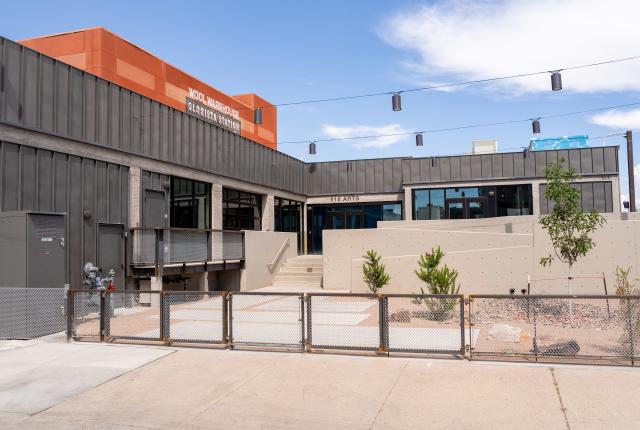
In its 20th year, 516 Arts is making big moves in Albuquerque. This month, the museum opens a new destination for contemporary art that’s creating fresh opportunities for artists to live and work in the community—along with an exhibition to honor the land that makes it all possible.
The exterior of the new 516 Arts space, in downtown Albuquerque. Photograph courtesy of 516 Arts.
THROUGH THE ICE-BLUE frosted vestibule at 508 First St. NW, Albuquerque’s summer heat vanishes into a concrete chamber that serves as a cool refuge for artists. Just a half mile north of historic Route 66, the warehouse once functioned as a cold-food-storage facility. Since 2022, it has been inhabited only by insects, small lizards, and dust bunnies, while the rumbling adjacent railroad tracks and a nearby laundromat encase the area in an ambient industrial hum.
This downtown neighborhood, lined with late-19th-century and Depression-era industrial architecture, has long held the potential to be a contemporary arts hub. This month, with the official opening of the sprawling new complex for 516 Arts, that era is kicking off.
Founder and artist Suzanne Sbarge formed the non-collecting museum on one principle: Albuquerque deserves world-class contemporary art that’s accessible to the public through free entry and community-engaged programming for folks of all ages. Starting in 2006, 516 Arts operated out of a tight footprint at 516 Central Ave., establishing itself as a premier institution dedicated exclusively to living artists.
Margarita Paz-Pedro’s adobe and porcelain foundations: “land & sky (close up),” 2025, featured at 516 Arts’ new exhibition.
Photograph courtesy of 516 Arts.
As 516 Arts’ mission grew, so did its reputation for tapping radical local talent alongside established artists with national and international acclaim. Programs such as the Fulcrum Fund (funded by the Andy Warhol Foundation), Desierto Mountain Time, the Indigenous Arts Program, the Latinx/Intersectional Art Initiative, and the Youth Education series have uplifted artists and arts organizations from Santa Fe to Las Cruces, providing vital financial support, mentorship, and audience engagement.
With its expanding community programming, it was only a matter of time before the museum outgrew its namesake location. About five years ago, Sbarge began collecting capital outlay funds with the City of Albuquerque in a private-public partnership. When the city presented 516 Arts with an empty warehouse building a short distance from the original gallery, the move was a no-brainer. The new location is set to anchor the City of Albuquerque’s efforts to designate a “Warehouse Arts” district in the zone, with a front-row vantage on the forthcoming Albuquerque Rail Trail.
Visitors take in the final show at the 516 Central location.
Photograph courtesy of 516 Arts.
“I knew about [the expansion] from day one. I felt positive about Suzanne’s vision for a more collaborative, programs-oriented space,” says April Chalay, executive director of 516 Arts. “Even a 50 percent increase in space would have been an improvement to build out a separate program area. That way, we don’t have kids painting right next to artworks.” Now, the team is looking at three times the floorspace for art programming and galleries.
The new 516 Arts complex opens to the public on November 14, with three gallery spaces, two kitchen areas, offices, artist studios, a meeting room, and a labyrinthine basement slated for performances. Rather than fill the 16,000 square feet immediately, Chalay is prioritizing a slower, more intuitive flowering of community over static displays. That relational approach begins with Kincentric Ecologies, on view from November 14 through March 13, 2027—an exhibition centering Indigenous lifeways, reciprocity, and land-based community ties. Featuring 10 artists from the West Coast, Great Plains, Pacific Islands, and the Southwest,the exhibition affirms Sbarge’s original mission: 516 Arts is a dynamic space where artists and audiences from all walks of life converge, learning together.
Textile artist Lehuauakea’s “Kiliwehi” (2026) is in the new location’s opening show.
Photograph courtesy of 516 Arts.
“WE WANT TO DEVELOP GOALS WITH artists,” Chalay explains as we walk through the new space. “Like, What do you need in the next year? What can this studio do for you?”
She guides me down a hallway of empty chambers with little squares of skylight, explaining a burgeoning artist residency model that is set to host a cohort of local creatives for a year. The program is an incubator, offering subsidized rent, 24/7 access to the facilities, a network of peers, and an exhibition. With the building’s eight studio spaces, Chalay imagines a residency founded on collaboration, where artists not only engage with each other but also contribute to the community beyond the art world.
Alongside facilities such as the Albuquerque Rail Yards, 516’s new home stands as an ambitious example of the adaptive reuse ethos that is sweeping through the historic neighborhoods near Central Avenue. Through free events, performances, workshops, and exhibition openings, Chalay hopes for the complex to become an accessible third place, turning the new Warehouse Arts District into a proper neighborhood. Who needs the beaten path when you can center the periphery?
“We want to develop goals with artists. Like, What do you need in the next year? What can this studio do for you?”
516 arts executive director april chalay
In July, 516 Arts began bidding the old location farewell and set a celebratory tone for the new one at the opening of its final show in the 516 Central gallery, The Rest Is Drag. The event was a hot-pink-infused send-off for the space, packed with bedazzled burger sculptures by performance artist and social media star Vita Kari; visual explorations in lowriding from Rose B. Simpson (Santa Clara), California duo The Perez Bros., and Jesse Littlebird (Laguna/Kewa); a portrait on subcultural continuity by Albuquerque-based painter Eric Romero; and an experimental video montage of RuPaul’s Drag Race contestants “sashaying away” by Los Angeles artist Chris E. Vargas. It was an appropriate birthday bash for both the art center’s 20th anniversary and Route 66’s centennial, plus an exciting preview of upcoming exhibition and performance programming in the new and expanded space.
For 516 Arts head curator Olivia Amaya Ortiz, setting the tone for the expansion is a welcome responsibility. “I’m imagining exhibitions that take advantage of the possibilities of the new space, more opportunities for artists to develop ambitious installations and projects, and deeper engagement with the communities that make Albuquerque such a dynamic cultural place,” Amaya Ortiz says. “I also want us to continue taking risks—to be a space where artists can experiment and audiences can encounter ideas they may not otherwise.”
The new space’s opening exhibition, Kincentric Ecologies,translates Indigenous knowledge systems into a contemporary gallery context. It recognizes that all things on Earth, including water, stone, flora, and fauna, are entwined in reciprocal relationships in which humans are not separate. “Dominant Western relationships to the environment historically position humans outside of nature—as consumers or owners,” Amaya Ortiz notes. “Kincentric thinking challenges that separation.”
A gallery in the 16,000-square-foot space.
Photograph courtesy of 516 Arts.
Kincentric Ecologies features Indigenous contemporary artists with distinct regional connections: Venancio Aragon (Diné), Leah Mata Fragua (Northern Chumash), Porfirio Gutiérrez (Zapotec), Ian Kuali’i (Kanaka Maoli’i/Mescalero Apache), Lehuauakea (Kānaka ‘Ōiwi), Michael Namingha (Hopi-Tewa), Brandon Ortiz (Taos Pueblo), Mikayla Patton (Oglala Lakota), and Margarita Paz-Pedro (Chicana/Laguna/Santa Clara). Working across traditional mediums such as clay, shell, stone, quill, and other repurposed and found materials of place, these artists engage with their respective lands as collaborators.
“I’m interested in asking, ‘What can these artists’ different relationships to place illuminate for us here in a local context?’ ” Amaya Ortiz continues. “The artists aren’t presenting one universal model of ecological relationship.”
The common ground the artists share are land-based-material practices and the forms of knowledge embedded in them, including harvesting, migration, and sustenance of cross-generational relationships. While the threat of extractive industries certainly haunts the show, Amaya Ortiz is more concerned with continuity, which seems only possible through a rejection of a doomed mindset. To borrow from Toni Morrison: “It’s not possible to constantly hold onto crisis. You have to have love, you have to have the magic.”
The artworks, in their lively materiality, are knowledge bearers themselves. Each one holds a contour of memory from its maker, their ancestors, and the lands that gave them life.
One example is Santa Fe–based artist Lehuauakea’s Kiliwehi (2026), a sweeping 9-x-10-inch kapa, a nonwoven textile constructed from hand-processed paper made of mulberry bark. A patchwork of crimson, charcoal, and honey-yellow, Kiliwehi, which evokes volcanic rupture and the incandescent glow of magma, carries both ecological and personal weight. While wauke (mulberry bark) is central to the tradition of kapa, it is not actually native to Hawaii. “My ancestors out of Southeast Asia brought the plant, along with their traditions, to the islands thousands of years ago,” says Lehuauakea, who uses they/them pronouns.
Working in New Mexico, far from island resources, has also altered their practice. The honey-yellow in Kiliwehi is a Navajo tea pigment gifted to the artist by Diné artist D.Y. Begay. “It’s not just a plant material,” says Lehuauakea. “It’s reflective of my relationship with her, and her relationship with the land her family’s been on for a very long time.”
Pueblo artists Margarita Paz-Pedro and Michael Namingha bring regional depth to these diasporic dialogues. Namingha’s Yupkoyvi 9 (2023) warps an image of Chaco Canyon into a neon polyhedric silkscreen print, with sand from the site embedded into the piece. Parallelograms cut through the iconic ruins, as though reality is glitching in and out of time through the illusion of a three-dimensional object rendered on a flat surface. Yupkoyvi 9 is one piece of a six-year project investigating oil extraction in the vicinity of the sacred site.
Michael Namingha’s “Yupkoyvi 9” (2023) is in “Kincentric Ecologies.”
Courtesy of 516 Arts.
Meanwhile, Paz-Pedro deconstructs traditional Pueblo pottery in hand-thrown porcelain works propped upon adobe bricks to address what a “land of many uses” can mean within a Pueblo worldview that prioritizes sacred balance. Mud, whether employed to build a large village or form a delicate teacup, can withstand many elements, even fire.
As supporters of public lands vie with extractive industries and threats to downsize protections, questions surrounding who stewards the land and how, have arisen. Kincentric Ecologies posits Indigenous lifeways and cultural survivance as a priority amid these debates.
Chalay, who is originally from Illinois, and Amaya Ortiz, from Arizona, both note that they are guests in the ancestral Río Grande Valley. “When I think about community and Southwest art, New Mexico is a place that is proud of what it is and where it came from,” Chalay reflects. “I’ll forever be an outsider, but my wife’s from here, and my kid was born here. So I just want to be supportive and not push an agenda. Olivia understands that—we have to be constantly listening and open to the needs of our audiences.”
As Chalay and I talk in the new space, still empty before the exhibition is installed, her kindergarten-age daughter tags along a short distance behind us, tracking another visitor: a cricket. Periodically, she announces the movements of the cricket from across the room: “Mom, the cricket is still here.” Chalay replies, “The cricket is still there? I’m glad.”
The interaction tickles me. “Seems like you have your first artist-in-residence, then,” I add. The new 516 Arts may flaunt an upgraded look, but its arms are still open, even wider than before.