


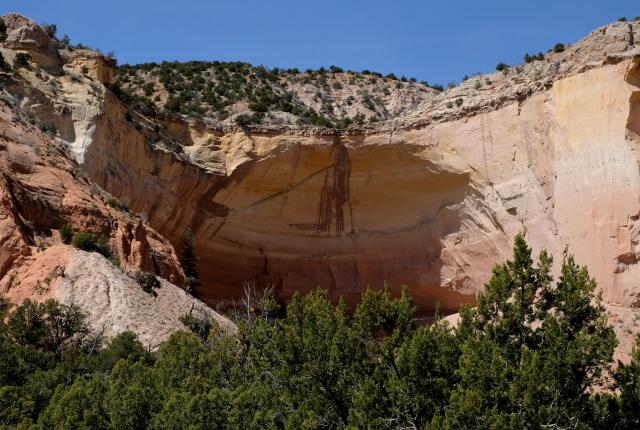
ABOUT 20 MINUTES NORTH OF ABIQUIÚ, in the Carson National Forest, Echo Amphitheater creates the clearest echoes I’ve ever heard. My daughter’s voice ricochets across the concave wall of pink and yellow sandstone that rises hundreds of feet into the sky. After a short hike to the cliff wall, we take turns calling out, listening as the sound bounces back to us. The deep red streaks on the cliffs, which look like dripping blood, are mineral varnish left by running water long ago. They add to the place’s eerie, almost spiritual quality. “A lot of people like to sing or chant or pray or yell—and it just amplifies,” says David Martinez, a battalion chief with the U.S. Forest Service. That clarity comes down to shape and surface. Water erosion carved the hard sandstone into a curved bowl that reflects sound waves instead of scattering them. Meanwhile, the smooth walls act as a natural amplifier, sending voices cleanly across the canyon face. Following a closure in 2024 for trail, picnic-area, and campground improvements—including new electric hookups and a water station—the site reopened last spring. “In the summertime, it’s a very popular place,” Martinez says, noting that artistically inclined visitors often come to paint the dramatic landscape on their way to and from Ghost Ranch, where Georgia O’Keeffe once lived. For others, the site carries a deeper resonance: It’s tied to the late activist Reies López Tijerina, who led an October 1966 five-day occupation of Echo Amphitheater as part of the land grant movement.
CARSON NATIONAL FOREST
Call on Echo Amphitheater, approximately 14.5 miles southwest of Canjilón via US 84 or 15 miles northwest of Abiquiú on US 84.