EARLY IN The Mystery of Chaco Canyon, a petroglyph appears on-screen as narrator Robert Redford discusses the harsh living conditions found in the canyon: “Yet here, ancient people chose to construct the center of their world,” he concludes. The small piece of rock art, located inconspicuously on Fajada Butte, depicts a semicircle pierced through the center by an arrow, which points toward a spiral that emanates from the half-circle’s straight edge.
It’s easy to miss the connection the first time you watch the 1999 documentary. (It’s available for free on New Mexico PBS at nmmag.us/pbs-chaco.) But in some ways, that’s the point. Chaco was designed to be impressive on an almost overwhelming scale. Three- and four-story-high buildings spread across miles of rugged landscape. Roads 30 feet wide run perfectly straight between them. So director Anna Sofaer, who rediscovered the butte’s sun dagger spiral in 1977, almost overlooked the tiny drawing too.
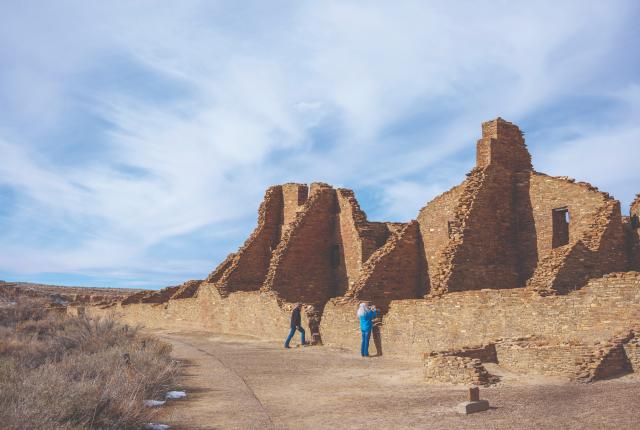
As the film progresses, we come to learn that the semicircle represents Pueblo Bonito, Chaco’s three-acre main structure, which contained up to 800 rooms and 30 kivas. And just as the central wall in that great house is perfectly aligned north and south, the arrow in the petroglyph bisects the semicircle and points toward the spiral, as if linking it to the heavens. Meanwhile, geological surveys of Pueblo Bonito’s east-west wall show it aligns perfectly with the sun’s path on the summer solstice. “It’s the middle of time,” Sofaer suggests.
Pueblo Bonito at Chaco Culture National Historical Park at night.
Photograph by Wayne Suggs.
What’s fascinating is how these details are all connected, providing meaning within Chaco and telling a story, constructed over 12 generations, about this place of physical, intellectual, cultural, and spiritual power. And yet, what we know about Chaco only seems to highlight how much we do not know.
It’s a sentiment that weaves throughout Elizabeth Miller’s “Beyond Belief” feature story as she walks among the buildings of Chaco Culture National Historical Park, camps under the night sky, and talks with people who have a deep connection to this place.
“It is not a ruin. It is not a park,” educator Jon Ghahate (Laguna/Zuni) tells Miller during their tour. “It’s the beginning of who we are as a human society.”
Maybe that’s why Chaco is so difficult to comprehend; why it is inspiring and humbling all at the same time; why it deserves protections both big and small; and why it’s worth returning to time and time again.
Read more: The Ancestral Puebloan culture that thrived in Chaco Canyon continues to reveal new signs of its reach and influence, even as it keeps some secrets.