IN 2019, DINÉ MULTIMEDIA ARTIST Eric-Paul Riege exhibited Hóló—it xistz at the Institute of Contemporary Art, Miami. In video documentation of the five-hour performance, Riege wears a masked headdress and a heavy cloak, its floor-grazing tassels tipped with bells that softly chime as he sways, shuffles, and tiptoes through the museum. He moves among smart-suited art dealers and women in madras shorts; gallery attendants politely tuck in their chairs as he silently glides past them. At one point, Riege triggers the automatic sliding doors, which open and close as visitors variously gawk, avert their eyes, or let out an uncertain giggle.
As Riege’s first solo exhibition at a major museum, Hóló—it xistz also brought about other firsts: his first flight, first glimpse of the ocean, and first time ordering an Uber. “I remember landing in Miami and being so nervous,” he recalls. That arrival marked his initiation into the contemporary art world, with its own pressures and protocols.
“The art world can be preoccupied with keeping things pristine,” he says. “My work is activated by human interaction, by touch, so things might get dirty. That’s part of it.”
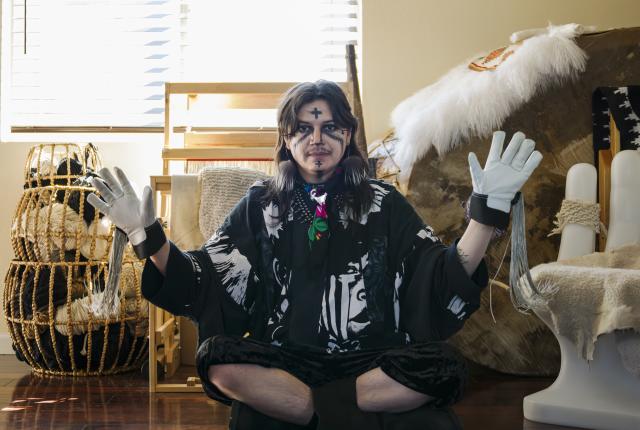
The multimedia artist uses a variety of textured materials in sculptures, performances, and collaged works.
Photograph by Tira Howard.
Since then, the fiber artist has received major grants and awards, appeared in international biennials, and exhibited at king-making institutions including the Los Angeles County Museum of Art and the Hammer Museum, in Los Angeles. Instead of fitting neatly into either Native or contemporary art categories, Riege’s work erases the boundary between them.
Drawing on traditional Navajo materials and techniques—alongside deliberately nontraditional choices such as faux fur and chemical dyes—he creates modular, sometimes wearable sculptures that are activated through interaction, even if the viewer is passive. Performance, photography, video, and collaged personal objects extend this textural language. Figures central to Navajo cosmology, such as Spider Woman, shape a creative ethos grounded in hózhó, a Diné worldview centered on balance and relational responsibility.
Working across performance and sculpture, everything Riege does is informed by his Diné ancestry. Born in 1994, he remains rooted in his hometown of Gallup, where proximity to family and matrilineal weaving traditions continues to shape how—and why—he works.
“+ [pronounced t’],” a 2021 installation of mixed fibers and materials at the Contemporary Arts Center in New Orleans.
Photograph courtesy of Eric-Paul Riege.
When Riege showed me around his downtown Gallup studio this winter, he had just received a prestigious USA Fellowship, which includes a $50,000 award. In his light-filled workspace—a converted duplex in the same neighborhood where Riege grew up—sheep hides, fabric scraps, foam pillows, yarn skeins, pieces of wood, and fragments of former sculptures are arranged in neat cubbies. An entire back shower is filled with carefully saved flats of cardboard.
“I’m a decorator at heart,” he says. “More is more. At the same time, I am my mother’s son. She was a schoolteacher, and I got her spirit of organization.” Riege’s favored palette of cream, charcoal, black, and wheat beige figures prominently in the studio; the effect is restrained, soft, and calming. “All of us love the feeling of diving under the covers and getting cozy,” Riege says. “I associate softness with comfort, and I want the viewer to see it this way too.”
Years ago, when he was waiting tables at the nearby Grandpa’s Grill, “There was this little kid who would come in and try to sell jewelry,” he remembers. “People weren’t willing to pay as much as they would next door at the pawn shop, where jewelry is under glass and sold by a white trader.”
The artist uses a mix of traditional Navajo and more unconventional fiber materials, with a focus on softness.
Photograph by Tira Howard.
The experience sharpened his awareness of how meaning and value are constructed. With its proximity to a handful of Southwest tribes, Gallup has served as a trading hub for hundreds of years. Anglo-owned pawn shops and trading posts set up here at the turn of the 20th century, boasting of curated Native goods and earning a reputation for taste-making that Riege questions. “Who’s to say what has value and why?” he asks. “Objects from Native culture tend to gain authority only once they’re placed under glass or validated by people outside the culture.”
Riege believes all kinds of things—stuffed animals, passed notes, little trinkets—have inherent aliveness and therefore contain value. “I look at everything as having a little heart or memory. It’s something kids do that I guess I never grew out of.”
His inclusive approach makes all kinds of materials fair game for art. “I love using ancestral materials like handwoven fiber and hand-dyed wool,” he says. “But I also like fake versions of the real thing. I don’t consider nonorganic materials like polyester yarns and paint from Hobby Lobby to be ‘less than.’ I like the old and new coming together.”
2025 installation view of “Eric-Paul Riege: ojo|-|óló,” David Winton Bell Gallery, Brown University.
Courtesy of the artist and the Bell/Brown Arts Institute/Photograph by Julia Featheringill.
His personal story also feels part ancient, part new. His maternal great-grandmother, Angela Ashley, was a master weaver and is a towering figure in Riege’s personal cosmology, since Ashley’s ancestors have lived in this region and its surrounding tribal communities for many generations. His German-American dad, Ken, is a Gulf War veteran from Ohio.
Growing up, Riege says, his friends and cousins were all female, as was his supportive circle of mom, aunties, and grandmothers. “I was this gay little boy who wanted to play with dolls,” he remembers. “My family treated me with so much love.” He learned to sew at his mother Retha’s side, at first in order to make his Bratz Dolls their own regalia and, later, to create what he calls “angsty artsy teenager clothing.”
As an undergrad at the University of New Mexico (UNM), Riege enrolled in Politics of Performance, an art course taught by Szu-Han Ho, a professor whose work explores embodiment and inherited history. Under Ho’s guidance, Riege began to understand his lineage in fiber arts through movement, approaching weaving as something that is activated by the body. Ho says this philosophical shift is marked by fearlessness. “The activation is about animating these installations—bringing the spaces he creates to life,” she says. “They’re not just sculptures. They’re connected to home, culture, and tradition, and Eric-Paul brings all of it into contemporary, everyday life.”
“Hóló—it xistz,” 2019, ICA, Miami.
Courtesy of ICA Miami/Photograph by Fredrik Nilsen Studio.
For his 2017 thesis exhibition at UNM, DiBÉ Hózhó Yitł’ó, Riege took on the role of a lost sheep, moving silently through a striking mixed-media fiber hogan he built at the center of campus. “When Eric-Paul is performing, there’s somberness, playfulness, and mystery,” Ho says. “Audience members don’t necessarily know what’s happening or how to engage.”
After a summer 2025 exhibition at Canal Projects in New York, Riege mounted his largest show to date, ojo|-|óló, at Brown University’s David Winton Bell Gallery. The fall exhibition grew out of his research in Brown’s Haffen-reffer Museum of Anthropology collections, where he encountered Diné objects in storage. “We’re unpacking these old artifacts, and I found a loom underneath some other stuff,” he recalls. “It felt buried alive.”
In ojo|-|óló, Riege brings the loom and other collection objects into dialogue with his own work, treating them not as static artifacts but as materials deserving of attention and renewed engagement. “Eric-Paul understands art as a living rather than static form,” says SITE Santa Fe curator Brandee Caoba, who has worked with Riege. “He reminds us that the work does not begin or end with the object but rather exists within the exchanges it generates.”
from left
Riege in performance costume. “….oo-O-oo-O-oo-O-oo-O-oo-O-oo-O-oo-O-oo-O-oo-O-oo-O-oo….,” 2021, a collaboration with Jeffrey Gibson at deCordova Sculpture Park and Museum.
Photographs courtesy of the artist.
ojo|-|óló traveled to Henry Art Gallery, in Seattle, where it opened March 14. Riege plans to visit with a large group of assorted family and longtime friends. “I like to swim between two beaches,” he says. “There’s family, craft, and inherited material on one hand, and then there’s the object and its life in the world—how people interact with it.”
Despite his success, the artist doesn’t see himself as a jet-setter. “I like the slowness of life in Gallup,” he says. “I like feeling like I’m home.” In Riege’s evolving cosmology, his inner world will always be a shining bead in an ever-changing arrangement.
Iris Fitzpatrick is consistently drawn to the Gallup region and its mix of people and ideas. She has written about art in New Mexico since 2011.