I’VE ONLY MET Judy Tuwaletstiwa a few minutes ago, but the Galisteo mixed-media artist and I are blinking back tears in her creekside studio. Leaning over Chaco Series, Tuwaletstiwa’s latest art book, we’ve just read her moving poem about the birth and loss of her son.
Sun pierces the skylight. On a worktable, pieces of jet-black glass shaped like a little girl’s dress catch the light. Along the wall, otherworldly masks made from Tuwaletstiwa’s own visage watch over a kiln waiting for its next firing. It feels intimate and elemental—and very Galisteo. “The basin bathes you in wonder, whether you’re meditating or just picking a tomato,” she says of what drew her and her writer husband, Phillip Tuwaletstiwa (Hopi), to the rural community south of Santa Fe more than 20 years ago.
But this valley along Galisteo Creek has been attracting inhabitants for thousands of years. Around AD 1300, the Tano and neighboring Pueblo peoples raised stone plazas and kivas here. After monsoon rains, potsherds still flash proof that creativity is the land’s oldest language.
The Chi Center offers a peaceful respite.
Fast-forward, and the roll call of past-and-present residents reads like an art biennial: minimalist legend Agnes Martin; feminist critic and village historian Lucy R. Lippard; conceptual giant Bruce Nauman; painters Harmony Hammond and Woody Gwyn; Chris Griscom (one of Shirley MacLaine’s healers), who opened the Light Institute; and even designer Tom Ford, who built a ranch here with Japanese architect Tadao Ando. Not bad for a place you could miss if you glance over to adjust the radio on NM 41.
“I think creative or spiritual souls are drawn to Galisteo for the light, the beauty of place, and the deep silence that informs,” Tuwaletstiwa says. “It is a land that invites one to expand one’s vision.”
Michelle and Ken Frumin welcomed that invitation when they left Dallas mid-pandemic and bought a 60-acre ranch. A small-but-mighty farm stand and bright teal picnic table mark the entrance to their ranch, El Cortijo, once home to The Elephant Man playwright Bernard Pomerance. “I knew nothing about farming,” Michelle says. “I just loved goats.” Their honor-system stand stocks piñon-cedar goat milk soaps, sourdough bread, and eggs that “sell out by nine,” she warns, “blink and they’re gone.”
Allan Houser’s "Mountain Echos."
Visitors linger by the stand and trade tips on what to see next in town because, as Michelle adds, “We’re only the second place to spend money in Galisteo—the first being Duende Gallery.”
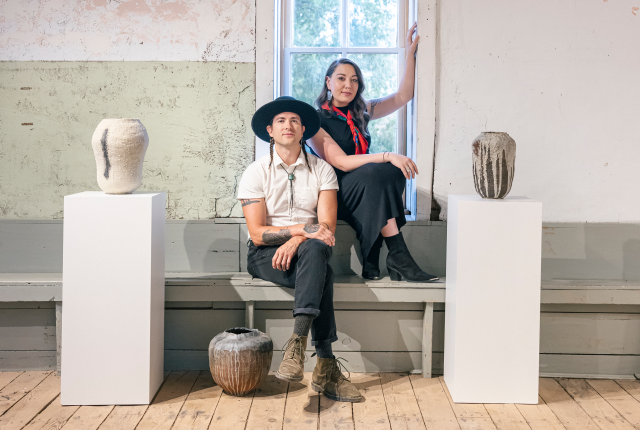
Which is exactly where the art-and-neighborliness thread culminates. In New Mexico’s oldest dance hall—now Duende Gallery—founder and artist Rob King (Choctaw Nation of Oklahoma) sets his clay vessels glazed in storm-cloud gray on worn floorboards that remember every two-step. “The seeds, the soil—my work is, literally, this landscape,” says the former physician, who trained Native doctors in Oklahoma’s Choctaw Nation, where he grew up.
For a back-road address, the openings are lively. “It’s a real scene,” says Jaime Herrell (Cherokee Nation), King’s partner and an agent for Native artists, who notes that everyone from MoMA curators to local ranchers attend.
Duende Gallery was once a dance hall.
“No one gets to be too cool here,” King adds. “I won’t tolerate it.” That spirit fuels the annual Galisteo Studio Tour (October 11–12), which has been attracting collectors and casual art fans to visit the 21 artist studios—including Tuwaletstiwa’s—in the village for more than 35 years. “I sold enough work from the tours to open the gallery,” King notes.
The spiritual side of the engine hums nearby at the Chi Center. Qigong master and retreat owner Mingtong Gu spent two years during the pandemic communing with the land and Grandmother Tree, a massive cottonwood on the 150-acre resort. “She told me my mission was to gather people,” he says.
Mingtong Gu at the Chi Center.
Gu promptly launched bi- monthly Magical Sundays—brunch with live music, slow-flow Qigong, and a quiet walk to the ancestral trees to pose your own questions. “Nature is the teacher, community is the sangha, self is god or goddess,” says Gu, who teaches Wisdom Healing Qigong, an ancient healing art he learned in China. “We foster all three here.”
Woven all together and I start to understand how this tiny place makes big things. I leave a little more inspired, a little softer, a little more human from the people and the land. As Lippard writes in Pueblo Chico, her second book on the history of Galisteo: “From its inception, Galisteo has been about the vortex of land and lives.”
SIDE QUEST
Across from the 19th-century train depot, the rambling Legal Tender Saloon is Lamy’s sole eatery (and closest restaurant to Galisteo). Under pressed-tin ceilings, you’ll find green chile smashburgers, red chile wings, key lime pie, and a bar that channels John Wayne’s 1939 Stagecoach. Grab a stool, order a local pilsner, and watch the afternoon train arrive across the street at the Lamy Train Depot.
WHILE YOU'RE THERE
Explore. This fall, the Santa Fe Conservation Trust cuts the ribbon on its Dovetail Trailhead, a fresh parking lot, an all-access one-mile loop, and a four-mile dirt track threading through 300 protected acres of piñon and sandstone within the Galisteo Preserve. “Galisteo is one of the areas where we’ve done the majority of our conservation,” says operations manager McAllister Yeomans. The trust also offers two annual Insider Tours in the area, where an archaeologist guides hikers past petroglyphs and Pueblo ruins.
See. Roughly eight miles from Galisteo, just off the Turquoise Trail, the Allan Houser Sculpture Garden is a must visit. The Chiricahua Apache sculptor translated Native stories into modernist bronze, steel, and stone. On 50 acres of juniper-dotted hills, more than 70 works meet the open sky. “My grandfather used his own face for the children and his sister for the mother figures,” says his grandson Sam Haozous, gesturing toward an eight-foot, obsidian-colored mother and child. Walk the paths, put a hand on the patina—no security guards, no ropes—just you, the breeze, and work that lives outdoors on purpose.
Learn. “Old-home feel with a lot of new thinking,” explains Chip Conley, a former hotel owner who chose the basin to open Modern Elder Academy (MEA) on a 600-acre ranch. Billed as the world’s first midlife wisdom school, MEA hosts three-to-five-day workshops for people navigating big life changes—from empty nest to cancer diagnosis. “People in transition come here to find what’s truly meaningful,” he notes.