“WHEN WAS THE LAST TIME you had a massage?” AnnaMarie Vaughan asks.
I am face down on the table in the attic of her cozy cabin just north of Taos. Afternoon light hits crystal suncatchers and throws small rainbows across the vaulted space. We have given ourselves a cushion of time to catch up, share notes on our experience as clinical counselors in training, and chat about her new space, creative challenges, and life shifts. And yet, this small, simple question as my treatment begins is the hardest to answer.
I feel my body tense, then I cringe-laugh into the face cradle. “Ugh, way too long,” I reveal, “like a year or more.” I had received some treatments in the meantime—regular visits to the chiropractor, a few acupuncture sessions—but those were for maintenance and function. I realize I have not been practicing what I teach as a somatic facilitator: the importance of pleasure, presence, and peace in our bodies and in our lives.
Bianca Correa grows and forages her own herbal remedies.
Vaughan warms her hands and waits a breath, then begins, gently and quietly. My fear of judgment is replaced by total attunement. For the next hour, I enter a state of surrender, relief, and gratitude.
I wonder about her approach, especially after experiencing such seemingly intuitive pressure and pace, as well as special attention to areas like my jaw, neck, and feet. “My hands listen first,” she says. “Those first compressions tell me vitality, and from there I am a guide for your body to do the healing.”
I ask how Taos has informed her work. “Come without expectations,” says Vaughan, who arrived here five years ago. “That’s how Taos shows her real face. It’s how a session works too.”
Taking this to heart, I leave without a plan—only a promise to recommit to receiving and to let Taos help me remember how.
With that in mind, I head to Paseo del Pueblo Sur, which takes me to a place that has been a clearinghouse for everyday care for more than four decades. Taos Herb Company began in 1981 with a simple charge from Robert L. Hawley, a local physician who listened to patients share what was working at home.
Hypnotherapist Alicia Boyes.
“Doctor means teacher [in Latin],” says Tina Hahn, Hawley’s daughter and one of three co-founders, alongside her brother and husband. “We started to preserve the elders’ remedies and to validate them where current studies could. We don’t diagnose or prescribe. We listen, share what we know, and let people decide.”
Hahn, who sold Taos Herb Company to longtime employee Chelsea Crawford in 2024, traces the shop’s roots to Taos itself. “There was a strong tradition among Hispanic families and at the pueblo of using herbs for medicine, especially before there were doctors here,” she says. “Part of why we started was to keep that knowledge alive as elders passed.”
Outside the shop, a bulletin board offers a glimpse at Taos’s variety of mystical- and wellness-centered offerings: conscious dance events, Reiki sessions, writing workshops, astro-cartography readings, and herb walks. Inside is an impressive selection of supplements, flower essences, tinctures, teas, gifts, and ceremonial items—and the buzz of conversation.
Folks inquiring about the effect of the altitude, digestive despair, or seasonal allergies are greeted with curiosity and provided with suggestions, not directives. Chlorophyll and electrolytes for skiers. Mullein for respiratory ailments. A new omega oil for your canine companion. Often what lands first is that someone listened.
“We ask questions,” Hahn says of Taos Herb’s approach. “How do you eat? When do you eat? How stressed are you? People want quick relief, and sometimes you need a doctor. Often you need patience. Participation is part of the medicine.”
Hahn, who continues to work at the shop, finds an important through line here. “Taos has changed, but the land and the traditions still teach,” she says. “Respect the pueblo. Respect the Hispanic families who kept these practices going. Be a good neighbor.” That is medicine too. “Things heal slowly, and we change slowly,” she adds. “There has to be some acceptance around that.”
AnnaMarie Vaughan at her studio.
THIS RESPECT FOR LINEAGE AND LAND ISN’T performative in Taos—it’s foundational. For more than a millennium, Taos Pueblo has anchored these sacred lands at nearly 7,000 feet in the Sangre de Cristo Mountains. In more recent decades, others have arrived: Hindu devotees drawn to the Hanuman Temple for more than 40 years, spiritual practitioners at the Lama Foundation since the 1960s, and Buddhist communities maintaining gompas in the hills, plus hippies, homesteaders, pagans, artists, and those looking for an alternative to more conventional lives.
What sets Taos apart isn’t just the breadth of traditions, but how its residents coexist on land that has always been sacred. This layering—Native, Hispanic, Anglo, and many other lineages—has created something rare: a place where wellness isn’t an industry import but woven into the cultural fabric itself. The best practitioners here understand they’re working on sacred ground and that humility shapes everything they do.
Bianca Correa’s dried juniper berries.
OFTEN, I SIT IN THE MANDIR, OR TEMPLE, AT the Neem Karoli Baba Ashram. Established more than 40 years ago on over 10 acres just minutes from the center of town, this, too, is Taos. Some days are quiet, others are not. During festivals, thousands of Hindu devotees from all over the world join in song, prayer, shared meals, and seva, or selfless service.
I have been coming here since before I moved to New Mexico seven years ago—in fact, the ashram was a motivation for doing so and definitely a reason that I stayed. Every visit is different, no expectations, yet always an opportunity to ground and to listen.
This same spirit is what draws me to sound healing with Jvala Moonfire, a maestra who works with crystal bowls and mantra in a way that feels like a bridge between prayer and physiology. “Through the bowls and chant we move from the running mind to the still place,” she tells me. “When breath regulates, the nervous system can reset, and what no longer serves can release.”
After decades in India, Moonfire moved to Taos, where the land feels equally sacred. “I had lived in caves, walked pilgrimages, practiced mantra and breath with my guruji along the Ganges,” she recalls. “When I finally came here, this was the one place I knew could hold me. The mountain felt like an old friend.”
She regularly offers bowls and chant to groups and individuals, but also as reciprocity, by singing to wind and waters so the place answers back in a living weave of prayer and ceremony. “Sound has been used since ancient times and in all lineages, all tribal people, all indigenous people,” she says. “These lands have resonated with the healing power of the drum, the healing power of the flute, the healing power of the footsteps that have danced the sacred dances of the Pueblo people.”
To her, Taos represents a living soundscape. “There is an unbroken chain of prayers, drums, and dances on this land,” she says. “I offer into that stream.”
Tina Hahn co-founded Taos Herb Company.
“TAKE A DEEP BREATH …” A VOICE SAYS ON KNCE-93.5 FM True Taos Radio.
I have lived in many places, but never somewhere with a recurring radio spot that reminds people to breathe. The ad, sincere and simple, is what I call “totally Taos.” And what is the thread between sound and self if not the breath?
“The first thing I pay attention to isn’t the story, it’s the breath,” says certified hypnotherapist Alicia Boyes. “There’s a moment when presence replaces performance. When the body signals safety, the subconscious becomes available. That’s where real change happens.”
Both in person and online, clients often arrive to consultations more frazzled than they realize. Boyes’s presence is grounded yet open, the kind that has you drop your shoulders and ready to lean in and share your secrets. Years in high-end hospitality honed her attunement to pace, room dynamics, and safety, which now anchors her clinical work.
Breath-led hypnotherapy and gentle somatic cues help clients downshift from overdrive, then she works with the patterns underneath. “I’m not the healer,” she says. “I’m a facilitator and a mirror. We start with regulation so the mind and body can work together. From there, people feel more resourced, empowered, and able to meet life with greater ease and inner steadiness.”
How does practicing in this mountain town shape that stance? “Taos isn’t a destination, it’s a relationship,” she tells me. “Arrive with humility and respect. Wellness isn’t a product. It’s a process of becoming more human.”
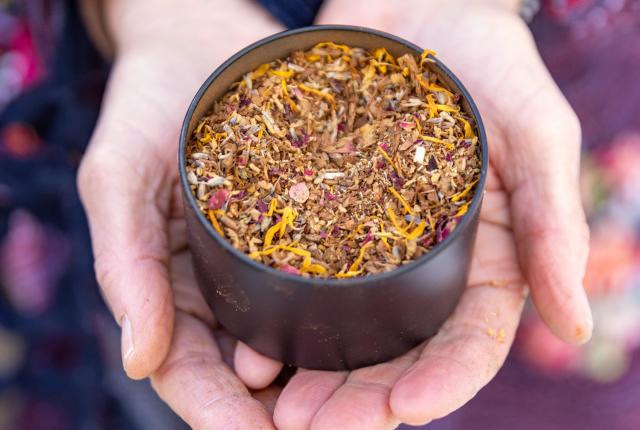
For herbalist Bianca Correa, the path to embodied wellness runs through the plants themselves. Founder of Mythos Libations, her apothecary offers steams, bitters, elixirs, and tinctures shaped by spagyric alchemy and story.
Correa grew up with Caribbean humidity. Learning the dry, windy rhythm of Taos has been an initiation, and it shapes her products and teachings. She grows most of what she bottles and forages the rest in small amounts from the northern mountains. Her concoctions are both tasty and effective: milky oats for frazzled nerves, honey-sweetened elderberry for the first sign of a scratchy throat. “Sagebrush is the quiet guardian of northern New Mexico,” she says. “In steams or baths, it opens the breath and clears what lingers.”
In addition to her product line, Correa’s craft weaves herbal alchemy, curanderismo, astro herbalism, gardening, and bodywork into education. “Everyone brings a unique gift,” she says. “What I offer is a collaboration in which I connect plants, land, and people so each person can begin to step into their own empowerment.”
Jvala Moonfire offers bowls and chants to the Río Grande.
FOR A DIFFERENT KIND OF GROUNDED CARE, I head to Antara Retreat, a nonprofit retreat center that caters to community through care and wisdom.
Located on five acres just west of the Neem Karoli Baba Ashram, the family-operated center integrates the sacred into everyday life. Founded and led by psychologist and contemplative teacher Jan Birchfield and her daughter, Dillon Runyon, an Ayurveda-informed chef and spiritual practitioner, the property is a vessel for satsang and other community gatherings, as well as retreats throughout the year.
Antara’s ethos is devotional and practical at once: Spiritual practice, psychology, and care for the planet share the same table. “People come to Antara from all walks of life,” Birchfield says. “We work from the idea that ‘as it is within, so it is without.’ We explore the contours of our inner world and then connect this to how we show up in our relationships, communities, and work.”
When it’s time to leave Taos but the yearning and learning are far from done, Angelika Heikaus centers deep healing through listening and continued practice.
Heikaus arrived in Taos in the 1990s from Berlin via Ireland, then California, after searching for “a backdoor into a different kind of life,” as she puts it. She raised her son here, built homes, got married, ran a permaculture business, then slowly shifted from designing land to tending community. She founded the GreenElder Project, a seven-month circle featuring a curriculum of work that is both practical and nourishing.
from left
Angelika Heikaus founded the GreenElder Project. A spiral labyrinth at the Lama Foundation.
Created for women, this remote and hybrid cohort is informed by her long-term commitment to the Danza de la Luna in Mexico, the Tonalamatl book of days, as well as her travels, practices, and other experiences. GreenElder is her version of a pilgrimage, with seasonal ritual, accountability buddies, and acts of service that anchor values in daily life. She is clear about respect: observe first, honor Taos Pueblo, learn the water lessons of the high desert, be a good neighbor.
“I don’t chase grand gestures,” she tells me. “Keep it simple. Listen. Show up.” Her style is humble and steady, her energy magnetic. Importantly, however, she does not call herself a healer.
“We become elders by practicing together, not by waiting to age,” she says. “An elder listens, serves, and stands steady for family, land, and the greater web.” She reminds newcomers to arrive with respect. Watch first. Learn the basics. “High desert healing is elemental. ‘Chop wood, carry water’ is a way of life for many here. And this, too, becomes medicine.”
Heikaus shares a story about hippies in the 1960s being invited into sacred ceremonies, only to be told to sit, be quiet, and watch—for as many as seven years. It’s an exaggerated tale, but the lesson holds. “As a newcomer, you don’t lose your sense of self,” she says. “But you do take the time to observe, honor, respect, and understand a particular way of life before offering big ideas or changes.”
This posture of humble arrival isn’t just Heikaus’s teaching—it’s somewhat of a local ethos, one that Moonfire echoed when we first spoke.
“I saw this poster on a billboard, and it said, ‘Don’t change Taos. Let Taos change you,’ ” she says. “The open skies, the great high-altitude desert mountains, the Río, this huge gorge chasm cutting through the land, the echoes of the ancient peoples and the current peoples who are here. It can change and expand you. It can slow you down. Don’t use these lands, come with humility to the history, with an openness to the magic.”
This phrase stays with me. At the first sign of crunchiness in the mind or the body, it’s easy to think we need fixing and that healing is an outside job. But healing is a conversation, and sometimes the most radical thing you can do is receive. Taos is good at teaching that, if you let it.
AROUND TAOS
Where to gather, rest, and recharge.
STAY. Hotel Willa offers 50 rooms in an artistically reimagined 1960s adobe motor lodge at the edge of the Taos Historic District. The on-site restaurant, Juliette, helmed by Taos Pueblo chef Johnny Ortiz-Concha, features craft cocktails and a well-provisioned menu rooted in the local landscape. At El Monte Sagrado, the Living Spa presents a curated wellness menu featuring services from local practitioners, including Ayurvedic massage, sound healing, meditation, and breathwork.
EAT & DRINK. Suchness chef Kevin Sousa’s contemporary American cuisine is vibrant and precise, while his general manager wife, Meg, curates a thoughtful beverage program. Nearby, Corner Office offers natural wines and seasonally driven small plates with European and Asian influences. Plaza-adjacent Tomorrow and Tomorrow, aka TNT, is a beloved sourdough bakery where the focaccia, boules, and bagels are favorites among locals (as well as pizza nights and First Friday DJ sets). Within Taos Pueblo, Dawn Butterfly Café occupies a gallery space first opened by the Bernal family in the early 1990s. The cozy off-grid cafe serves signature espresso drinks, fresh-pressed juices, and herbal concoctions surrounded by art honoring generations of Pueblo creativity. Soon, chef and owner CJ Bernal expects to open the cafe as a full-service restaurant just outside the pueblo.
EXPLORE. Gallery and event space Atelier 111 spans more than 2,000 square feet across two floors with thought-provoking art and immersive experiences such as a recent concert by pianist Katya Grineva. Muna’s Singing Bowl Shoppe sources metal singing bowls and gongs from Nepal with solo or duo sound healing sessions offered by owner Emily Davenport Luzzatto. Next door, Maharasha, a woman-owned lifestyle shop, features small-batch, low-impact everyday objects and hosts events like cacao ceremonies and new moon circles. Near Taos Herb Company, family-owned Taos Gems and Minerals is full of calming crystal energy, hand-strung mala beads, jewelry-making supplies, and more.