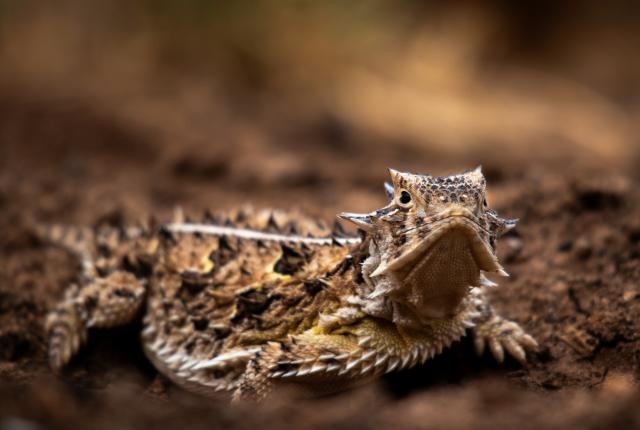
AS A BOY, Tom McCain could hop over the backyard wall of his home near Eubank and Menaul boulevards to explore what was then Albuquerque’s northeastern frontier. He looked for horned lizards and learned to gently place them on his palm, backside down, stroking their bellies until they fell asleep.
“We called it hypnotizing them,” says McCain, who’s now 80 years old and widely considered the Horned Toad King of the Southwest.
In his Albuquerque home studio, he’s crafted a national reputation for finely rendered metal casts of every type of horned lizard (aka horned toad or horny toad), while also boosting awareness of their precarious state. Habitat loss, agricultural chemicals, and homeowners’ destruction of the anthills that supply 80 percent of their diet have greatly reduced the population.
The short-horned lizard is found in higher elevations like Sandia Crest.
Photograph by Shutterstock.
“In Texas, California, and Wyoming, they’ve been pretty well wiped out,” McCain says. “And they’re a protected species here.” New Mexico law forbids willfully killing the squat-bodied critter, as well as collecting or transporting it to other states—a ban that addresses a once-thriving international trade. Several agencies monitor their populations, which have declined, though not enough to draw “endangered” or “threatened” status.
From 2017 until just recently, the Albuquerque BioPark oversaw a program to breed the lizards and return them to the wild. It isn’t easy. McCain notes that horned toads establish a relatively compact roaming area and, if moved, tend to freeze in place and then starve to death.
Four species call New Mexico home. The short-horned is found in higher elevations, like Sandía Crest; the Texas lives below 5,000 feet, especially in eastern New Mexico; the round-tailed dwells below 6,000 feet and is common in Albuquerque and Rio Rancho; and the regal lives in the southwestern bootheel.
The round-tailed horned lizard dwells below 6,000 feet and is common in Albuquerque and Rio Rancho.
Photograph by Shutterstock.
McCain can reel off a litany of what sets this lizard apart from all others. Its horns attach to the skull and can be used to dig underground. Most species deter predators, like raptors and coyotes, by spurting blood from ducts near their eyes. They can change skin color to match their surroundings. Their ancestors exist in fossil records as old as 30 million years. Indigenous people call them “grandfather.”
Some gift shops carry McCain’s works, but mostly he trucks them to state fairs and rodeos, although this year he’s recovering from a car accident that cost him part of his left leg. “I still might make the Fort Worth Rodeo in January,” he says.
McCain has soaked up every tidbit about horned toads told to him by Native Americans, Hispanics, and old cowboys. Each time he repeated a tale to customers, a cha-ching followed.
As one Navajo tale goes: Long time ago, Horned Toad decided to grow a corn crop. Just as it ripened, Coyote came along, grabbed an ear, and chomped it down. “Hey!” Toad cried. “That’s my corn!” When Coyote took another ear, Toad leapt onto it. Coyote gulped it all down. From inside Coyote’s stomach, Toad did the only thing he could and stabbed with his horns. “A-oooo!” Coyote howled. “That hurts!” Toad crawled from the stomach, stabbing along the way, until he reached Coyote’s throat, making it choke and cough until he spit Toad out.
“Look at the fur of coyotes,” McCain says. “Some of them—not all of them—have a red spot on the neck. That’s where the horned toad stabbed them.”
Read more: New Mexico’s nine National Wildlife Refuges offer safe havens for creatures big and small—and unforgettable encounters for the humans who visit them.
Sharpen Your Horns
Learn more about horned lizards, conservation efforts, and Tom McCain’s sculptures at hornedlizardcreations.com.