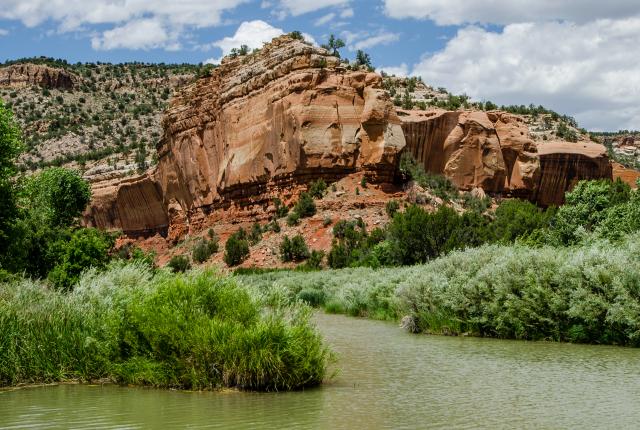
For millions of years, the Canadian River patiently penned one of New Mexico’s most remarkable landscapes. It composed a story of sandstone, forest, wetland, and wildlife along the banks of a green ribbon of water beneath the open prairie.
The Canadian River winds beneath the sandstone cliffs of Mills Canyon.
A SLOW PLUME OF DUST HANGS behind my truck, then dissolves with the wind. For miles, the shortgrass prairie of eastern New Mexico offers little beyond itself. Side oats, blue grama, buffalo grass, and purple three-awn bend in restless waves. Fence posts lean against the horizon. A defunct windmill slurps water from the aquifer below. Cows cluster. Meadowlarks sing from the wire. A pronghorn pauses, then drifts back into the grass. And the sky, the yawning blue sky. Sun. Grass. Distance.
The gravel road is rough. I’d turned onto it just past the ghost town of Mills, where trees poke from roofs, vines blanket house walls, and tumbleweeds pile on porches. I park at the empty upper Mills Canyon Campground and crawl from the truck, stiff from the two-and-a-half-hour drive from Taos. The canyon rim is close enough, just through the pines. It’s not that the wide prairie gradually surrenders here. Rather, it simply disappears.
At Mills Canyon, the Canadian River threads through an almost thousand-foot cleft in the earth, a green corridor stitched into walls of red and orange Jurassic and Triassic sandstone folded beneath the plains. The canyon itself dominates the landscape, the visible expression of water at work far below. From the forested Cretaceous cliffs of the canyon’s rim, wind rushes upward carrying the refreshing scent of cottonwoods.
The jaw-dropping gorge on the Kiowa National Grasslands, southeast of historic Springer, has hosted me many times. I was first drawn by the wild diversity of birdlife in the 78,000-acre canyon. Later, it was the geology and the solitude. Eventually, it became the deeper story of the place that pulled me: the tale of a river that carved an often-overlooked but fertile world occupied by red and gold cliffs, thick forests, abundant wildlife, human dreams, and ancient stories.
Hikers explore the river corridor, where water supports a unique concentration of plant and wildlife habitats.
SUNSCREEN, HAT, BOOTS, SUNGLASSES, and water—lots of water. I shoulder my pack and start down the road into the canyon toward the lower campground and the historic marker. It’s a steep, four-mile rutted road of sharp turns and sharper rocks, requiring a high-clearance vehicle. My truck can make it and has before. But on this visit, I walk the descent, eager for the diversity of birdlife revealed along the way down. The road itself is a transition zone. The grasslands give way to ponderosa and Gambel oak, then piñon and juniper, and finally cottonwoods along the river. This improbable gathering of habitats is what draws so many different birds to Mills Canyon.
“Mills has nearly 160 recorded species,” says Tony Godfrey, author of the locally published Birding & Nature Trail Northeastern New Mexico. “Out here, the plains meet the mountains, and the south meets the north. It’s kind of like fishing. You never know what you’re going to get, but you’re going to get something wonderful.”
The wind that swept unchecked across the grasslands loses its edge among piñon, juniper, and Gambel oak. The scent of warm sandstone fades to the butterscotch aroma of ponderosa pine. Lizards vanish into cracks in the rock. Ravens drift below, calling. Each switchback feels less like a descent than an unfolding. The canyon reveals another layer of itself with every turn.
The remains of Melvin Mills’s hotel recall a ranch and orchard enterprise that included more than 14,000 fruit and nut trees.
Near the bottom, I sit by a cottonwood-sheltered pool to photograph a blue grosbeak, then a summer tanager, a vireo, and an oriole. Dragonflies and damselflies dart back and forth. While spring and fall bring migrating songbirds and cooler temperatures, summers offer wildlife shade and pools of water along the canyon walls.
The Canadian River gathers habitats that rarely meet so closely: shortgrass prairie, piñon-juniper woodland, ponderosa-forested cliff faces, cottonwood- and willow-dominated riparian forests, springs, wetlands, and flowing water. Together, they support an astonishing array of life within a narrow corridor beneath the plains.
“It’s not just the location,” Godfrey says. “It is the diversity of habitats all packed into one place. And, of course, the year-round water. Out on the plains, water is like a magnet.”
After the long descent, the canyon floor opens. Cottonwoods cast deep shade across the floodplain, leaves flashing silver in the breeze. Canyon wrens, yellow-breasted chats, and lazuli and indigo buntings fill the morning with bursts of song. Deer tracks press into damp sand beside the river. A sinewy snake swims the current in rapid curls.
“Out here, the plains meet the mountains, and the south meets the north.”
author Tony Godfrey
TENS OF MILLIONS OF YEARS AGO, northeastern New Mexico was covered by a shallow inland sea and coastal plain into which numerous rivers poured colorful sedimentary deposits. Eons later, volcanic eruptions fractured and reshaped these sedimentary deposits, building buttes, plugs, and mesas. Then came the water, cutting through it all.
As I stand by the river, the geology is visible in the walls above: layers of sandstone tilt, warp, and weather, exposing the sediments of ancient seas, shorelines, and floodplains.
“The Canadian and its tributaries have carved out a window into the geologic history of northern New Mexico,” says Paul Bauer, emeritus principal geologist at the New Mexico Bureau of Geology and Mineral Resources. “The Canadian has an enormous high-elevation drainage area with plenty of power to excavate such a canyon over a few million years.”
As I follow the waterway, it isn’t difficult to imagine summer thunderstorms turning arroyos to torrents. Winter snowmelt slips through fractures in the rock. Cottonwood roots pry apart stone one hairline crack at a time. Gravity finishes what water begins. Mills is an unfinished landscape, evolving one season to the next.
“Over geologic time,” Bauer says, “the canyon is likely to deepen and expose the next-older sedimentary strata.”
Golden tuft alyssum blooms against the layered Mesozoic sandstone of Mills Canyon.
WHEN MELVIN WHITSON MILLS ARRIVED at the canyon on a bright day in 1881, he imagined a future of personal prosperity. A politically connected lawyer, mining entrepreneur, district attorney, rancher, and land speculator, he aspired to create something new. For 20 years, Mills did.
A photograph from that era is difficult to reconcile with where I stand today. In the image, rows of trees fill the floodplain. A bearded man wearing hip waders stands, shovel in hand, ankle-deep in irrigation water diverted from the river, tending the flow that made this unlikely garden possible.
Mills planted more than 14,000 fruit and nut trees: apples, peaches, pecans, plums, pears, cherries, apricots, walnuts, and almonds. He planted vineyards and vegetable gardens. He built irrigation ditches, ranch buildings, a suspension bridge, and eventually a hotel that welcomed travelers eager to experience the canyon’s abundance.
That utopia was brief. In 1904, the Canadian reminded everyone who actually ruled this landscape. Floodwaters swept through, destroying most of the orchard, the bridges, irrigation works, and much of the thriving settlement. Mills died in 1925, having lost the fortune he once imagined.
More than a century later, a sandstone skeleton of Mills’s hotel remains, baking in the sun. I stroll through the gap of the old front door and squat in the shade beside what had been the parlor fireplace, peering at the sky through empty window frames.
The canyon still carries traces of Mills’s ambition. The irrigation ditches remain visible, and several large apricot trees grow alongside volunteer apples, descendants of the orchard that once transformed this river valley.
The canyon draws bird species like the summer tanager.
LONG BEFORE ORCHARDS, HOTELS, OR market towns, people repeatedly utilized Mills Canyon. The wide-ranging Kiowa people, migrating from the Missouri headwaters, came to call this place home. Archaeologists have documented scatters of chipped stone, walled fireplaces, a large rock shelter, and panels of petroglyphs and pictographs, including images attributed to the Comanche Nation. Together, they record generations of people camping, hunting, working stone, and seeking shelter and dependable water.
For modern travelers, there is no single way to experience Mills Canyon. “For my wife and I, it’s the peace and quiet, the dark skies,” Godfrey says, “and the chance of seeing something totally new.”
Over the past decade, the rock climbing community has discovered the challenges carved into the cliffs and formations. “The geology has certainly created the world-class climbing and bouldering opportunities,” Bauer adds, “with the nicely weathered, overhanging boulders of Mesozoic sandstone.”
Thankfully, there are no services—phone or otherwise—at Mills. Visitors must bring plenty of water and be prepared to bushwhack, as there are no formal trails. Rattlesnakes are not uncommon.
A morning can easily disappear wandering the remnants of Mills’s ambitious orchard, following the river beneath towering cottonwoods, or simply sitting beside the water while canyon wrens trade songs across the sandstone walls and a beaver tends the river.
Every trail, every ruin, every birdsong, and every stand of cottonwoods eventually leads back to the same place: the Canadian River.
One of eastern New Mexico’s largest semiprimitive landscapes, Mills Canyon includes 7,466 acres without roads.
AS WITH RIVERS THROUGHOUT THE West, the Canadian was dramatically altered by the arrival of Euro-Americans. One hundred and fifty years of overgrazing, agriculture, invasive trees, and the extirpation of native species like wolves and beaver altered riverbanks, weakened the entire watershed, and transformed the ecology of Mills Canyon.
By the 1940s, tamarisks and Siberian elms choked out native cottonwoods and willows. Riverbanks hardened. Erosion increased. Floods became more frequent and more destructive. The intricate relationship between water, soil, vegetation, and wildlife unwound. For visitors, this meant less water, brush-choked banks, and a nearly silent landscape. The river remained, but the world it had built over thousands of years grew a little less diverse with each passing decade.
Fortunately, that’s not what visitors encounter today.
Beginning in the early 2000s, a broad coalition of state, federal, private, and nonprofit partners launched the Canadian River Riparian Restoration Project, a watershed-wide effort to remove invasive species and replant tens of thousands of native willows, cottonwoods, shrubs, and grasses. The goal was not simply to restore scenery. It was to revive the river’s natural functions and once again allow it to shape the living world along its banks.
Much of that work centered on Mills Canyon. After removing dense stands of invasive tamarisk and Siberian elm, crews planted more than 58,000 willow stems, nearly 1,000 cottonwood poles, and hundreds of native shrubs and trees along the Canadian River through 2021.
from left
The remains of Melvin Mills’s ranch house survived the 1904 flood. A windmill stands guard.
I’ve watched the restoration work for years. The changes, unfolding at the pace of rivers, were not dramatic. Cottonwoods slowly rose above their protective cages. Willows spread across banks once choked by tamarisks. Beaver returned to some reaches, helping sustain the new vegetation.
“The Canadian River is not an isolated ribbon of water,” says Mark Allison, executive director of New Mexico Wild, a nonprofit that has long pushed for protections for Mills Canyon. “The Canadian is a living corridor connecting the mountains of northern New Mexico with the grasslands and plains to the east. Protecting and restoring the river means protecting those landscape-scale connections that wildlife and people depend on.”
I leave the ruins of the hotel and hike down among the young cottonwoods, protected in circles of wire. I follow a vireo into a thicket of willows shading quiet backwaters. Just beyond the bend, a beaver dam stretches across the stream. It appears to be no more than a tangle of willow stems, mud, and branches, but the dam is, in fact, an engine of the canyon’s renewal. Behind it, the river slows and spreads, trapping sediment that nourishes sedges, the young cottonwoods, and the dense willow thickets that have returned since restoration began.
“Re-establishing native riparian habitat is important for a host of reasons,” says Reid Whittlesey, restoration director at Rio Grande Return, a key partner in the project. He ticks off benefits that include improved habitat for game, better water quality, and enhanced drought resiliency.
That’s especially important as severe climate change continues to alter our landscapes.
“Any area in New Mexico that has surface water is a precious resource that must be protected, or we will lose them,” says Levi Irwin, district ranger for the Kiowa and Rita Blanca National Grasslands.
Rains wash across the prairie.
EVENING SETTLES OVER MILLS CANYON. It takes me over an hour to trek back to the rim, where I set up camp, then sit with a cold beer.
The wind softens and the sandstone begins to glow with the deep reds and golds of the day’s last light. Shadows climb slowly toward the rim while the river flows beneath the cottonwoods, hidden now except for the occasional green shimmer where the current catches the sun. Lightning brims across the eastern rim of the prairie. Above me, only stars.
Most judge the prairie. Flat. Dull. Lonely. But these are just shallow first impressions, and I no longer believe in first impressions. There, tucked among the ponderosas, I know there is a river moving, patiently shaping stone as it has for millions of years.
Mills Canyon reminds me that the most remarkable landscapes are not always the ones above the horizon. Sometimes they lie beneath, waiting for water and time to write what has been there all along.
Explore, refuel, and settle in around Mills Canyon.
Do.
Hiking and picnicking at the lower campground and horseback riding from the rim area are common draws, along with birding, wildlife watching, riverside ramblings, and stargazing. Keep an eye out for golden eagles, canyon wrens, and riotous flocks of piñon jays in the fall. The Forest Service recommends a high-clearance vehicle along the rugged and steep Mills Canyon Road. Cars and vehicles towing trailers should remain at the rim. The nearby ghost town of Mills adds another glimpse of the region’s boom-and-bust history. Climbers can find nearly endless opportunities for bouldering in Mills and nearby Mesteño and Beaver canyons. For sites and routes, a second edition of New Mexico Bouldering (Southwest Bouldering Guides) is expected out this year.
Eat.
Mills Canyon has no food, fuel, or drinking water, so arrive well supplied. Travelers coming through Springer can stop at the Depot at Springer Station for breakfast burritos, burgers, sandwiches, pizza, steaks, coffee, and other hearty road-trip fare. “We’ve got a comfy stop for a weary traveler,” says owner Melissa Gore. Zayra’s Café offers hearty homestyle food, including breakfast burritos, burgers, and green chile. Roy provides a couple of small-town dining options, including Twisted Toppings Pizzeria and Claudia’s Coffee Shop, both operating out of Ma Sally’s Mercantile. Hours and availability can change quickly in this corner of New Mexico, so call ahead, and carry more food and water than you expect
to need.
Stay.
For the full Mills Canyon experience, camp for free either beside the Canadian River at the lower campground or on the rim at the upper campground. The lower Mills Canyon Campground has 12 primitive sites at 5,160 feet, while the rim campground offers six sites accessible to RVs and trailers. Both have vault toilets but no potable water. Those looking for a bed and hot shower can overnight in nearby Springer at Springer Station, a renovated lodging in the heart of town, or the locally owned Broken Arrow Motel. RV travelers will find full-hookup sites at Santa Fe Trail RV Park. The restored Sundance Inn, in Roy, offers modern guest rooms inside an early-20th-century Territorial-style building about 10 miles south of the Mills Canyon Road junction.