


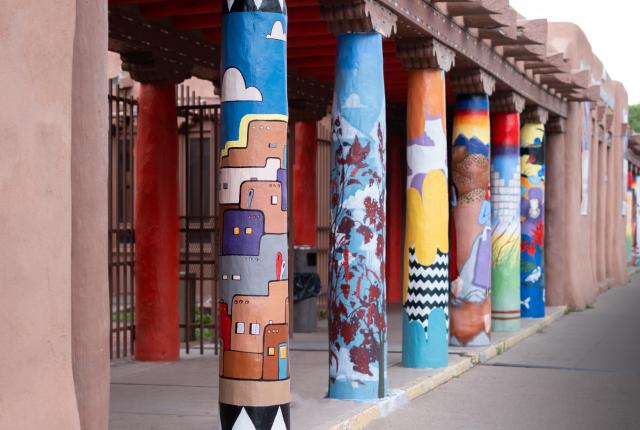
“WHAT’S DIFFERENT HERE is that you can really see what Indigenous artists are doing today,” says Patsy Phillips (Cherokee Nation), director of the IAIA Museum of Contemporary Native Arts (MoCNA). Although the institution is housed in a 100-year-old Pueblo Revival–style building in the heart of downtown Santa Fe, MoCNA’s focus is on the here and now. The roughly 10,000-piece collection includes works in almost every medium, created from 1962 to the present day. “Our exhibits reflect Native communities and what’s happening in them,” Phillips says.
The Institute of American Indian Arts (IAIA) was founded in 1962 and launched the museum a decade later. What began as a collection of IAIA-student-honors-program works and donations from private collectors and artists has grown into the premier institution for exhibiting, collecting, and interpreting the most progressive works of contemporary Indigenous artists. Some of the world’s best-known Native artists are represented in the collection, including pieces by painter T.C. Cannon (Caddo/Kiowa), beadwork artist Marcus Amerman (Choctaw), multimedia artist Rose B. Simpson (Santa Clara Pueblo), and painter Fritz Scholder (Luiseño).
Recent decades have also seen the museum’s focus expand to include representation from international Indigenous artists. Last year, for instance, the museum presented an Indigenous Taiwanese exhibition. “What we have found is that all tribal communities face similar issues,” Phillips says. “We’re able to educate people about what’s happening in Indigenous communities globally.”
The museum’s rotating exhibitions showcase varied and fresh views on Indigenous life today. “We don’t often see a lot of international Indigenous contemporary art exhibits in the United States,” says Dr. Shelly C. Lowe (Navajo), president of the Institute of American Indian Arts. “The museum has done a very good job creating opportunities for international Indigenous artists to have major exhibits.”