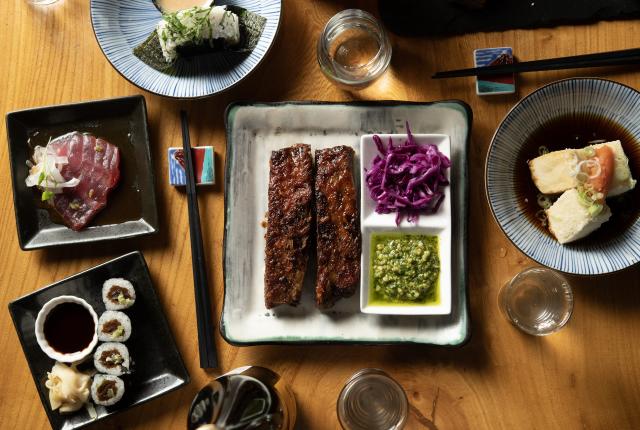
THE SERVER ARRIVES with a bottle of Chokaisan Junmai Daiginjo Nama sake and a look of knowing anticipation. He sets down a glass, leans in slightly, and begins to chant as he fills it. “Oooohhhh-to-to-to-to-to-to…TOOOOH!”
Before I can ask what’s happening, he keeps pouring, past the rim, until cold, clear sake spills over into a small ceramic dish below. He looks up, satisfied and slightly gleeful—like he’s just let me in on a secret.
“To welcome the choose-your-own adventure,” he says, “it’s tradition to kiss the glass.” I comply, bending to meet the glass and slurping hands-free, like it’s the most dignified thing I’ve done all week. In Japan, this is called mokkiri—a style of service in which sake is poured past the rim into a small wooden masu box, the overflow a deliberate act of abundance, prosperity, and the host’s generosity.
Mokkiri-style sake service distinguishes Izanami’s afternoon happy hour.
It’s 3:03 p.m. on a Monday afternoon. I’m sitting at the patio bar at Izanami restaurant on the grounds of Ten Thousand Waves spa and resort, in a seat overlooking the Sangre de Cristo Mountains on a sun-kissed day. The Chokaisan sake I’m sipping uses a unique dianthus flower yeast and carries hints of cotton candy and berry notes. A couple is celebrating their 25th wedding anniversary to my right, and two friends—both young moms—are on my left, enjoying a well-deserved spa respite. What’s not to be happy about?
Izanami—a sophisticated izakaya, or Japanese-style tapas restaurant—launched its early afternoon happy hour last summer. It’s become one of Santa Fe’s most talked-about, in-the-know dining rituals. The format is simple: Arrive at 2:45 p.m. to wait in hopes of claiming a seat on the mountain-view deck or inside at the glowing Squid Bar. Order a craft cocktail, like the slightly tart lychee martini, or a non-alcoholic drink—the strawberry shrub made with vinegar and club soda is quite refreshing—and then let the kitchen come to you. Every 15 minutes or so, a server appears with an alluring new small plate. You take it, or you don’t. That’s the beauty.
“You will get between 10 and 12 food items,” says chef Kiko Rodriguez, who has helmed Izanami’s kitchen for a decade. “If you don’t like something, you just wait for the next one.”
from left
Server Jose Guzman pours sake; Miso-glazed hamachi.
It’s dim sum service—that Cantonese tradition of plates wheeled through the dining room on carts, taken or passed at a diner’s whim—applied to a Japanese izakaya at high altitude. This happy hour is, without exaggeration, one of the most fun ways to spend an afternoon.
There’s something inherently engaging about it, even dramatic, as every few minutes the room gets a little jolt of excitement from tuna temaki hand-rolled like an ice cream cone; hamachi sashimi with jalapeño and cilantro sprouts; eggplant split down the middle, glazed with miso, and crowned with sesame seeds; or sweet shrimp tempura with a pineapple-habanero dipping sauce. Rodriguez doesn’t telegraph the menu, except for a lone chalkboard with a few handwritten teasers vaguely listing a shiso onigiri or beef itame.
“You never know what to expect,” says co-owner Deborah Fleig, who also serves as the restaurant’s sake sommelier and importer of rare sake from Japan. “It’s like a little dinner theater.”
This spring, the lantern-lit restaurant expanded its happy hour offerings to include two distinct experiences: the afternoon dim sum service (3 to 5 p.m. daily, except Tuesdays) and a new late-night happy hour from 9 p.m. to close, featuring half-price versions of the restaurant’s most popular dishes, including the grilled avocado, salmon rolls, karaage (an elevated take on chicken nuggets) with spicy mayo, and Rodriguez’s signature six-hour, sweet chile-glazed pork ribs.
from left
The kanpyō roll features cooked gourd; Cristina McIlroy watches a mokkiri-style sake pour.
“We are one of the only places in town open past nine,” Fleig says. “If you get out of a show at the Lensic, or your spa treatment runs late, or you just want to keep the night going, there’s nowhere to go. We decided to do something about that.”
While the 3 p.m. regulars skew toward people who can take a weekday afternoon off (“Retirees, for sure, or people on holiday,” Fleig says), the late-night set includes the after-show crowd, post-shift restaurant workers, creative night owls, and spa guests who worked up an appetite in the hot tubs.
Whatever happy hour suits your circadian rhythm, the sake experience is a must. Fleig spends nearly a third of the year in Japan cultivating relationships with brewers for her prolific import business. The restaurant claims to have the largest sake selection in the United States, with roughly 80 to 100 labels on the menu at any given time. The list includes around 15 nama, or unpasteurized, “still alive” sakes, a rarity that you’d be hard-pressed to find even in Japan. (A new spring-release rosé sake, Tenko; a KID Junmai; and anything from Kaze no Mori are just a few rare sakes to try now.)
from left
Izanami is nestled in the Sangre de Cristo Mountains; Co-owner Deborah Fleig and chef Kiko Rodriguez.
“If you show our sake list to brewers in Japan, they can’t believe it,” Fleig says. During early or late happy hour, glasses of sake run about $9, or roughly half price, providing a great excuse to expand your sake knowledge.
While waiting for the next course, I seize the educational opportunity and order a second glass. The “ototo” ritual is technically for first-timers, but I’m not above asking for a repeat performance. Besides, the mountains haven’t moved. The sake is cold. Every seat is full, yet the vibe is chill. In the kitchen, Rodriguez is deciding what comes next. And there’s nowhere else in the world I want to be right now.
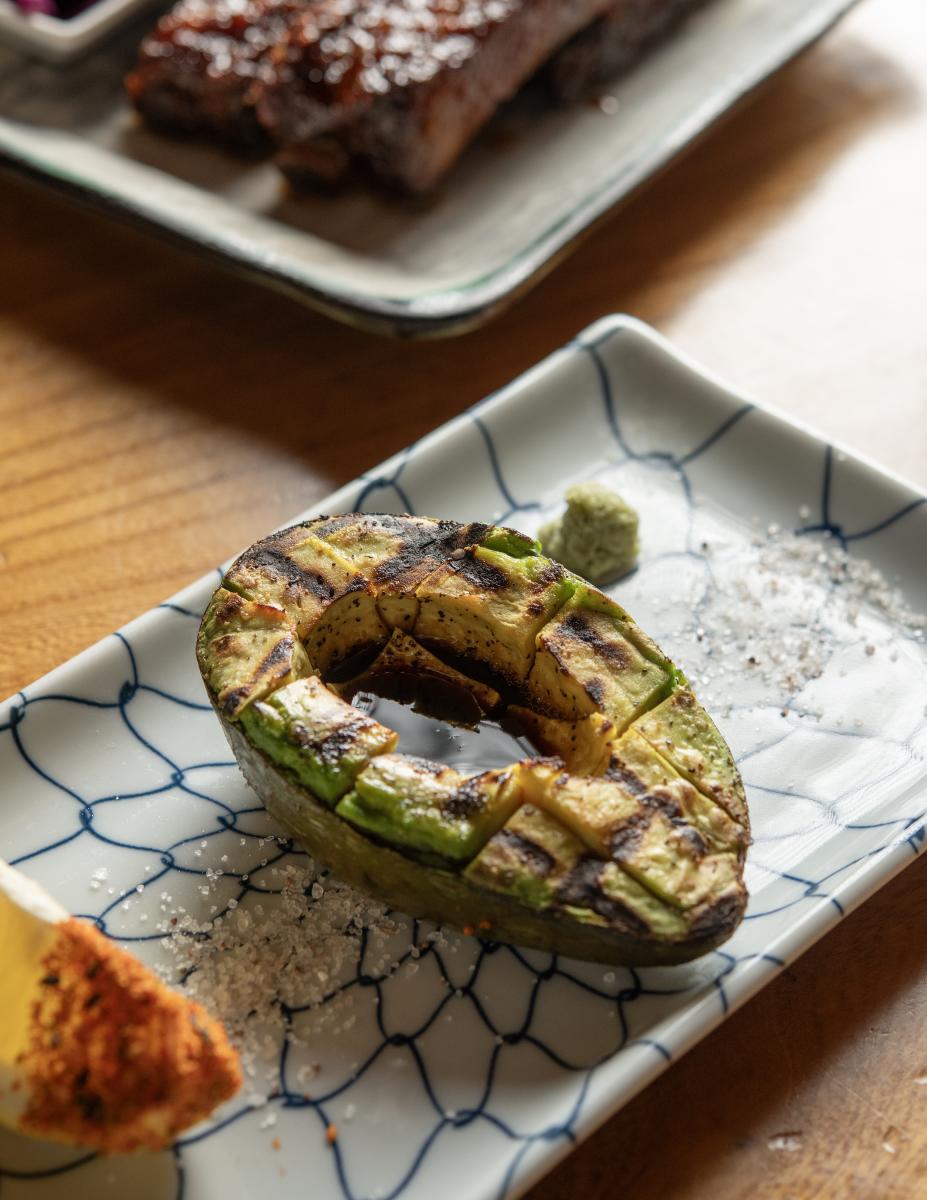
GRILLED AVOCADO
This traditional Japanese dish is warm, creamy, and one of Izanami’s most popular items. When soaring avocado prices forced the Santa Fe restaurant to temporarily remove it from their menu a few years ago, a revolt nearly ensued, says co-owner Deborah Fleig. “It’s a very simple recipe,” says chef Kiko Rodriguez. “But it comes down to using the best avocado at its peak ripeness.” Rodriguez recommends using Hass avocados and fresh wasabi when available because it “offers a cleaner, more nuanced heat than prepared wasabi paste.” Serve the smoky and citrusy appetizer alongside grilled seafood, yakitori, or a chilled sake pairing.
- 2 large ripe avocados, halved and pitted
- Extra-virgin olive oil spray
- 1 teaspoon kosher salt, or to taste
- 1 teaspoon freshly ground black pepper
- 4 tablespoons smoked soy sauce (or premium soy sauce)
- Fresh wasabi, finely grated, to taste
- 1 lemon, cut into 4 wedges
- Shichimi togarashi (Japanese seven spice) to taste
Makes 4 servings
1. Preheat a grill to medium-high heat. Using a sharp knife, lightly score the flesh of each avocado half in a crosshatch pattern, being careful not to cut through the skin.
2. Coat the cut surfaces with olive oil spray. Season with salt and black pepper.
3. Place the avocados cut-side down on the grill. Cook for 3–5 minutes, or until distinct grill marks develop and the flesh is lightly caramelized.
4. Carefully turn the avocados over and grill skin-side down for another 3–5 minutes, until warmed through. Transfer to serving plates.
5. Spoon about 1 tablespoon of soy sauce into the cavity of each avocado. Top with grated wasabi and squeeze a lemon wedge over each half.
6. Finish with a light sprinkle of shichimi togarashi; serve immediately.