


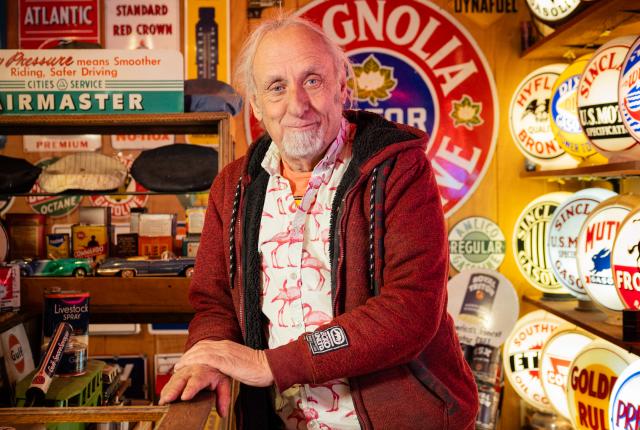
HISTORIC PRESERVATIONIST Johnnie Meier is an alchemist of sorts, restoring the magical glow of yesteryear’s neon signs along New Mexico’s Route 66. He’s also the owner of the Classical Gas Museum, in Embudo, a quirky collection of colorful vintage gas pumps, old vehicles, neon signs, and other artifacts of America’s roadside culture that’s hard to miss on NM 68 between Santa Fe and Taos. The dazzling neon signs he’s helped to restore include the KiMo Theatre in Albuquerque and most of the neon signs in Tucumcari, including Tee Pee Curios and La Cita Restaurant.
I spent 25 years at Los Alamos as a scientist, and my specialty was lasers.
There’s little difference between gas lasers and gas tubes. I understood immediately how neon signs worked, down to the atomic level.
It’s such simple technology, and that’s why neon proliferated all over the country.
I really responded to the art of it and then the history.
The signs played such a cultural role in representing the history of New Mexico. They had meaning. I didn’t want to see that meaningfulness lost.
About 20 years ago, I spearheaded a project with a $50,000 grant from the National Park Service. We went to a local PBS affiliate to film the restoration of 10 classic neon signs in the state. The project resulted in the Emmy-winning PBS documentary Route 66: The Neon Road.
These one-of-a-kind neon signs have come to be appreciated as great examples of American folk art.
They are sculptures, very figural in their representation. I was fascinated how they captured local themes like cowboys, Indians, Mexicans, the Wild West. They were snapshots of culture.
What you have are pearl whites, ruby reds, emerald greens, and sapphire blues all wrapped in crystalline. It’s street jewelry.
There’s a postcard that describes Central Avenue in Albuquerque as “a galaxy of neon.” I love this phrase.
I think Route 66: The Neon Road was a catalyst. It generated a lot of interest in restoring the signs.
These signs are touchstones for a lot of communities. They contribute to the identity of the communities. When they lose these touchstones, the whole community is impacted.
Some towns along 66 in other states celebrate the single neon sign that’s still standing. But go to Tucumcari—they have nearly a dozen. Albuquerque has more than a dozen.
New Mexico really has the premier collection on all of Route 66.