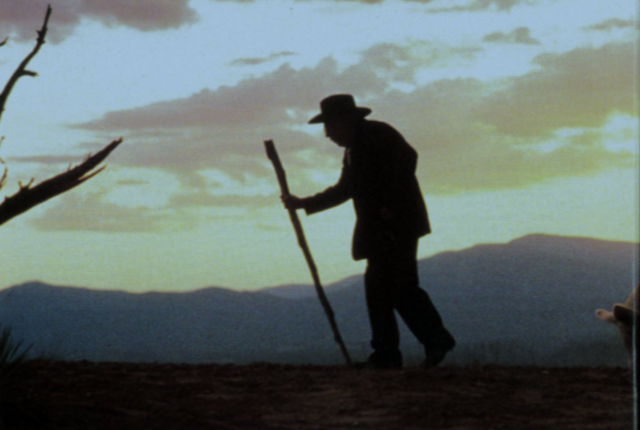
A STATE OF WAR grips Truchas. Trucks by the dozen round the hairpin curves on the narrow mountain road leading into the village. Guards stand sentry at strategically placed barricades. A helicopter circles overhead, drowning out all conversation as it drops thousands of leaflets urging the citizenry to revolt.
It’s cold out, and the early-morning wind whips fiercely through the canyons that cut sheer cliffs into the Sangre de Cristos flanking Truchas. Snow already covers the crests of the highest peaks, stretching white fingers into the aspen forests below.
Despite the elements, large crowds swell the streets. Chaos and confusion reign until the fair-haired leader of the occupying party arrives.
He glides into town on a bicycle with a few hardy fall wildflowers tucked into a pocket of his leather jacket. Not one to stand on pomp and ceremony, he nevertheless commands attention with his ruggedly handsome looks and charismatic presence.
Several people wait impatiently outside his trailer. He will give each of them their marching orders for the day. But first, he parks his bike and chats with a student from nearby Peñasco. The boy walks away from the brief encounter smiling, having sold a chocolate bar to benefit his school to Robert Redford.
Welcome to The Milagro Beanfield War, a new film directed by Redford based on a New Mexico novel. It’s the most earthshaking event to hit Truchas since the Incredible Outhouse Explosion. For those uninitiated in famous Truchas lore, the explosion occurred a few years ago when some teenage girls lost control of their car and careened into a latrine. It was occupied by an unfortunate soul who was sent sprawling in clear view of his neighbors. By the next day, the whole town knew the story.
Truchas won The Milagro Beanfield War by default. The $10 million film, adapted from the novel by Taos author John Nichols, originally was scheduled for shooting in the valley community of Chimayó, just down the road. In what could have been a page from Nichols’ book, a handful of Chimayó residents objected to having their hamlet invaded by a movie production company and by tourists out to catch a glimpse of Redford. He threatened to pull up stakes for Colorado until Truchas offered its picturesque views and classic tin-and-adobe buildings as a backdrop.
Today, as Redford finishes his bike ride, looking ever so much like the Sundance Kid, he’s philosophical about the Chimayó flap. “Now that all is said and done, I’m very happy to be in Truchas,” he confides. “Maybe this is where we were meant to be.”
Director Robert Redford with actor Robert Carricart, who played Coyote Angel, on the set of "The Milagro Beanfield War." Photograph by Elliott Marks
As director of The Milagro Beanfield War, Redford has learned to be forgiving. It took more than a decade to convince Hollywood that Nichols’ 629-page novel could be turned into a successful film. Over that time, Nichols alone penned five drafts of the screenplay before relinquishing the project to David Ward, who wrote The Sting.
With a screenplay and financing in hand, the battle continued. Logistical problems plagued the production. Early snowstorms delayed the shooting of several key outdoor sequences. Cameramen discovered that New Mexico’s much-vaunted skies change dramatically from one moment to the next. Trying to match up scenes became a critical concern.
The snag today is the wind. A helicopter rented to paper the town with leaflets makes several passes over Truchas, unable to dump its load on target. Every time the helicopter goes for a direct assault, a dust devil kicks up and carries the leaflets off into a ravine. When the helicopter attacks from an angle, the wind suddenly dies and the leaflets plummet straight to the ground out of the range of the cameras.
With each take, extras from Truchas and the surrounding area trudge back to their stations in a New Mexico-style plaza created for the film. Crew members gather up chickens and goats and sweep stray leaflets from the porch of Nick Rael’s country store, adorned with chile ristras.
“One thing you can say about the delays,” publicist Reid Rosefelt whispers. “The local dogs have been getting real fat with us around.”
The Milagro Beanfield War should reach theaters nationwide in March, one-and-a-half years after filming began. Linda Taylor Hutchinson, director of the New Mexico Film Commission, believes the release couldn’t come at a better time. The success of La Bamba and Born in East L.A., she says, has primed audiences for movies that explore Hispanic themes.
“It’s been realized now that there is a market for Latino films. I certainly think Milagro will fit right in there and be successful.”
Robert Redford with Carlos Riquelme, a noted Mexican actor who made his American screen debut as Amarante Cordova, in "The Milagro Beanfield War." Photograph by Elliott Marks
Nichols’ comic story, part of his New Mexico Trilogy, tells of a Hispanic villager who launches a one-man campaign to preserve his rural way of life. The enemy: a conglomerate with plans for megadevelopment, backed by the political establishment in Santa Fe.
The story struck a chord with Redford, who was raised in Sawtelle, a MexicanAmerican neighborhood in Santa Monica, California. “The thing that makes our country so interesting is that it is made up of many cultures,” he says. “Nowhere is this more true than the Southwest. It was settled by the Indians and the Spanish long before we arrived on the scene.”
Redford sees Milagro, with its eccentric characters, quirky plot twists and mystical occurrences, as a quintessential American drama. “If you scratch the surface of our history, you’ll see how nuts we really are. This country attracted outlaws, renegades, visionaries, people with a checkered past. What I find very appealing about this story is that it taps into that vein.”
As Redford speaks, riding in the shotgun seat of a Dancing Trout Ranch van, the town of Truchas whizzes by. The asphalt road turns to dirt, and he points out a field in which fake bean stalks have been erected as part of the movie set. Soon, fields give way to woods and the van begins lurching to skirt deep ruts.
“Boy, do I hate these automobiles,” Redford confesses. As if by command, an assistant awaits around the bend, bicycle in tow. Redford asks driver Billy Ray to pull over and bolts out of the vehicle. The director pedals the remainder of the way to his next shooting location.
A cowboy in the Ratón area most of the time, Ray hangs up his spurs whenever he can get movie work. “It’s a clean industry and great for the economy. It’s helped me out. It does everybody good, from the shoeshine boy to the big powerful men.”
Chick Vennera, playing Joe Mondragón, stands in the middle of arid land that once was his father's farm. Photograph by Elliott Marks
Truchas resident Ronald Martinez, a guard at the Milagro base camp, echoes those sentiments. “At first the people didn’t like it when they came in. But now the town has gotten used to it. There’s work for the people who stay home, and it’s good for the businesses. A lot of tourists come in and buy things.”
Most likely, the film will raise the profile of this community, a stop on the High Road to Taos. Milagro lead Chick Vennera trusts the result will be positive. A bundle of energy, cradling a huge cigar, he is the epitome of Joe Mondragon, the “feisty hustler with a talent for trouble” at the heart of Nichols’ tale.
“This area is out of this world,” Vennera says. “The outsiders should visit and go back home knowing they’ve seen heaven. If they try to become part of it, they’re going to spoil it.”
Down a few dressing rooms, salsa star Ruben Blades paces back and forth, smoking cigarettes. Originally from Panama, he plays an easy-going sheriff in the film. Today, he’s tense. A publicity photo session has gone wrong. He takes a walk to work off his frustrations.
“This is a very spiritual place,” Blades says. “It’s probably the most beautiful place I’ve seen in the states so far. I’m really impressed with the skies. It reminds me of Panama, a placed called Chiriqui, which is also very, very beautiful.”
Some of the cast members have grown restless from the long, arduous weeks of filming and relative isolation of Truchas. Not Blades. He soaks in the atmosphere like a native.
“I love sopaipillas,” he says. “We have something just like them in Panama. We call them hojaldres.”
Even if The Milagro Beanfield War doesn’t put Truchas on the map, it seems certain to open new opportunities for Latins in the film industry. In addition to Blades and Vennera, the movie stars Julie Carmen, Freddy Fender and Sonia Braga. Many locals won roles, among them IO-year-old Espanola resident Mario Mondragon, who says being in a movie beats going to school. “I got to meet a whole lot of people. Yeah, I’d like to be an actor.”
Blades, for one, hopes the film represents “the tip of the iceberg,” leading to a wealth of new roles for Hispanics beyond “the drug dealer, the welfare case, the low life.” He has an ally in state film director Taylor Hutchinson, who says, “If, in fact, this starts a new trend, then New Mexico could benefit just as it has from the Western genre.”