


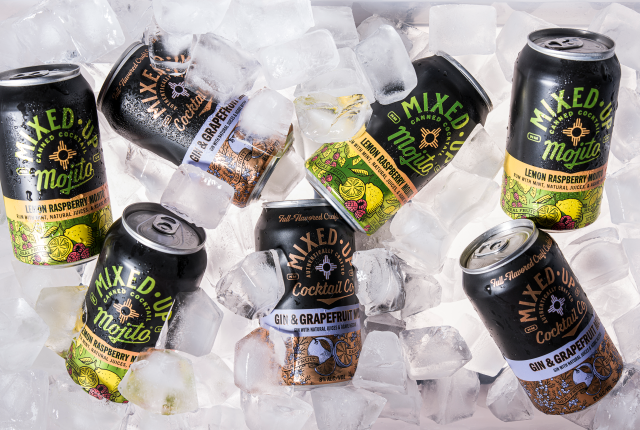
“WE JUST SORT OF had a hunch that it was a good time to launch a cocktail brand,” says Teresa Dahl-Bredine, co-owner of the Silver City–based Little Toad Creek Brewery & Distillery and Mixed-Up Cocktail Co. When Mixed-Up debuted in 2020, the canned cocktail market was about to take off. As bars closed during the pandemic and drinking shifted toward homes and backyards, U.S. ready-to-drink cocktail consumption surged more than 50 percent that year. Dahl-Bredine already had a head start.
She and her husband, David Crosley, had founded Little Toad Creek in Silver City in 2012. Mixed-Up took their popular cocktails beyond the bar. “We made it in a way that we believed in and that we would enjoy,” she says of the drinks that range between 8 and 10 percent alcohol by volume. The first releases riffed on the mule, from a classic version to Dahl-Bredine’s favorite, a gin-and-grapefruit mule, both with spicy ginger juice. Six years later, the lineup has expanded to seasonal releases, such as this summer’s Pink Guava Mai Tai and a blood orange hurricane planned for next spring. “I’ve loved playing with flavor profiles,” she says. “I’m kind of obsessed with whole ingredients and natural ingredients—distilled spirits, juice, and a dash of agave nectar, and that’s still our basic formula today.”
The company uses pasteurization to avoid preservatives, a process now carried out at a 46,000-square-foot former chile plant in Deming with a canning line that produces 300 cans per minute. Mixed-Up distributes to nine states and Japan. As its reach has grown, regional partnerships have kept it connected closer to home, including New Mexico State University’s raspberry Aggie-Rita and cocktails for the Colorado Rapids and El Paso Locomotive soccer teams. “The collaborations are just a way to connect with the local market to say, ‘Hey, we’re here,’ ” Dahl-Bredine says.
That regional identity may also be an advantage in an increasingly crowded ready-to-drink market, where growth has become more measured as it becomes more mainstream. “It’s a lot of the more regional brands that are doing something really truly unique and focusing on quality that are having the staying power,” she says. “The market just sort of met us in the right place at the right time.”