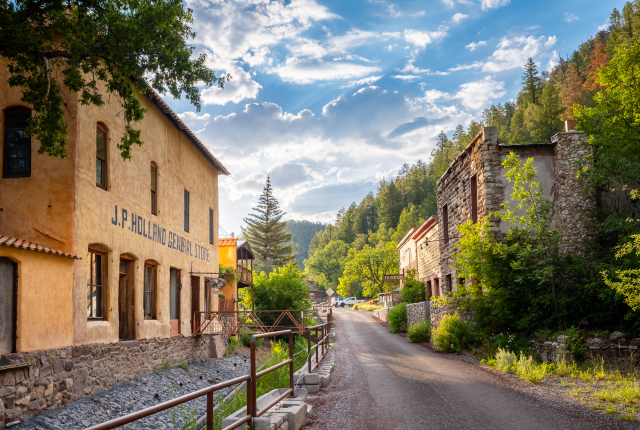
CRESTA TERRELL HAS A REQUEST. The proprietor of the Old Kelly Store does not want this story to begin with a description of the road to Mogollón, as so many tend to.
Instead, let’s reflect on what a visiting mother said to her child one day this summer at Terrell’s eclectic emporium in the stunningly well-preserved ghost town, which is located about 75 miles northwest of Silver City.
The Old Kelly Store is filled with art, jewelry, and furniture made by more than a dozen artists, including Terrell; a selection of shiny gems, polished rocks, knives, and locally made skin-care products; and an array of colorful T-shirts (those have to do with the road, so we’ll stop there). That morning, the kid walked up the wooden porch, peered in, then paused and asked his mom what they were doing there. Not at the store, he meant, but what were they doing in Mogollón, the strange old village at the bottom of Silver Creek Canyon that’s populated by stately frontier-era storefronts and ramshackle miners’ cabins.
The Mogollón Cemetery contains 207 unique graves.
“We’re looking at everything,” she replied firmly.
That’s a good rule to keep in mind when visiting Mogollón. If you don’t live nearby, it’s hard to determine the next time your life might allow the bandwidth to visit this great magical realist relic of America. After all, it’s a place that’s been called “the Southwest of the Southwest,” tucked into a holler that’s about a 225-mile drive from both El Paso and Tucson (and a bit farther from Albuquerque), on the edge of the largest roadless wilderness area in the continental United States. So, when in Mogollón—ideally on a weekend between May and October, the only time most of the businesses are open—you’d best get to looking around.
A view of Mogollón from the road above.
THAT’S WHAT ARMY SERGEANT JAMES C. COONEY was doing on a scouting expedition from Fort Bayard in the early 1870s, when he found a rich quartz vein along Mineral Creek in the Mogollón Mountains. He savvily kept his discovery to himself until he’d left the service. In 1876, he returned to work the claim, where gold and silver were plentiful.
It’s easy to imagine how Chiricahua Apache leader Victorio and his soldiers might have felt in the spring of 1880, during their yearlong battles with U.S. and Mexican armies and settlers across Apache homelands, a conflict known as Victorio’s War. When they looked down a ridge into the freshly named Cooney Canyon and saw how the former sergeant and his friends had ravaged the land—clearing forests for firewood, tearing great big holes into pristine slopes, muddying creek waters with their rudimentary mining waste—their revenge was swift.
Two men were killed by Apache raiders at the mine around dusk on April 28. That night, Cooney and William Chick rode down into the canyon to warn others; they were executed on their journey back, along with about a dozen other miners, sheepherders, and settlers.
Cordelia Rose at Whitewater Mesa Labyrinths.
But the operation Cooney had set into motion became a runaway ore cart laden with riches for those who followed. By the 1890s, miners were pouring into the nearby settlement of Mogollón (named for Don Juan Ignacio Flores Mogollón, a governor of New Mexico in the early 1700s). At the peak of operations, the Little Fannie Mine ran 24 hours a day. Between 1887 and 1942, when the Little Fannie was shut down for good, Mogollón was the largest producer of gold and silver in the state, and its mines were among the most valuable in the United States.
Get-rich-quick operations tend to attract bad elements, though, and Mogollón became notorious as an untamed town rife with riffraff: claim jumpers, horse and cattle thieves, gamblers, vice peddlers. Its remote location meant law enforcement was limited.
“There were four red-light districts here,” says Mogollón Museum owner Katie Morgan. “A lot of cave dwellers, a lot of single men in boarding houses,” she explains of the fluctuating population, which swelled to as many as 6,000 at the turn of the century.
Artist and resident Julie Jones.
The museum’s collection of photographs, town and mining memorabilia, Mimbres and Gila pottery, antique firearms and tools—and even a re-created mine shaft in the building’s old root cellar—showcases Mogollón’s triumphs and tragedies. The latter includes a plague of fires that occurred in 1894, 1904, 1910, 1915, and 1942, the last of which effectively shuttered the town, and floods that rushed through the creek in 1894, 1896, 1899, 1914, and 2013, wiping out buildings, bridges, mine tailings, and people.
It takes a romantic intention to find and visit Mogollón and true grit to stay and build a life. Morgan, who has lived there for 57 years and has a house on the old schoolhouse site, first came to the area as a girl vacationing with her family. After a visit, she says she told them, “ ‘I’m going to marry me a cowboy, I’m going to come to Mogollón, and I’m going to run a museum.’ And I did do just that.”
The Painted Coyote, Jones’s shop of stained-glass art.
Over at the Kelly Store, Terrell has her own tale of predestination. Her sister was living in town in 1993, when Terrell visited. “I was taking a walk up here in Mogollón on Trail 810, and I was upset like you are when you’re depressed,” she remembers. “I always wanted to live in a small town—I grew up with Little House on the Prairie, Big Valley, Bonanza, all that stuff, totally fantasy.” Standing on the trail, the single mother asked God for a “concrete sign” to tell her whether it was a good place for her and her children to live. She then looked down at her foot to find a heart-shaped piece of concave shale. “I asked for something concrete,” she says with a smile.
Stan King, who bought the J.P. Holland General Store and began converting it into the Silver Creek Inn in 1979, says, “I had seen this building in a dream.” When he first set eyes on the hulking adobe former mercantile and boarding house, he was driving his pickup truck up the road to Mogollón, seeking to settle “somewhere remote and dry” after leaving a corporate electrical engineering job in Seattle. “As soon as I saw it, I was like, That’s where I want to land,” he says.
Niels Mandoe at Mogollón Woodworks.
EVEN IF THE SILVER CREEK INN WASN’T the only place to stay overnight in Mogollón, it’d be the place to stay in Mogollón. King’s top-to-bottom renovation of the 5,000-square-foot two-story building, which was built around 1885, begins with the custom-built bridge that spans the 14-feet-deep creek bed in front of the bed and breakfast.
The front door leads into a great room filled with art, historic photos, gems and minerals, and a cheerful open kitchen helmed by King’s longtime partner, Kathy Knapp. (Knapp herself is a regional celebrity, known by many New Mexicans as the original Pie Lady of Pie Town. She ran the Pie-O-Neer cafe there for decades before moving to Mogollón to reopen the inn with King after the pandemic.)
I sleep upstairs in the elegant Patio Room, which features a private outdoor space to enjoy the sunrise seeping down the canyon walls the next morning. I do just that, feeling like the doyenne of some grand old European villa in a mountain resort town, albeit one where you can commune with visiting coatimundi and watch western tanagers pillage the patio’s Maréchal Foch grapevines. In the adjoining Library Lounge, I pick up The Mogollón News by Uncle River, a local personality who wrote a series of widely published columns about the fictional exploits of Mogollón residents between 1985 and 1995.
from left
Stan King and Kathy Knapp on the Silver Creek Inn bridge. The inn’s welcoming open kitchen.
A passage jumps out that seems to explain the folks you meet in Mogollón. “Many of the people who stay,” River writes, “turn out to be unique and often exceptionally sensitive individuals who, with patience and effort, create a constructive niche for themselves in a setting where every individual counts.”
That’s true of Niels Mandoe of Mogollón Woodworks. “There’s not too many cabinetmakers in this area, so I have certainly profited,” he tells me at his cedar-scented shop downtown, which is open on weekends and “whenever anybody happens to find me working here,” he says. His sleek designs encase collections in the museum and at Silver Creek Inn. Tourists stop in for handcrafted cutting boards, clever kids’ puzzles, and smooth chairs and stools made from local mesquite, juniper, and black walnut.
Mandoe’s strong artistic talent is shared by his wife, Marianne Scharn, a painter who keeps a studio next door. She invites me in to see her striking abstractions of local vistas like Eagle Peak and Spring Mountain, which evolved from the 26 years she spent as a seasonal fire lookout, mostly at Bearwallow Mountain.
In fact, the Mogollón Historic District is a murderers’ row of uncommonly good artists, including Julie Jones. I meet her at the Painted Coyote, her small shop of unique stained-glass designs mostly set into restored antique window frames. Jones’s father, Robert Wey, bought many of the ghost town’s historic buildings in the 1990s with the goal of preserving them, incorporating several businesses that persist as Mogollón Enterprises.
Carvings by Gila-based Bill Kaderly are among the art at the Old Kelly Store.
“Everybody here is amazing,” Jones agrees of the improbable talent pool in a wilderness town of 15 people. “But then you wonder, how do you find another generation to come here?” The glass artist, who manages the properties Wey left to his family, has lived in town full-time for three years now. “There has to be a certain frontier spirit.”
Potential new residents must also appreciate stillness, which descends into the canyon each fall with the first snows and the easing of tourist traffic. That’s what Brittanie Pederson tells me at the Purple Onion cafe, located adjacent to the Painted Coyote, after she serves up an excellent green chile cheeseburger and a signature purple coleslaw.
“If you just sit in silence, you’ll have deer, bear, mountain lion, wild turkeys come right up,” she says of her corner of Mogollón. Pederson took over the only restaurant in town from her mother in 2018 and enjoys serving seasonal visitors at the nearly 25-year-old spot for the love of meeting new people. “How far our town’s name has gone around the world—it’s so weird,” she says.
Most visitors naturally ask about ghosts. Knapp had a paranormal experience at the inn several years ago when she was seated at the table eating with friends. “Out of the corner of my eye—the only way I can describe it is as a red bullfighter’s cape—I saw something just fly up the stairs.” King says that just a few months into gut-renovating the inn in 1980, he and a few others heard phantom footfalls on the stairs. “They just kept going right up through the ceiling,” he recalls. “We all heard it and looked at each other. We went out and looked, and the door was still shut and there was nobody around.”
Cresta Terrell poses on the porch.
RESIDENTS AND VISITORS ALIKE FIND spiritual fulfillment in hikes to the 1892 Mogollón Cemetery, where Mogollón’s oldest souls are commemorated. Up a rough 1.25-mile road accessible by high-clearance vehicle, the recently restored graveyard contains 207 burial sites dating to John Jose, who died in 1892.
Cordelia Rose is a longtime local yoga teacher whose Whitewater Mesa Labyrinths attraction is situated along the road that leads to Mogollón. Over the past few summers, the 84-year-old Rose has led a volunteer effort to clean up the cemetery and uncover every grave. On my last morning in town, we jump into her old stick-shift 4WD Tacoma and drive up the nearly vertical gulch. We walk the 2.3-acre burial ground using paths that take us through pines, cedars, and family plots, around mounds and the wire-basket cribs that denote the resting places of children. Some graves are marked with granite headstones; others contain cairns, handmade wooden crosses, miner’s spikes, or recycled tin decorations. An unknown individual, for no known reason, has left sand dollars on certain resting places around the cemetery.
As a creator of labyrinths, Rose was uniquely up to the task of helping sort out the mazelike cemetery, enlisting Forest Service crews to clean up and re-enclose the overgrown space. “That is the mass flu grave,” she says as we stop at a large, unmarked plot with fieldstones piled over it. More than 50 Mogollón residents died in the 1918 pandemic. It’s rumored that many were hastily buried together here.
Visitors peruse the collections at the Mogollón Museum.
In August, Rose presented the restoration work and research to the state Historic Preservation Division (HPD), which unanimously approved a resolution to put the graveyard on the State Register of Cultural Properties. Steven Moffson, an HPD historian, says, “It’s the large number of handmade markers that are really exceptional.”
Rose’s ultimate goal, in solidarity with the local grassroots group called Mogollón Concerned Citizens and the Gila Guardians organization, is to protect this wild and lovely place from further encroachment by the Canada-based Summa Silver Corp., which staked a claim in the mining district in 2021. “They want to do slant drilling here, which comes under the cemetery on that side,” she says, pointing west.
“We’re just such a tiny group of people,” she adds, regarding their fight to stop exploratory mining. The invasive prospecting threatens the local Mexican spotted owl population, along with the tranquil way of life that has settled on Mogollón since most mining operations began leaving a century ago.
“They’ve been poking around for gold ever since I came here in the seventies,” King says. “But I don’t think the miners left a lot.”
The Purple Onion is the town’s only eatery.
THE RUGGED ROAD YOU TAKE OUT OF Mogollón is the same one you take in. The old Bursum Road was built by convict laborers in the late 1800s. Now known as NM 159, it’s a breathtaking route containing mountain curves that overlook a network of canyons. Leaving Mogollón, the road rises 800 feet for a spell, then drops 2,700 feet over several miles, with turns you’ll try not to think too much about while navigating them. In some places, only several hundred feet of solid rock walls support one-and-a-half driving lanes, with seemingly only air on both sides of your car.
“That road filters out a lot of people,” Knapp says proudly. At the Kelly Store, the T-shirts and bumper stickers for sale say, “i survived the road to mogollon.”
Remembering my somewhat harrowing arrival, I was dreading the way out of town. But it only took less than 20 minutes of slow and cautious driving to hit terra firma on two smooth lanes with plenty of room. And as soon as I found myself safely on the other side, heading west over Whitewater Mesa, I could only wonder when I’d get back to that hauntingly beautiful place again.
WHEN IN MOGOLLÓN...
Meditate. Tune up your mind for a Mogollón visit with a stop on NM 159 at Whitewater Mesa Labyrinths, where founder Cordelia Rose has built six contemplative mazes and offers them to visitors for reflection, healing, and occasional retreats. On the first Saturday in April, Rose and hundreds of others gather for the free annual Whitewater Mesa Fun Kite Flying Picnic event from noon to 5 p.m. Bring a kite and your own nosh; 2026 will be the event’s 20th year.
Relax. Book a room at Stan King and Kathy Knapp’s handsome and comfortable Silver Creek Inn. Reservations open in May and close October 31; six bedrooms are available with optional yoga class add-ons taught by Cordelia Rose. An open kitchen with a pre-1945 Wolf Junior gas range is available for meal prep, along with a complimentary continental breakfast that could feature Knapp’s homemade granola if the timing is right.
Learn. The Mogollón Museum, just across the road from the inn, contains an excellent collection of town and local artifacts, as well as a very cool mine shaft replica for kids to explore safely. Note to prospective residents: The museum and its collection are up for sale.
Hike. The atmospheric Mogollón Cemetery is approximately a 45-minute hike from the north end of town that climbs just over a mile to 207 burial sites.
Grub. The Purple Onion is open 9–5 on weekends seasonally, serving burritos, omelets, burgers, sandwiches, and milkshakes.
Shop. Discover locally made goods and souvenirs at the Old Kelly Store, including jewelry, alligator juniper furniture, and proprietor Cresta Terrell’s decorative gourds. Peruse the Mogollón Cemetery Archive in the back of the store. Pop next door to Mogollón Woodworks to shop artisan Niels Mandoe’s handcrafted creations. Drop in on Julie Jones at the Painted Coyote to purchase her intricate stained-glass art, or follow her on Instagram (@the_painted_coyote).