DOZENS OF BOTTLES OF FINE POWDER line the windows of Stella Maria Baer’s Santa Fe studio. Their contents vary vastly in color. Some are light mauves. Others are deep spruce greens, sunny yellows, and charcoal grays. The unifying factor in these pigments is that they were gathered from the land; the lineup of dusts represents the disparate hues of earth’s palette. Put simply, they’re dirt, which the artist uses to color her world.
Baer is a painter and teacher whose work veers into the territory of the mystical and spiritual. Her pieces are populated by women and horses silhouetted against the New Mexico dawn, birds in flight, and celestial bodies, all rendered in careful detail. Although she was trained in traditional oil paints and synthetic pigments, Baer discovered a passion for natural and nontoxic materials while studying under a master of Russian iconography at Yale Divinity School, in Connecticut, and taking graduate-level classes at the art school.
Stella Maria Baer consults a natural dye color card.
Baer remembers a point the iconographer made one day in class. “It’s impossible to paint the things of the spirit with chemicals made by man,” she recalls him saying. “You can only paint the things of the spirit with the things of the earth, because the earth is sacred and holy and made by God.”
But she didn’t fully commit to natural pigments in her own work until a few years later. During her first pregnancy, the artist became increasingly concerned by many paint companies’ lack of transparency about ingredients. “I was writing to them, and no one got back to me,” she recalls. “I got mad.” She also got crafty. When she returned to her home state of New Mexico in 2016, Baer found inspiration in the veritable playground of hues surrounding her and focused on making her own paints.
The landscape around Santa Fe contains not just the obvious palette of red, yellow, green, and brown earth for artists to sift and mill and put to good use. Purples and blues hide in the rocks, while deep, infinite black can be gleaned from burnt juniper wood. In 2017, Baer’s experimentation with the high desert landscape led to an artist residency in California’s Joshua Tree National Park, where she began diving deeper into earth pigments. “I’ve been back every year since to teach a workshop,” she says. “The more I work and teach with earth pigments, the more I want to be in relationship with the land and to invite people into that relationship—to help people create relationships that are responsible and reciprocal.”
Stella Maria Baer works in her Santa Fe art studio.
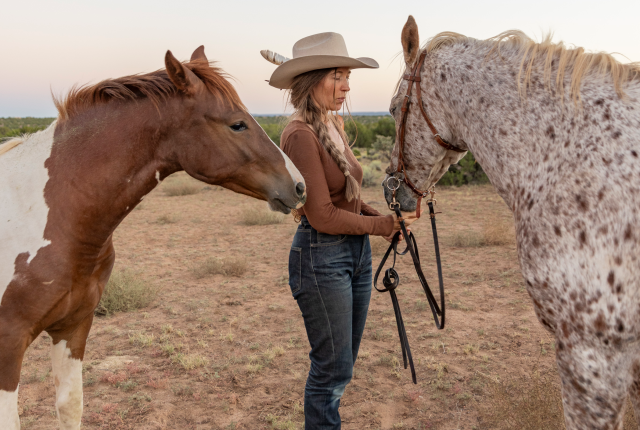
Baer’s works often feature her beloved rescue horses. They gallop across a soft taupe foreground in her painting The Appaloosa, the Pinto, and the Raven, racing joyfully under the sharp, dark wings of the bird. The subject matter—cacti, mountains, birds, horses—feels iconically Western, but the muted warmth of the colors imparts a tenderness to the scene.
Natural hues can enliven a scene with this sort of familiarity. For as long as people have been living in the Southwest, they’ve been working with earth pigments and natural dyes, using colors gleaned from their surroundings to make petroglyphs, santos and retablos, pottery, and paintings.
The colors of the land haven’t just altered local art, they’ve shaped its very basic foundation—the distinctive color schemes of Native pottery are typically due to the variations in the earth where the clay was harvested. Although it’s now possible to access almost every hue imaginable, plenty of New Mexico artists are choosing not only to follow the old ways, but to instruct others in the tradition.
The artist holds vials of pigment dust.
For Scott Sutton, a multidisciplinary artist based in Taos who also calls himself the Pigment Hunter, the decision to work with natural colors comes from a desire to do better by the environment and an interest in connecting to New Mexico’s history and culture.
“Even synthetic pigments come from some raw element or material that comes from planet Earth, including those that are petroleum generated,” he says.
For Sutton, it’s not enough to simply purchase so-called natural colors, because even those can be produced under unethical circumstances. “How is it impacting the people who work in the mines or factories? The only way to really know,” he says, “is to collect your own materials.”
To make colors is to engage with the environment in an intimate and generative way. The practice involves a certain level of deep place-knowledge—necessary for locating and harvesting raw ingredients—combined with a similarly expansive skill set that’s necessary for turning dirt, plants, bones, and bugs into usable glazes, paints, and dyes.
Scott Sutton prepares indigo dye.
The process also requires commitment: Sutton doesn’t just glean rocks and clay from the area surrounding his home in Taos, he grows his own materials. Over the years, he’s planted madder root (which produces red and pink hues), indigo (for that deep blue), and dyer’s chamomile (which makes a brilliant array of yellows and browns). He also uses bee plant, chamisa, and marigold for paper dyeing and paint making.
When he’s not working on his own fluid, dreamlike pieces—or running his artist residency program or building a mobile art lab—Sutton teaches two-day workshops in pigment making.
“There are a lot of people interested in it,” he says. “That wasn’t true 20 years ago. It’s a matter of sustainability.” He notes that most artists’ supplies, coming from factories and labs, represent a disconnect between the artist and the materials and process that went into creating those colors. “I want to provide people with the skillset to do this kind of work in their own art practice, to lighten their own eco-footprints,” he adds.
Sutton in his garden in Taos.
Of course, natural colors have their limits. One can’t simply pick up a trailside rock and grind it into neon green, and no plants produce as brilliant a blue as ultramarine. But working within a limited palette is part of the draw for many artists. It allows them to capture a holistic sense of place, one that goes deeper than otherwise possible.
At Tierra Wools, in Chama, where a team of skilled weavers produces stunning “hoof to loom” textiles on a small scale, natural dyes have always played a part in the artistic process. “All of the natural dyes are a little more muted than many of the commercial dyes,” explains owner Molly Manzanares, who helped found the company in 1982.
“Everything we do is based on what we have available here. We raise the sheep and make our own yarn. We dye the yarn,” she explains. “That’s who we are—the natural dyes just add to that.” While Manzanares and her team do use commercial dyes, the process of dyeing with cottonwood blossoms or cochineal is something they enjoy teaching and promoting.
But as Ephraim Anderson points out, sometimes the use of natural colors is simply too time-consuming to be practical. A member of the Navajo Nation based in Shiprock—and 2024 Ralph Lauren Artist in Residence who works professionally as Zefren-M—Anderson is an artist, weaver, and scholar steeped in the rich tradition of Churro sheep tending and spinning wool into naturally dyed yarn. While Anderson has taught classes in natural dyeing and weaving (including workshops at SITE Santa Fe), they admit they often use synthetics in their works.
“I don’t use a lot of natural colors in my work because it is utilitarian,” Anderson says. “I need [my weavings to] be sunfast and washable. Natural colors will last for up to 300 years in perfect conditions.” The difference between utilitarian weaving and fine art, Anderson adds, is largely one of class and social pressures. For centuries, Navajo weavers were incentivized to create brighter and more vivid rugs to appeal to outside buyers; many of the colors used were reflective of the market rather than their personal preferences.
But weaving with naturally colored materials is still important to Anderson, who says they enjoy passing down ancient practices of gathering, processing, and dyeing. As a teacher, they try to encourage students to learn traditional rules in order to break them later.
“If you learn the basics of the hardest techniques—the slow way, the nuanced way of making your art—and then you go to work with a digital loom, you will be that much more informed,” Anderson tells their mentees. “It gives you a deeper connection to the weaving, even when the tools are technological.”
Katy Kelleher is the author of The Ugly History of Beautiful Things: Essays on Desire and Consumption (Simon & Schuster, 2023).
DYE-ING FOR ART
Try your hand at place-based color making.
Stella Maria Baer hosts frequent classes at her Santa Fe studio. In addition to lessons on gathering and processing dirt- and stone-based pigments, she also brings in guest teachers to discuss issues like foraging responsibly and natural tanning. “Those are all taught by friends of mine who have similar love and respect of the land,” she says. “It’s a dynamic relationship.”
Scott Sutton leads several workshops throughout New Mexico every year. The Art of Pigment Hunting brings students into landscapes to seek their color fortunes, using geological maps to learn about the rock formations and their histories. Materials are collected in an environmentally responsible manner and processed on-site.
Tierra Wools, in Chama, presents two-day natural dyeing workshops taught by local weavers. “We teach people how to understand some of the principles of hue, intensity, and value,” says owner Molly Manzanares. Students work with foraged hues from chamisa and cottonwood as well as exotic dyestuffs like cochineal bugs, madder root, and indigo.
Tilke Elkins, who founded the Wild Pigment Project in 2019, is a New Mexico–based artist and pigment maker who teaches online and in-person color making. To sign up for a class, contact Elkins at info@wildpigmentproject.org.