


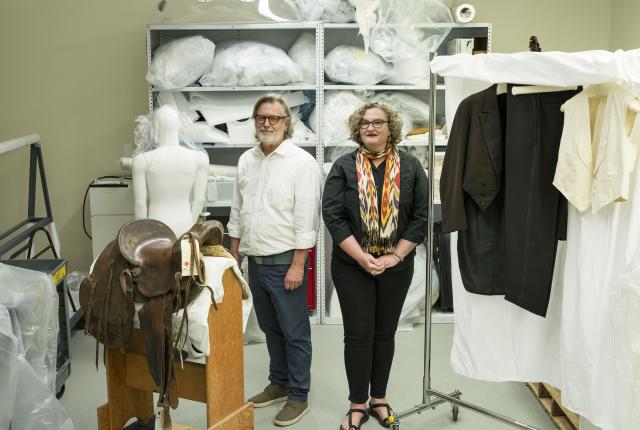
AT THE MUSEUM OF New Mexico system’s Conservation Lab, on Santa Fe’s Museum Hill, the old canvases kept coming. Over the decades, the Paul Burlin paintings had been cut and resized, yellowed by bright light, stripped from their frames, rolled into brittle scrolls, and packed into boxes.
“It was daunting,” says Bradford Epley, the Museum Resources Division’s head of conservation, who serves eight state museums and eight historic sites. “I could tell they were going to need so much work.” Over the course of two years, Epley meticulously cleaned six of the seven canvases by the Santa Fe–based modernist (1886–1969) that are currently on view at the New Mexico Museum of Art in Paul Burlin: An American Modernist in the Southwest.
“Burlin was showing work at the Armory Show in 1913,” Epley says of the New York exhibition that would become a watershed moment in American modernism. But the Burlin paintings are only one example of the culturally significant objects that pass through the lab, requiring the time and expertise of a conservator.
In New Mexico, where Indigenous, Nuevo-mexicano, European, and more traditions overlap, conservation means recognizing when expertise alone is not enough. At the lab, conservators often work alongside artists, historians, and community experts to determine how objects should be repaired, stored, or exhibited.
“As a profession, we’ve realized this work cannot happen in isolation,” says Epley, who previously led the conservation center for the Menil Collection, in Houston. “If we’re gluing an ancestral vessel together, we make sure to use community-approved adhesive.”

A carved door awaits preservation.
Conservators regularly consult descendants, working artists, and regional specialists before treatments are carried out, particularly when objects are tied to living cultural traditions. On some days, that collaboration unfolds directly at the worktable, where Pueblo potters and conservators examine ancestral vessels together under magnification, discussing repairs, clay behavior, and whether signs of age should remain visible. Lab employees treat conservation as more of an ongoing conversation than a solitary scientific process.
On a spring day at the lab, Epley pauses before an insulated tent humming with oxygen-stripping nitrogen. Most incoming organic objects are treated in the nitrogen tent before entering collections storage. Nearby, conservators move carefully between easels, tables, and trays of artifacts. Treatments applied by conservators must be both identifiable and fully reversible, core principles of the field. Between documentation, environmental monitoring, and preventive care, Epley says, conservation is often less about dramatic restoration than constant vigilance.
“We have to be detail-obsessed,” says senior textile conservator Angela Duckwall. “We’re trying to anticipate worst-case scenarios.” Navajo rugs or Río Grande–style weavings are vulnerable to ultraviolet light, fluctuating humidity, pests, fading, and fiber loss. Textiles arrive after decades of exposure and handling. So for stabilization, she says, “We try to find the best compromise given time, money, and other resources.”
Still, behind the technical work lies something less tangible. Spend enough time with an object, and curiosity about its maker and origins becomes inevitable. “They want to understand them,” Epley says.
But understanding an object, he adds, is not the same as claiming authority over it. “When I’m working with the material culture of others, I’m not the expert,” he says. “Objects are more than their physicality. Communities and artists help determine the best way to care for their patrimony. Conservators do not always belong in every conversation about how an object should best be treated, and that’s okay.”
MUSEUM CHECKLIST
If you’re into museum conservation, check out the Segesser Hide Paintings at the New Mexico History Museum core exhibit, Telling New Mexico, in Santa Fe, or visit the FossilWorks exhibit at Albuquerque’s New Mexico Museum of Natural History and Science.