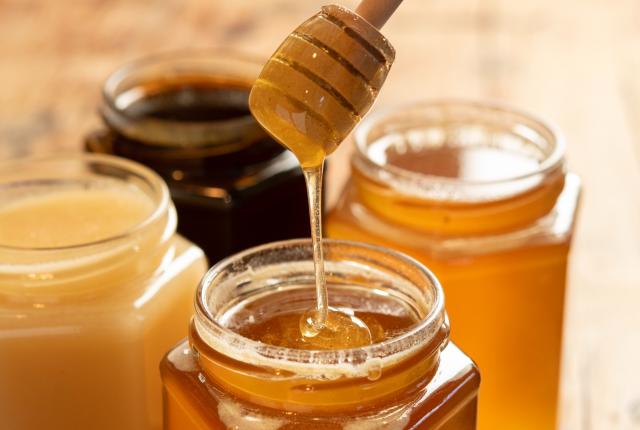
TIJERAS BEEKEEPER Amy Rogers withdraws the wooden taster from the jar, the tip coated in amber. She twirls it before handing it to me, the thimbleful of honey at the end glittering like blown glass. “These spring honeys,” Rogers says, “it’s almost like eating a bouquet sometimes.”
She isn’t wrong. The distinctive honey scent gives way to a floral perfume and a delicately sweet flavor reminiscent of fresh strawberries. While the silky goo is still dissolving on my tongue, Rogers hands me a second sample. This one is much darker, with a reddish hue—fall honey from hives near Isleta Pueblo. “It almost tastes like caramel,” she says.
The contrast between these honeys is no fluke; each reflects where and when it was made. Spring honeys taste of the first blooms of yuccas, prickly pears, and globe mallows fed by rainwater and winter runoff. By fall, bees forage among late-blooming wildflowers like purple aster, rabbitbrush, and goldenrod, which put out a final burst of thick, mineral-dense nectar that is concentrated by months of heat and little water. Summer honeys run the gamut, shaped by the hives’ location and what is blooming nearby.
Desert Hives beekeepers and educators Amy Rogers and Matt Vaive keep bee colonies healthy and honey flowing in Tijeras.
But the annual rhythms that shape New Mexico’s remarkable honey are changing. Climate disruptions alter the length of the seasons, precipitation patterns, and other pollinator lifelines, making it harder for honeybees—and the beekeepers who care for them—to thrive. As rising temperatures and prolonged drought reshape the landscape, beekeepers are evolving in order to keep colonies healthy—and preserve the flavors that make the state’s honey taste unlike any other.
Just beyond Rogers’s tasting table, the bees responsible for those flavors buzz inside Desert Hives’ apiary. More than simply selling honey, Rogers and her cofounder and collaborator, Matt Vaive, have spent most of the last 11 years raising healthy bees and helping others do the same. They teach classes, host hive tours, and consult with beekeepers across the region, enriching the community with the knowledge they’ve gained through participation in cutting-edge bee health research around the state and country.
“Bees need water,” Vaive explains as Rogers pries open a hive, one of about a dozen inside the bear-fenced apiary paddock. “They need water to drink, but flowers also won’t push up any nectar until there’s enough rain.” During the current drought-stricken season, the rain shortage has put a strain on many bee colonies, requiring beekeepers to provide water for hydration and cooling as well as for supplemental food to replace the nectar bees aren’t finding in the wild.
Bee Chama owner Shay Kelley.
With incense-like bee-calming smoke filtering through our protective veils, Rogers holds up a writhing, bee-covered sheet of honeycomb. “Can you spot the queen?” she asks. I can. She’s about twice as big as the rest, with a blue dot crowning her abdomen.
This queen is mother to tens of thousands—almost all of which will eventually become flower-seeking foragers, connected to the hive and one another by the queen’s genes and pheromones. The connection runs so deep that when a bee finds a patch of blossoms, she can communicate its location through an elaborate “waggle dance,” sending thousands of sisters to harvest the same blooms. That’s how a single flowering event can define the flavor, color, and texture of an entire honey harvest.
Across New Mexico, those differences are reflected in every jar.
In the cozy, wood- and plant-filled interior of the Bee Chama Honey shop, in Polvadera, beekeeper Shay Kelley practices honey alchemy, creating mushroom-, cocoa-, and even green chile–infused
honeys, alongside an extensive line of honey-based skin-care products. She guides customers through a tasting of dozens of raw honeys, each collected during distinct blooms. The rainbow of jars ranges from the creamy white cat’s-claw honey gathered in southern New Mexico to the deep chestnut of desert wildflower honey, made from a mix of salt cedar, mesquite, and cactus flowers. Somewhere in the middle of the spectrum, a very rare northern New Mexico variety appears only under extraordinary conditions.
The regal blue markings of a queen bee at Desert Hives, in Tijeras, help her stand out.
“Mountain gambel oak honey can only be harvested about once a decade,” Kelley explains. “During extreme droughts, bees will collect the honeydew left by aphids on gambel oak leaves, even though it’s not flower nectar.” This act of desperation by hungry bees produces a mellow, reddish honey with a complex, almost savory flavor.
Such adaptations are increasingly common as honeybees, alongside hundreds of other native pollinators, face mounting pressure from rising temperatures, lingering drought, and habitat loss. When flowers fail to bloom or produce little nectar, malnourished colonies become vulnerable to diseases. In the worst cases, entire hives—containing upwards of 60,000 bees—can die off in a matter of days.
“In 2024, we lost 85 percent of our hives,” says Jim Lyssy, a Fort Sumner beekeeper and owner of Happy Bees LLC. His hives have since recovered, and today he has nearly 500 that he uses both for honey and for pollinating crops such as watermelon, chile, and alfalfa. Lyssy, who grew up farming and ranching, says being able to support New Mexico’s agrarians is why he keeps going: “We do it for the passion and to do the best that we can to take care of God’s land.”
For Rogers, the desire to help “save the bees” is what inspired her to get into beekeeping in the first place. But after more than a decade of witnessing their intelligence and resilience firsthand—and even getting stung a time or two—she now says she had it backward.
“I’ve learned that bees don’t need us,” Rogers says. “It’s us who need bees.”
Before I leave Desert Hives, Rogers offers a final insight. “One bee makes one-twelfth of a teaspoon of honey in her entire life,” she says, pointing to the tiny glob of gold at the end of my tasting stick. A life’s work in a single drop. Savoring it, I’m sure I can taste the delicate work of the craftsbee and the thousands of New Mexico flowers she visited, distilled into one lingering note of sweetness.
Sarah Mock recommends spreading local raw honey on toast for some seasonal allergy relief.
PLAZA CAFÉ SOPAIPILLAS
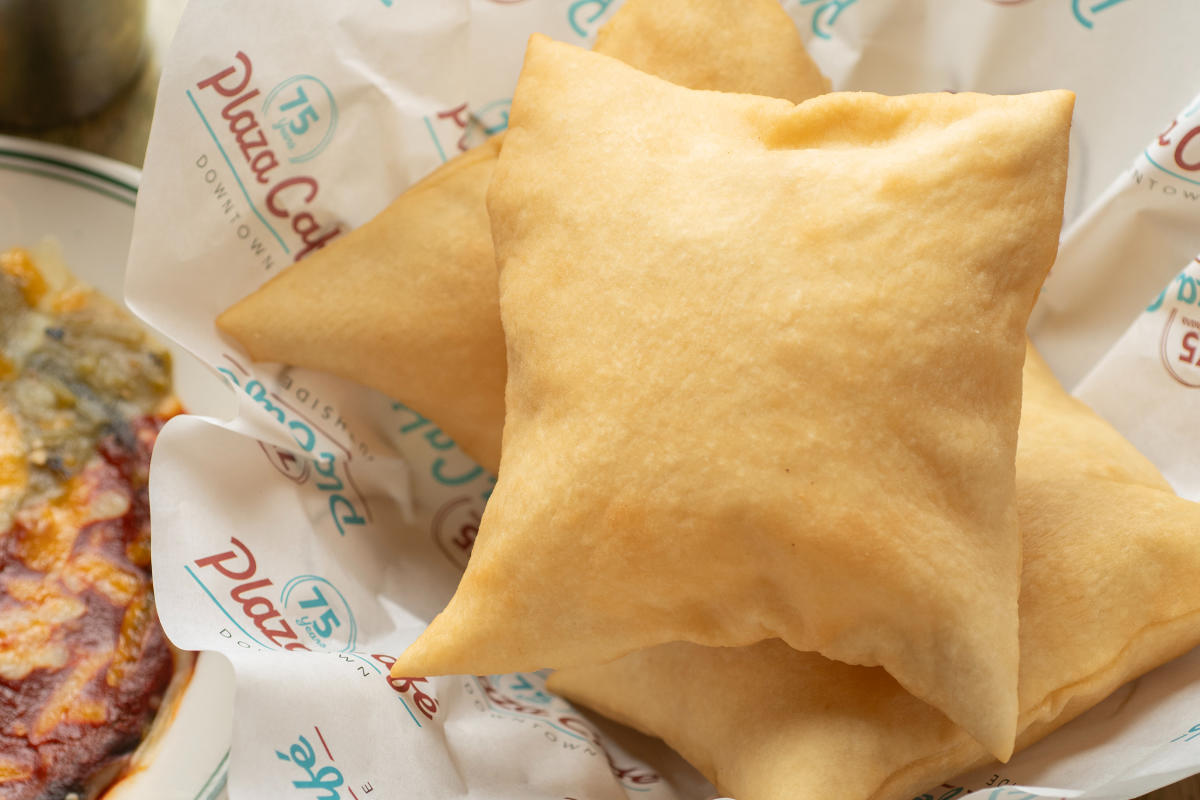
Among the most beloved offerings at Plaza Café, in Santa Fe, are these airy sopaipillas, perfect for drizzling with honey. Inspired by owner Leonardo Razatos’s mother Beneranda’s family recipe, they’re “so popular,” he says, “that we even serve the fried breads on the side with otherwise carb-hearty dishes like burritos and our stuffed sopaipillas.” To celebrate 80 years of Razatos family ownership of the beloved Santa Fe restaurant, I teamed up with Leonardo to write its first-ever cookbook, The Plaza Café Cookbook: Classic New Mexico Recipes from the Santa Fe Landmark (UNM Press). The book, published this September, pairs the cafe’s storied history with that of the family that has guided it for eight decades, while sharing the recipes and techniques behind its classic American diner fare, homestyle Mexican and New Mexican specialties, sky-high pies, cakes, and, of course, sopaipillas.

- 2 cups all-purpose flour, plus more for work surface
- 1 tablespoon granulated sugar
- 1 ½ teaspoons baking powder
- 1 teaspoon salt
- 1 tablespoon lard, softened
- ¾ cup hot water
- Corn oil or other neutral oil, for deep frying
- Honey
Makes 12
1. In an electric mixer, combine the flour, sugar, baking powder, and salt over low speed. Stop the mixer and add the lard and hot water. Beat on medium speed for about 5 minutes. The dough will start out sticky but eventually will become soft and pillowy.
2. Cover the bowl with a damp dish towel and let rest for 15 minutes. Divide the dough into 3 balls, cover again on a floured work surface with the damp towel, and let them rest for another 15
to 30 minutes.
3. On the floured work surface, use a tortilla roller or rolling pin to roll out each ball of dough into a circle or rectangle approximately ¼ inch thick. Trim off any ragged edges and discard them. To avoid toughening the dough, avoid rerolling it. Cut each portion of dough into 4 wedges or smaller rectangles.
4. Warm at least 3 inches of oil in a heavy, high-sided skillet or saucepan to 400°. Slip 1 or 2 dough pieces into the oil. After sinking briefly, the sopaipillas should begin to balloon and rise back to the surface. Once they start bobbling on the surface, carefully spoon oil over them for the few seconds it will take until they have fully puffed. Turn them over and cook until the second side is golden. Drain with a slotted spoon.
5. Arrange in a napkin-lined basket and serve immediately with honey.