New Mexico’s Surreal Landscapes
Eons in the making, New Mexico’s surreal landscapes help define us. Here are three to visit.
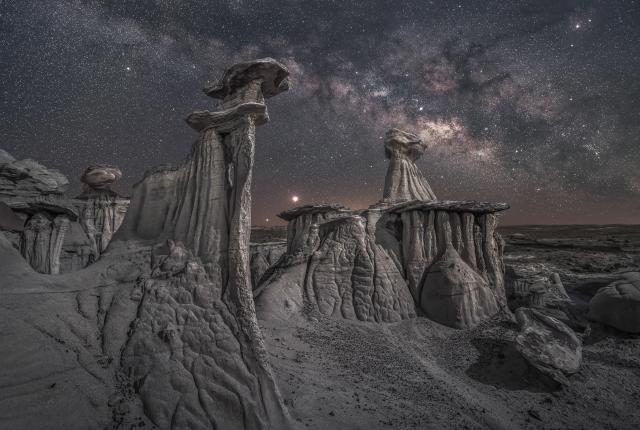
BISTI/DE-NA-ZIN WILDERNESS AREA, BLOOMFIELD
The lattice of colorful badlands, clay hills, and hoodoos located south of Farmington marks the remains of an ancient seaside swamp that was home to trees, reptiles, dinosaurs, and primitive mammals 65 million years ago. “The colors and the textures that you get from the Bisti Badlands is because they’re shales and sandstones, so these are rocks that formed when New Mexico had an ocean,” explains Nels Iverson, a geochemist with the New Mexico Bureau of Geology and Mineral Resources. “Some of the largest dinosaurs on the planet were walking around as these sediments were being formed.”
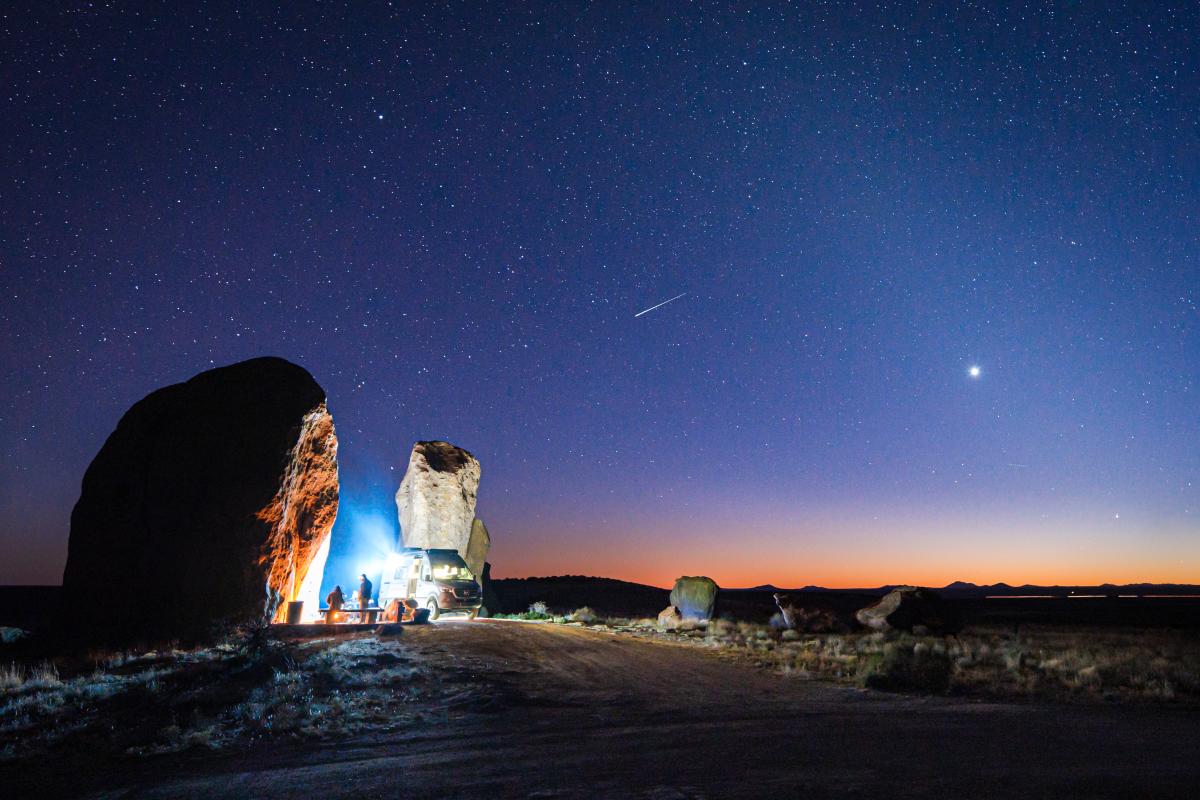
CITY OF ROCKS STATE PARK, BAYARD
A volcanic eruption 34.9 million years ago blanketed southern New Mexico in a layer of ash now called the Kneeling Nun Tuff (most famously found in the formation that bears its name in the cliffs at Santa Rita). But in what’s now City of Rocks State Park, that tuff filled a low point, and over millions of years, erosion cracked and wore away some of the rock to create a latticework of tawny domes that hikers now meander and campers sleep among. “It’s like walking down the streets in a city, but all the buildings around you are columns of rock,” says Nelia W. Dunbar, director and state geologist emerita with New Mexico Bureau of Geology and Mineral Resources. “The fracture pattern that got the erosion started is kind of a right-angle fracture pattern.”
GOBLIN COLONY, JEMEZ PUEBLO
Something like alchemy created the haunting features at what’s now called the Goblin Colony in the Jemez Mountains. When the volcano central to the Valles Caldera National Preserve erupted just over one million years ago, ash flowed into what was likely an ancient stream valley, and that water strengthened the rock into tubes and pipes. As softer material eroded away, mazelike, gnarled pillars and fins of pinkish-tan tuff emerged. “The amount of erosion that’s happening on each of these columns—which can be, like, five meters tall—is very different,” geochemist Nels Iverson says. “So they all kind of have their own appearance and character, kind of like we all have our own personalities.”