


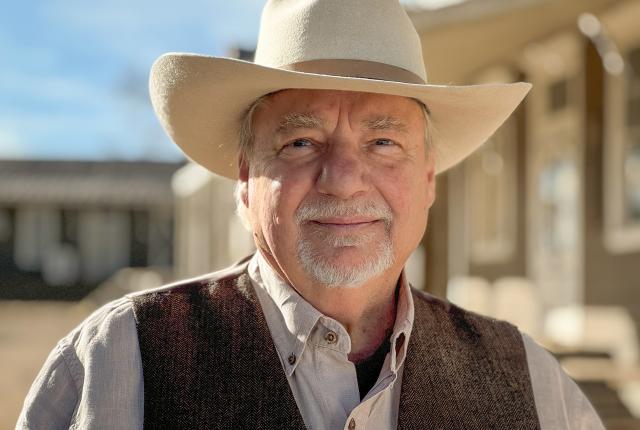
PAUL ANDREW HUTTON saw Walt Disney’s Davy Crockett: King of the Wild Frontier for the first time when he was six years old. “That just stamped itself on my psyche,” says the longtime University of New Mexico history professor. Adopted by a U.S. Air Force family stationed in Germany, Hutton lived all over the world, but the American West was always in his heart and mind. That passion has translated into award-winning books, appearances on A&E’s The Real West, and consulting work on Hollywood films. His new book, The Undiscovered Country: Triumph, Tragedy, and the Shaping of the American West (Dutton), which came out in August, chronicles the exploits of Daniel Boone, Red Eagle, Davy Crockett, Kit Carson, Sitting Bull, Buffalo Bill Cody, and others. “I confess to having a very romantic image of the West,” says Hutton, who serves as interim curator of the Buffalo Bill Museum in Cody, Wyoming. “There’s an air of romance in the book, but it’s tempered by tragedy.”
I did a lot of television starting in the ’90s, when Ken Burns had all that success with his Civil War documentary.
I did two specials for the History Channel, 35 years ago, about Crockett, Carson, and Cody that formed the nucleus for this book.
Everyone thinks they know these characters. But we know the story based on what we learned in grade school or from movies.
These White pioneers were reinventing themselves as they moved across the country. What a time of incredible dynamic change.
Daniel Boone has a series of incredible adventures, but he loses two sons, a brother, and a brother-in-law in the fight to settle Kentucky. The price is too high. He flees to Missouri.
Red Eagle is trying to protect the Creek Confederacy against the pressures coming from the British, the Spanish, and most especially the Americans.
He has a series of victories, but then he’s defeated and eventually his people are removed from their homeland.
For people like Andrew Jackson, the goal is to seize that land.
Davy Crockett’s political career was fighting for squatters’ rights for the pioneers who built their cabins, put in their crops, raised their kids.
Then in comes the government, which says they have no right to this land.
Crockett saw the same thing with Native peoples, so he stood up in Congress and spoke against Andrew Jackson’s inhumane removal bill. It cost him his political career.
The destruction of the buffalo leads to the implosion of Native societies in the plains. They have no way to feed themselves, no choice but to go on the reservations.
Buffalo are replaced by cattle, which feed the millions of immigrants coming into the East every month.
People like Boone, Crockett, and Carson are interrelated with Native peoples. They live with the land and understand its rhythms.
They come to understand that they have more in common with the Indians than with the people in the East who are pulling the strings, causing these wars.
These White characters, in their way, are paternalistic. They think Native people need to assimilate. That’s an 18th- and 19th-century concept. It’s only in the late 20th century that that begins to shift.
I don’t think I’m sugarcoating anything.
The only way to reconcile the past is to recognize our common humanity.
SEE FOR YOURSELF
See Paul Andrew Hutton at the Coronado Mall Barnes & Noble, in Albuquerque, on October 18. Follow him at facebook.com/paulandrewhutton.