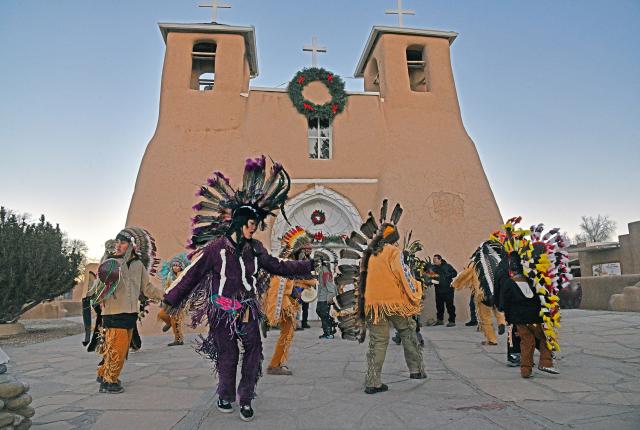
Dances begin after dawn on New Year’s Day in front of the San Francisco de Asís church.
THE FIRST SUNRISE OF 2025 has yet to warm the buttresses of San Francisco de Asís church in Ranchos de Taos. Several dozen people shiver in its front courtyard. A few wear a hodgepodge of ceremonial regalia—Plains Indian–style headdresses, fringed tunics, suede leggings with jingles, a shield emblazoned with an Aztec bird.
Soon, from inside the 200-year-old adobe mission, a drumbeat sounds. Hesitant at first, then steadying into a rhythm, it’s joined by other drums that call to those assembled. We, the observers, enter first, finding seats below the ceiling’s hand-carved vigas. Finally, the dancers of Los Comanches de la Serna file in, their steps adding tones of rustling feathers and tinkling adornments to the drums’ cadence.
The brief prayers that follow herald a full day of songs and dances here and in the nearby villages of Llano Quemado, Talpa, Córdova, and La Cordillera. The celebrations resound at any house where someone named Manuel or Manuela lives, to commemorate St. Emmanuel’s Day, January 1, when the baby in the manger was christened.
“We thank God for the past year and ask him to be benevolent and give us a better year,” says Francisco “El Comanche” Gonzales, who grew up in the Los Comanches tradition and has led it in recent decades. “To my knowledge, since the beginning of this community, these dances have happened.”
from left
A dancer with swirling tropical feathers. Because Los Comanches de la Serna is a cultural group and not a federally recognized tribe, their regalia uses not eagle but turkey, parrot, and pheasant feathers.
Not precisely Native and not exactly Hispanic, these New Year’s Day dances and songs grew from an often-ignored era when a peculiarly Southwestern form of slavery burned a lasting scar into the New Mexico story. Starting in the Spanish colonial era and lasting into the American occupation, the trading of people—mostly women and children—thrived among various tribes and settlers.
The Comanche (or Numunuu) people did much of the raiding and trading, but their members were taken, too, as Kiowa, Ute, Apache, Navajo, Paiute, Pawnee, and Pueblo people participated in and were victimized by slaving. Settlers would skirt antislavery laws by “ransoming” captives and then forcing them to work off the debt and assimilate to their new household’s language, religion, and customs. (Thousands of captive men were sent to work in Mexico’s silver mines.)
The result was a new type of Indo-Hispano person, the Genízaro, who was once described as a detribalized Native, a summation that discounted their heritage as well as the important role their members played in remote and dangerous communities.
Stephanie Gonzales keeps the beat.
From the 1790 census, when a variety of existing and freed slaves accounted for one-third of the population, to a mid-20th-century era when “Genízaro” became a slur to hurl at a naughty child, the mixed cultural identity quietly prevailed in communities like Ranchos de Taos, Abiquiú, Carnuel, and Tomé. In the last few decades, historians, folklorists, and photographers have documented the ceremonies, song lyrics, and genealogies, producing books, documentaries, and music collections. Their results combine the triumph of a people’s spirit with the sobering reminder of what they were forced to endure.
“The stigma of bondage follows them into freedom,” says Enrique Lamadrid, a professor emeritus of the University of New Mexico, who has written extensively on Genízaros. “It’s historical trauma.”
He loves coming to the New Year’s Day event, which he sees as an assertion of cultural redemption. But he warns: “If you don’t get there at the right time, it’s hard to find them. One year, I missed them at the church. You can hear the drums from way off, but I could never find them.”
Los Comanches dance for lifelong resident Julia Valero, now age 102.
Outside the church, the drummers and singers choose from a small repertoire of songs to kick off the day’s ceremonies. Veteran dancers recognize the tune and lyrics—many of them little more than “vocables,” or repeated syllables, like hey-a hey-a hey-a. They begin tracing the steps of a round dance and then an animal dance, one honoring the eagle. Children follow along, sometimes fumbling toward the rhythm.
“Once in a while I can get a bunch of kids together for rehearsals,” Gonzales says. “But it’s mostly the older ones who teach the younger ones. It’s a community process.”
Other Indigenous people have accused the dancers of playacting at being Native. Genízaros can’t claim tribal enrollment or federal recognition. They can’t possess real eagle feathers. “Some people say we’re wannabe Indians,” Gonzales acknowledges. “I tell the children, ‘You know what you are, and that’s what you are.’ I try to bring to the children to have pride in who they are and what’s around them.”
Their dances lack powwow polish, but the determination on each dancer’s face speaks to their commitment. Some, like Gonzales, can trace their lineage to Comanche people. Others may never know their precise roots. Regardless, he says, many of their ancestors likely spent time in Comanche camps, where the drumbeats and songs became a kind of primal memory.
from left
Dancer Estevan Gonzales. Manuel Vigil has danced with the group since he was nine.
“The influence of the Comanche stayed with these people,” he says. “They saw the traditions. They have it in their heart.”
That partly explains why Los Comanches would honor a tribe that inflicted depredations on at least some of them. Another explanation, Lamadrid says, is that Comanches were cool.
“They were fierce warriors, incredible horse people,” he says. “They were visually striking, with fur wrapped around their braids. Comanches were so charismatic that they became iconic. Pueblos do Comanche dances, too, but some don’t do them very often because it brings back bad memories.”
Still, he says, “if you’re from the pueblo and dress like a Comanche, you’re sharing in the power and celebrating the peace” that was eventually achieved.
Years of treaties interrupted by violence lasted into the American era, but Genízaros needed more than an end to fighting. Once they earned their freedom, questions of what to do next persisted. Some had successfully blended into their adopted families. Some could find their way back to their tribal people. Others couldn’t—or had lost any memory of who they had been. Where were they to live? And with whom?
IN A WORD
Genízaro(hen-EE-zah-roe) derives from the Turkish term yeniçeri (or janissary) used to describe elite fighters during the Ottoman Empire. The janissaries were abducted as boys, mostly from Christian homes in the Balkans. They were forced to convert to Islam but in turn received intense training and served as the sultan’s soldiers from the 14th through 19th centuries. Because the Spanish word translates to “slave” or “servant,” many people prefer to call themselves “descendants of Genízaros.”
In the Spanish colonial era, one solution was to include Genízaros in the land-grant system. That generally meant stationing them away from existing settlements where they could ward off raiders while also clearing land, building fortifications, farming, intermarrying, and raising families.
“The first one was Belén, where about half of the grantees were Genízaro,” Lamadrid says. “They only recently discovered La Plaza de Genízaros [the heart of the townsite], a corner of it, near the
Harvey House.”
Such discoveries are fueled in part by a surge of new scholarship on slave history in the Southwest. As state historian in 2007, Estevan Rael-Gálvez pursued the successful passage of a legislative memorial acknowledging the contributions of Genízaros to New Mexico history and their continued legacy here. For many, it marked an introduction to a neglected past. Since 2022, Rael-Gálvez has expanded that introduction into a hemisphere-wide digital project. Native Bound Unbound documents the lives of enslaved Indigenous people throughout the Americas.
As he writes on the recently launched website: “Recovering these stories is especially critical … for descendants, for whom this history has been quieted over the years by whispers as much as by silence, unknown perhaps but still held in an aching consciousness. In this way, the project holds the potential for transcendence and healing.”
“To my knowledge, since the beginning of this community, these dances have happened.”
—Francisco “El Comanche” Gonzales
In 2024, the RanchosValley faced a threat of partial annexation by the Town of Taos. Hank Saxe and Cynthia Patterson, a couple who describe themselves as “Anglo newcomers”—having moved to a house near San Francisco de Asís only 47 years ago—helped stave off that fate. They gathered images, documents, and oral histories that emphasized the distinct identities of the region, which included Los Comanches.
“We’re mere bystanders,” Saxe says of the New Year’s event, “but we value being vecinos in a place where this kind of community endeavor can happen and has happened for a few centuries. It’s a privilege to follow the Comanches as they make their rounds. The great generosity of people like Francisco and the many Comanches who keep reaching out to the young members of the community keeps this vital.”
Los Comanches sponsors an after-school program for elementary students at the Taos International School, where children learn about the songs and dances as well as their significance. The goals are to attract more dancers and build awareness of the culture.
In decades past, Los Comanches performed on the powwow circuit and at the Smithsonian Folk Life Festival, in Washington, D.C. Locally, they appeared at funerals and weddings, but those kinds of bookings have tapered off in recent years. And so, nostalgia plays a part in how the New Year’s event unfolds. The drummers and singers pick and choose which songs to perform, sometimes for no reason other than that a member who couldn’t be there liked it.
Francisco “El Comanche” Gonzales celebrates his birthday with family and friends.
“One song honors combatants, and the dancers emulate the actions of combatants,” Gonzales says. “The bull dance honors bulls for protecting their domain. The coyote song honors their ability to keep from getting caught by trappers or hunters. Some of those songs we’re losing because they’re not that easy to dance to. It takes practice. People don’t have time.” One of the songs they’ll perform during their visits on this New Year’s Day is “La Rueda,” which could speak to a past trauma. But the dancers, portraying captors, give it a brighter meaning by gathering around their captives, the homeowners, symbolically freeing them at the end with handshakes and hugs.
Before they travel the curving maze of roads connecting the villages, though, they have a close-by stop to make to a non-Manuel resident. Michael Howsden and his wife, Sarah, recently moved into the community. He grew up with his grandparents in Utah, though they held deep roots in Ranchos and returned every summer. As a child, he danced with Los Comanches at the Fiesta de Taos parade.
After living in the Washington, D.C., area and working on the tech side of publications like Scientific American, he chose to work from home, and “home” had come to mean Ranchos. Gonzales recently gave him a drum to practice on, and Howsden has helped develop the group’s application for nonprofit status.
“People grew up with these things,” Howsden says of the ceremonies. “They’re attached to them as a way to express yourself and your emotions. You take a part of yourself that wasn’t there before and you get something out. That’s attractive to me.”
He and his wife reward the day’s drummers and dancers with breakfast burritos and hot chocolate. Gonzales, who’s attached to a portable oxygen tank, rests in their courtyard. He’ll be 84 at this year’s celebration. When we spoke last summer, he had a mild case of Covid. Where will the group be in a future without him? His siblings, children, nieces, and nephews will be here, he assures me, along with stalwart members of the group.
Howsden shares his confidence. “It’s about continuing the heritage for the next generation,” he says. “America and globalization has kind of washed out a lot of culture, but here, we can still have our own dialect, our own food, the things that make a culture a culture. Genízaro is one part of it, but it’s not the whole of it. It’s the fact that we still have our own culture.”
Kate Nelsonnever passes up an opportunity to learn more about New Mexico’s culture and history.
HAIL 2026
Join Los Comanches de la Serna during the New Year’s Day celebration, which starts around 7 a.m., at San Francisco de Asís church in Ranchos de Taos. The event is free and photography is allowed. You can then follow the group’s caravan of cars and trucks, but be forewarned: One missed traffic light and you might get lost.