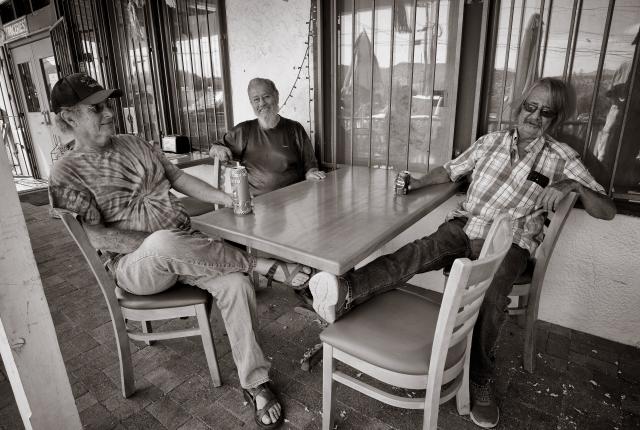
Nearly a quarter century after inaugural state poet laureate Levi Romero began investigating the historic northern New Mexico village tradition of resolana, he reflects on how gathering spaces—and the art of plática, or casual but meaningful conversation—have changed in his hometown of Dixon. Or have they?
From left, Clovis Romero, Louie “Fisher” Roybal, and Larry Williams catch up at La Tiendita. Photograph by Donald J. Usner
IN 2001, New Mexico Magazine published my article “La Nueva Resolana: Norteños Find Respite in New Gathering Places.” In the manito traditions of northern New Mexico, resolana is synonymous with people congregating in the warmth of the sun, usually along a south-facing wall shielded from incoming breezes, to discuss and observe current events, share the latest gossip, and partake in plática. “Resolana,” I wrote then, “had traditionally served as a communal discourse through informal conversation for the acquisition and dissemination of information and knowledge.” I suggested it was also “a means by which collective memory, language, and cultural traditions had sustained the spiritual essence of village life.”
At La Tiendita these days, which is what we call the Dixon Cooperative Market in my hometown, the informal setting outside the storefront reflects the social and cultural diversity of the village. The resolana serves as a form of communion, where villagers sit, talk, laugh, and share reflections on life’s pleasantries and unpleasantries. Whenever I feel the need to hear an insightful story, catch up on the latest mitote, or engage in plática with folks trading off chistes and the latest news, I head over to La Tiendita with the hope of finding Clovis, Fisher, Dolores, or someone else sitting under the portal to help break the monotony of the afternoon.
The patio of the Dixon Cooperative Market offers an easy gathering place.
Sometimes something new and interesting will be fodder for conversation. Other times, Fisher may say, “No hay nada de nuevo—es la misma gata nomás que revolcada.” (“There is nothing new—it’s the same cat, except thrashed about.”) Overcoming a sense of shame for the guilty pleasure of chisme I allow myself, I recall an elderly gentleman reflecting on the resolaneros from his village: “Tenían las esquinas de las paredes gastadas, tanto estar en la resolana.” The image of the corners of the buildings in the plaza of his village, worn out by the men standing in the resolana, comes to mind. There can be discussion on serious subjects and news or just idle talk.
Besides offering locally grown organic produce, breads, pastries, snacks, groceries, and a deli, the coop provides opportunities for socializing. Dixon was once a thriving northern New Mexico community that had three general stores, three gas stations, two bars, and a post office; all places where people stopped and talked when they came into town. By the late 1990s, the commercial establishments had all closed. The new post office’s solar orientation—with an entrance facing north rather than south, where people used to hang out and visit in the warmth of the sun—no longer functioned as a place for resolana.
Newcomers and lifelong residents were left without a spot in the village where they could socialize and nurture a sense of community, even if just in passing. Many towns that once thrived with general stores, small businesses, and other informal gathering places have lost their resolanas, overtaken by behemoths like Walmart, Dollar General, and chain fuel stations and mini-marts.
Two women engage in plática on the porch of La Segunda Secondhand Store, in Dixon.
Clark Case, one of the founders and visionaries for La Tiendita when it opened in 2005, recalls the impetus for the coop. “The town needed a place to go, even if just to get a newspaper or a soda,” he says. “But for it to be successful, it had to be a broad representation of the community.”
Over the past 20 years, even that has evolved. In 2023, the coop started hosting open mics. They are held the first Sunday of every month, showcasing live music and poetry on the patio, and reminiscent of traditional salas that once provided a place for entertainment. “The music is an extension of resolana,” Clark says. “People feel content.”
But still, “What happened to la resolana,” they ask outside La Tiendita. Or, more philosophically, “¿Qué pasó con la minifalda?” They’re not literally asking what happened to the miniskirt but referencing a line from a popular 1970s Spanish song to ask where the informal community gathering place went.
Eppie Martinez and friends use a remote switch to hop a lowrider in Chimayó, in 2012.
This is how it goes in La Nueva Resolana. Dichos, refranes, and colloquialisms are still used as forms of expression. Carrilla, a form of humorous friendly teasing, colors people’s conversations. “You wrote a book, huh? I didn’t think you even knew how to read,” a neighbor teased one afternoon when they saw me. Used constructively, carrilla can keep a person’s sense of self from getting too high or too low. In the resolana, it works as a system of checks and balances.
At a recent City of Santa Fe arts program honoring creativity and cross-cultural exchange, Cipriano Vigil, a New Mexico Music Living Treasure, was asked what he thought would be the most important Nuevo Mexicano tradition for the future. “Resolana,” he answered.
Spectators watch a car show in Española, in 2012.
MY LATE PRIMO Tomás Atencio—a sociology professor at the University of New Mexico and founding member of La Academia de la Nueva Raza, a grassroots organization established in the late 1960s and early ’70s for the preservation of northern New Mexico culture, history, language, and traditions—often used the concept of resolana in his work.
Recognizing the importance of these informal settings, La Academia incorporated them into the process for gathering and documenting people’s stories and histories. Dialogue and conversation with everyday folks informed their work on the preservation of manito culture that was on the precipice of being lost. They shared their findings in self-published journals and newsletters, networking with men and women from other villages who were also engaged in the same type of oral story documentation.
Many resolaneros and resolaneras from the village—local Hispanos who did not adhere to social norms—tended to be ostracized within the larger community. They didn’t seek employment at Los Alamos National Laboratories. They spoke the local Spanish variant of their ancestors and were viewed as non-progressives. The acknowledgment of these people by La Academia was important and foundational to celebrating their subjugated knowledge and traditional lifestyles. As unconventional as these locals might have been, they found an inviting and receptive informal community gathering place at La Academia’s headquarters in the old Plaza de San Antonio del Embudo.
“Places like FM Hill and El Car Wash, where we hung out as young lowriders, are now abandoned and filled with weeds. But they are still talked about, because life goes on in that way: remembering, remembering, remembering.”
—Levi Romero
I grew up around La Academia. I remember the creative energy that flowed through their headquarters, la casa Durán, which had been the house of my great-grandparents Elique and Alcarita Durán. After La Academia set up their headquarters in my visabuelas’ house, they removed the cardboard ceilings to expose the vigas, peeled off the wallpaper to reveal the adobe plastered walls, and removed the linoleum to uncover the wood floors.
These organic intellectuals practiced their own forms of deconstructivism as cultural purists and were serious about reclaiming their past. They beamed a light of reflective consciousness at their own cultural upbringing and celebrated the spiritual and physical realm of their pueblitos, not as un ejemplo de pobreza pero un modelo de nuestra riqueza. They embraced the notion that their village way of life was a model of rich traditions and history rather than a form of poverty.
My interest in incorporating resolana in contemporary building design was heightened when I was a graduate student at the School of Architecture and Planning at the University of New Mexico in 1999. I was given an assignment to create a conceptual design project titled “The Library of the Future.” My limited computer design skills prompted me to consider a library concept that would counter the rapidly evolving digital age. Recalling Tomás’s conversations on resolana, I invited him to speak to my studio class about how this vanishing practice could serve as a futuristic model for storing and sharing knowledge and information. He called resolana “a place of warmth, light, and tranquility”—a repository for people’s histories, stories, and wisdom made accessible through dialogue and discourse.
Tom, Telesfor, and Narciso Montoya take in the resolana in Chimayó, in 2011.
In my graduate thesis, I argued that with increased disconnection via the internet and other Information Age modes of communication, people would crave the direct human interactions inherent in traditional resolana. Over the past 25 years, the evolution of resolana throughout the digital age, and during the rise of social media and the Covid-19 pandemic, has been an intriguing question. Many of the locations that were thriving resolana spaces—rural parking areas and volteaderos, or roadside turnarounds where people once gathered informally—have given way to places with the best cellphone reception.
“I go there to use my cellphone,” a friend reflected recently about a spot near the place we called El Car Wash. “Then I see someone else in their car. Before we leave, we are talking and sharing updates with each other about something that recently happened in the village or sharing the mitote that we had just heard about on our phones.”
Places like FM Hill and El Car Wash, where we hung out as young lowriders, are now abandoned and overgrown with weeds. But they are still talked about, because life goes on in that way: remembering, remembering, remembering.
Loyola Montoya visits with friends on her father Ezequiel’s porch, in 2010.
A FEW WEEKS after I was selected as the first New Mexico State Poet Laureate in 2020, the pandemic emerged. The state Department of Cultural Affairs’s plans for in-person presentations at libraries, community centers, schools, and literary venues across the state were thwarted. Zoom became the online platform by which I could assume my duties. I worried that the connection with the audience and the informal nature that occurred with in-person readings and presentations would be lost.
But I soon found that the online events enabled larger and more diverse audiences to access the readings and even share their own work. What might have been only a few poets and attendees at a local venue became a collective that spanned local, national, and even international communities. I organized weekly virtual poetry readings and highlighted individual poets through my social media page. Using resolana as a model, my tenure as laureate focused on promoting other poets and introducing them to diverse audiences. Minus abrazos and other physical gestures of friendship, we were still able to create amistad and community through poetry.
In the face-to-face classroom settings at the University of New Mexico, where I have taught since 2011 as an associate professor in the Chicana and Chicano Studies department, I often used the concept of resolana to create an inclusive environment that inspired dialogue, reflection, and inquiry. The sharing of stories, knowledge, and information served as a catalyst for learning. How would I be able to replicate resolana through an online classroom? I wondered.
Folks gather at the Dixon coop.
After careful consideration, I decided to incorporate pláticas inspired by the reading. During the first class of the semester, I gave the students the option to post their reading reflections and questions through chat groups or to talk about them during the class sessions. “We already spend way too much time on our computers. Why don’t we address the discussion prompt questions in class?” I suggested. The students agreed enthusiastically. The traditional resolana format not only helped to establish a sense of community among the students, it made it possible for everyone to contribute from their own interests and experiences.
During one memorable class, a Native student who was sequestered with her partner at one of the pueblos shared how they had been tending to the family’s sheep earlier that day and had to bring an ewe indoors because it was too cold for it to be out in the corral.
“Is it with you now?” one of the students asked.
“Yes, I have it with me.”
“Let us see it!” the students requested.
The student held the ewe up to the camera. Everyone became enamored with Skip the ewe and thereafter looked forward to seeing it cradled in her lap during each session.
A family cools off at La Nasa, a swimming hole in the Río Grande, near Dixon.
In another class, we were discussing traditional gardening methods. The student told how she and her partner had been prepping waffle gardens earlier that day. Her boyfriend happened to be sitting next to her and could be heard in the background describing some of the waffle garden techniques they used. When I asked if he would like to speak to the class, he shared their traditional methods. In fact, his informal participation in our classroom pláticas became frequent throughout the semester, adding ancestral knowledge to what we were reading about acequia irrigation methodologies and other agrarian traditions. This is an example of what Tomás Atencio called resolana electrónica.
In my two-week summer field class, Community-Based Archaeology and Oral History of Indo-Hispano New Mexico, taught in conjunction with anthropology professor Severin Fowles from Barnard College and Columbia University, students are placed in direct conversation with people from the northern New Mexico communities in which they are working. I use cruising, or dando la vuelta, a favorite pastime of mine from my younger lowriding days, to introduce students to local people. Severin describes the exercise as “driving them around town, treating them to meandering cruises that are saturated with place-based narratives and chance encounters with locals that often expand into afternoons of storytelling.”
In addition, students use artifacts from their archaeological findings—bottles, linoleum fragments, car radios, and other discarded objects—as a conversational spark, asking people at the senior center and community library to reflect and tell stories about some of the objects that they recognize. Often, the least compelling archaeological remains become the most compelling. They have found their story. Those objects, alongside the pottery and animal bones that our UNM, Columbia, and Barnard College students put on exhibit in the community library and senior center, incite reflection and plática. Our ancestors’ voices speak to us in the resolana.
Clients wait for their haircuts, passing the time with chisme and mitote in Erasmo’s Barbería, in Chimayó, in 2013.
I RECENTLY OVERHEARD a conversation at La Tiendita where someone remarked, “People don’t visit with each other, only at weddings and funerals.” Someone else added, “But no one gets married anymore.” There was a pause for contemplation. Another person reflected, “Nowadays you can’t just drop in, you need to call before you go by.”
Although no one mentioned it by name, they were alluding to resolana and how it has become a rare activity. They were lamenting the lack of easy socializing even as they were enjoying the collective complaint.
Rural villagers were unable to attend rosaries or funeral mass when a neighbor or relative passed away during the early pandemic. People paid their final respects while parked along the roadsides as the hearse and immediate next of kin drove up to the church. People grieved alone without the presence of community to provide comfort. Barber shops and hair salons—places where one could share and hear stories—could only accept one client at a time. Gone were the informal gathering spaces that nurtured our collective existence.
Friends joke while playing bingo at the Dixon senior center.
Thankfully, the religious traditions and rituals in the kivas, morada prayer chapels, tribal chapter houses, and other places of prayer and spiritual fellowship are once again able to be observed. Feast days, matanzas, and small-town fiestas—when people invite friends, relatives, and strangers into their homes for food and mingling—can once again be celebrated. These occasions honor nuestras tradiciones and create spaces for resolana as a spiritual supplement in our daily lives.
The annual acequia meetings, held in spring to discuss the upcoming irrigation season, bring the parciantes together. And although the discussions may entail serious matters, the meetings are always sprinkled with personal conversations as people catch up after the long winter. It is true that agua es vida, but without plática, all the water in the acequia cannot quench our thirst to live in harmony and communication with each other.
Resolana has been referred to as the third place, where people gather to visit and that they use as a space for dialogue and reflection. Resolana es un lugar sagrado, a sacred space wherever two or more are gathered in the name of community. Whether at a coffee shop, brewery, Walmart, casino, winery, the Rail Runner Express, or other contemporary settings where people meet formally and informally, it is through resolana that we can maintain a nurturing, healing, and healthy social and cultural ecosystem that thrives on direct human interaction.
“Hablando se entiende,” my mother used to say. And she was right; it is through dialogue that we can know and understand each other.
Chimayó community members pause for conversation while tending to graces at Potrero Cemetery in 2011.
BLACK-AND-WHITE vintage photos of people from aquellos tiempos antepasados hang on an interior wall at La Tiendita. An elderly gentleman once pointed out the various individuals from bygone eras. “This one was my primo,” he said. “She was my tía.”
To him, they were not mere images of people captured in old photographs. They held local histories and memories of a time when people’s relations were honored. But they are still. On one of the store’s exterior walls, a ceramic mural maps local place names. Under the portal, a bench bears a small plaque inscribed with the name of Ivan Archuleta, a resolanero who frequented the coop.
Together, they serve as reminders of a past that lingers on. As with the resolana, these are dedications to the preservation of memory. For no one is truly dead until their name is no longer spoken or remembered.