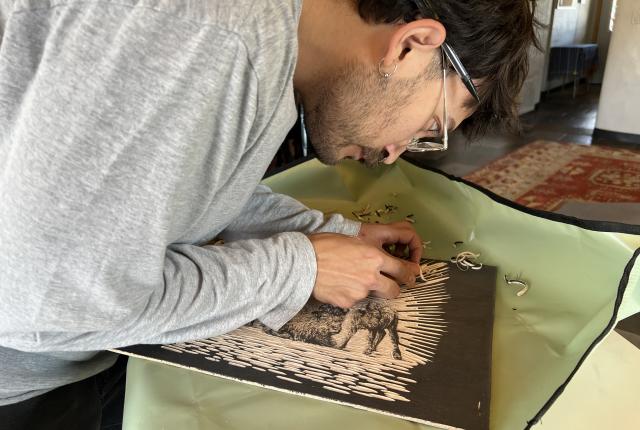
OUTSIDE THE RISOLANA ART CENTER in Albuquerque’s South Valley one recent evening, a happening unfolded that felt far-removed from the galleries of Nob Hill or downtown. Visitors were greeted by picnic tables richly laden with red chile enchiladas, green chile stew, charro beans, and chicharrones, all homemade by the family and friends of artist Jacob Gutierrez. A crowd from all walks of life lined up to feast. It was a fitting tribute to the work on display inside: Gutierrez’s first art book, Sacred Herd, a 17-panel collection of hand-carved woodcut prints exploring what he calls “the sacred New Mexican practice of ranching and sheepherding,” with accompanying text that gathers oral histories culled from ranchers across the state.
Born and raised in the Duke City, Gutierrez is Risolana’s fourth artist-in-residence to produce a book from the art center program, which is designed to guide artists of all mediums through the process. He printed Sacred Herd in a limited edition of 36 on a Risograph, a stencil-based digital duplicator that bookmakers, artists, writers, and organizers find efficient for ink printing in mass quantities.
Opened by Michael López and Karl Orozco in 2021, Risolana is New Mexico’s first Risograph studio, offering workshops, educational programs, and print services in addition to the annual summer residency. In their words, the aim is to “cultivate an art-making space as accessible as the Risograph itself.” (The term resolana, a sunlit community area that fosters conversation and connection, inspired the name Risolana.)
The wire-pages of “Sacred Herd” include stories of contemporary ranchers.
Photograph courtesy of Jacob Gutierrez and Risolana.
“We work with a lot of community members who are designers and artists who understand the digital side of things,” López says. “We call them design jockeys.” The learning often begins at Risolana’s monthly Thirty Under Thirty sessions, in which attendees pay a suggested donation of $30 for a half-hour session to help fine-tune illustrations, photos, and text to suit the Risograph medium for two-color printing. “They’re hyper-affordable,” López says of the sessions, “and people can observe for free.”
On the cusp of its sixth year, Risolana’s reach is expanding, with a growing collection of art posters, prints, books, and calendars for sale online and in its on-site shop. New exhibitions are regularly mounted in the center’s Sala, and institutions such as the Harvard Fine Arts Library have become edition collectors of the residency-produced books.
Gutierrez says Risolana’s guidance encouraged him to expand the book with stories from contemporary ranchers. “As I was visiting all these ranches and people, it became so personal,” he reflects.
Past artists have hosted other buzzworthy book launches: 2024 resident Ray Kim presented a performance where she tattooed her own body with healing mugwort-derived ink. López says the Risograph is the conduit for these connections. “The Riso is kind of like a sounding board for us to learn about ourselves, learn more about our stories, and also learn about process,” he adds.