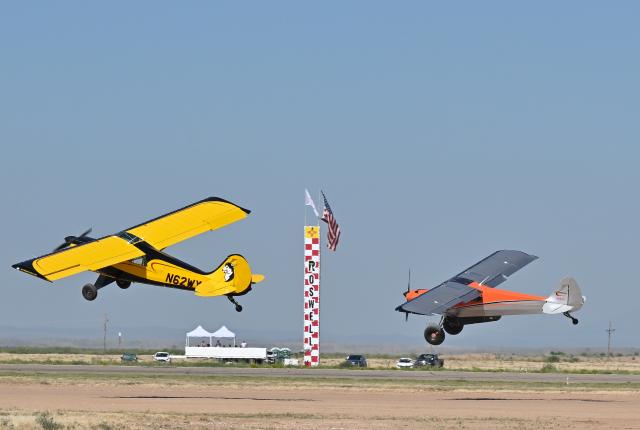
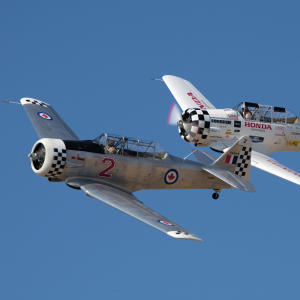
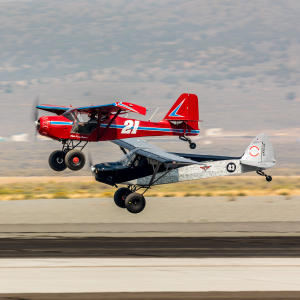
STOL drag race pilots Austin Clemens, left, and Cathy Page fight to the finish at the National Championship Air Races in Roswell. Photograph courtesy of National Championship Air Races.
I CLAP MY HANDS over my ears todeaden the roar as six military training jets thunder over the Roswell desert at close to 400 mph. Jostling for position along the 10.3-mile course, the modified Aero L-29 Delphín and L-39 Albatros jets fly just 50 feet off the ground—so low that the rivet holes on a pilot’s flight helmet are visible through the cockpit. Turning a complete lap every 60 seconds, the mid-wing aircrafts first appear as dots on the horizon, hurtling closer like painted bullets, the rumble of their engines arriving a split second before their lean, colorful shapes cut through the air.
It’s Thursday afternoon, the second day of competition at the National Championship Air Races, and I’m out by one of the far pylons with a group of writers and photographers granted special field access to this high-flying motorsport’s debut at the Roswell Air Center. Except for us and a few race judges and staff, there’s no one for miles.
During earlier qualifying for the Jet class, pilots Bob McCormack, Scott Farnsworth, and Jerry “Jive” Kerby clocked the fastest speeds of the six entries. But in this heat, Tam Camilleri’s No. 61 Miss Independence jumps out in front.
The National Championship Air Races opens with a military color guard and welcome ceremony.
Behind her, a battle ensues for second as Farnsworth’s navy-blue L-39GXT runs almost neck and neck with Kevin Roll in a L-29 Delphín, as they tightly maneuver around the 10 red-and-white pylons in a complex ballet of steel, horsepower, and aerial finesse.
Much like auto racing, it’s a dangerous game. Pilots must trust each other even during fierce competition. The top finishers of each heat—including Camilleri and Farnsworth—help determine who competes in the gold and silver races over the weekend.
“This is a truly momentous occasion for the National Championship Air Races,” Fred Telling, Reno Air Racing Association CEO, tells me later. For 60 years, the Air Races had called Reno, Nevada, home. But safety concerns from encroaching development around the Reno Stead Airport meant they had to find a new site for the September event that draws upwards of 110,000 fans over five days.
In 2024, Roswell beat out 38 other cities to host the Air Races. So the tension isn’t just among competitors. Since winning the bid, Roswell officials and the racing association have worked with the state to secure $28 million in infrastructure funding to make these races and the event’s accompanying aircraft exhibits, air show performances, STEM discovery zone, and hospitality possible.
“FIFI,” the B-29 Superfortress, draws crowds.
AS THE RACING STARTS ON WEDNESDAY MORNING,Roswell Mayor Timothy Jennings steps to the podium to officially cut the ribbon on the Air Races. “On behalf of the City of Roswell, I welcome all our aviation enthusiasts,” Jennings tells a crowd of ticket holders, city and state officials, and local media. “This is one of the fastest and most thrilling events you will ever see.”
In its last year in Reno, the Air Races set an all-time attendance record and hosted more than 150 pilots in seven race classes ranging from stacked-wing biplanes to World War II–era T-6 military training aircraft. The transition to Roswell has encountered some turbulence, however, as the Unlimited and Sport classes opted not to participate in 2025. But organizers remain optimistic. “It’s great how the city and the state have jumped on board to take care of everything and to make sure everyone here feels so welcome,” says Bobbi Thompson, Roswell Air Center director and longtime Reno Air Racing Association board member.
“We had lots of things we needed [in a new city],” says Telling, a former pilot who raced in the T-6 class. “But the most important thing was a safe location for all of the seven classes to race.” Indeed, the wide, flat desert bordering the former Air Force base was determined to be well-suited for racing. Roswell’s quality medical facilities, including a trauma center, also played a part, just in case an accident were to occur.
Jet pilot Scott Gusakov waves before takeoff.
The synergy goes beyond the logistics, though. The city’s aviation and space history includes the work of Robert H. Goddard, whose 1930s breakthroughs in liquid fuel and rocket propulsion design laid the foundation for modern spaceflight. During World War II, the Roswell Army Airfield served as an advanced pilot and bombardier training facility that graduated more than 14,000 fliers. Renamed Walker Air Force Base during the Cold War, the site became the Strategic Air Command’s largest, with nuclear-capable bombers and high-altitude balloon testing.
None of that would matter, though, without the on-the-ground work at what feels like supersonic speed since Roswell was selected to host in May 2024. In a little over a year, five multi-mile pylon racecourses were constructed, a new 7,500-seat grandstand was built, and fresh roads were carved throughout the Roswell Air Center. In January, around 15 pilots turned out for a test run on the budding courses. When nearby hotels booked up well in advance, organizers worked with Artesia, Carlsbad, and other neighboring communities to provide additional accommodations. “This is new,” Jennings says. “It’s really a huge change in the short time we’ve had.”
Pilot Aaron Greer competes in the STOL drag races.
AS FRIDAY’S EARLY MORNINGtemperatures eclipse 80 degrees, spectators wearing wide-brimmed hats and toting umbrellas to protect against the sun are already filling the grandstand. Behind the seating, others take the opportunity to hit the merchandise booths selling custom gear for popular planes and pilots.
From my vantage point in the stands, the 50-foot-tall metal pylons marking the course rise like alien formations in the desert. While Reno’s bowl-shaped layout obstructed some views, Roswell’s flat expanse lets spectators see the entire race, even when the planes circle back in the course’s farthest points. In the box seating at the front of the grandstand, longtime fans use binoculars to follow the distant action. “We can do things at greater speeds that we couldn’t do before,” announcer Tommy Sanders exclaims over the loudspeakers to fans new and old. “All the classes have told me they’re loving it.”
As the action begins, two yellow Short Takeoff and Landing (STOL) drag racers make their way to the starting line—Steve Henry in the No. 44 Yee Haw8 in lane one and Rod Hewitt’s No. 11 Angry Kitten next to him in lane two. Just like in Top Fuel drag racing, the souped-up backcountry planes inch to the starting line together and await the “3-2-1-Go” countdown.
Fans take in the National Championship Air Races from a VIP area.
Henry, who has been among the fastest qualifiers, powers off the line, lifting the back taildragger wheel and big front tires off the ground. Hewitt can’t nearly match the quickness. “Listen to that Yamaha,” Sanders gushes as Yee Haw hums down the 2,000-foot-long track. “Three-hundred horsepower, 8,000 rpms.”
There’s more to the STOL race than sheer speed. Henry lands first and slams on the brakes, but Hewitt seems to close the gap as the Angry Kitten touches down and comes to a stop. “Rod’s quick in that Rans S-7,” Sanders comments. Still, Henry’s at another level, turning his plane around 180 degrees and flying back toward the starting line. With a tilt of the wings to slow his approach, Henry lands the No. 44 back where he started, coming to a stop for a commanding victory.
In almost no time, the heat is over. Both yellow aircraft head off the runway and two red planes take their place. In a race that’s almost dead even down the first leg, Aaron Greer edges Cathy Page at the finish, coming to a stop in just over a minute, for an exciting next heat. The pairings continue as the 10 pilots match up against each other for the head-to-head competition.
“The Mach course is the fastest course that’s ever been put together in air racing.”
—Jet class pilot Jerry “Jive” Kerby
In between classes, Sanders and his announcing partner Rob Lowe banter about the Air Races’s triumphant return: “We couldn’t be happier with this iconic American sporting event,” Sanders says. “We’ve got closed-course pylon racing, we’ve got great air shows, we’ve got everything. A big day of entertainment here.”
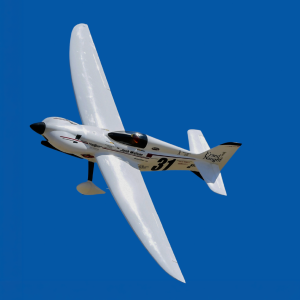
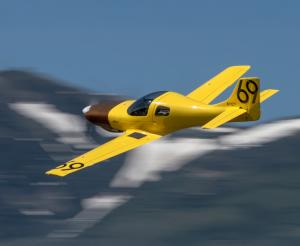
By mid-morning, Formula One planes are set to barrel down the straightway in front of the grandstand that’s known as “speed alley.” These kit-built, propeller-driven aircraft use identical four-cylinder Continental O-200 engines—similar to those found in a Cessna 150—so they all have the same power and speed. In F-1, winners and losers on the 3.19-mile course come down to the pilot’s skill. The eight-lap race around six pylons laid out in an oval covers a little over 25 miles.
We’re in the third round of heats now, with the slowest of the five qualifiers up first. The Grand Prix–style start begins with three rows of planes staggered for safety in a two-one-two formation along the runway. Crew members spin the single-mounted prop to get the engines started before the green flag drops. From the top of the stands, I can see five F-1 planes coming around in the distance. Churning at 160 horsepower, the fastest planes in this class can hit 250 mph.
Jerry “Jive” Kerby with his plane Ivan.
“Formula One is so exciting,” offers Lowe, a New Mexico native and longtime air show announcer. These small, high-performance aircraft with flat wings weigh about 500 pounds—or about two-thirds the weight of a Harley-Davidson touring motorcycle. They were developed as a lower cost and safer alternative to the big, expensive planes usually flown during the golden age of American air racing. “You strap these planes on more than you get into them,” Lowe adds. “It’s kind of like an extra-large backpack.”
All five planes in this heat take off simultaneously and bank left into a preparation lap before crossing the red-and-white checkered start-finish pylon. Chet Harris’s No. 00 Aught Nought roars from the second row to an early lead, passing pole sitter Carl Robinson in the No. 57 Heat Stroke. “Boy, he jumped out quick,” describes Lowe as No. 00 pulls away from the rest of the pack. By the second lap, Harris and Robinson have both lapped the fifth-place plane. “Pickin’ ’em up and puttin’ ’em down pretty fast,” Lowe says as Harris tops 220 mph. “He’s putting on a clinic right now.” Harris continues to pull away from the field and takes the final lap with the outcome a foregone conclusion, going wire to wire as the leader. “Just total domination,” Sanders adds.
A P-40 Warhawk.
ROWS OF VINTAGE AIRCRAFT and high-speed jets line the pit area. Bright wings and colorful fuselages fill every available inch of space around me. Scripted lettering proclaims monikers like Fraed Naught and Midnight Miss III.
While fewer racers are participating in the Roswell Air Races, the 60 competitors are among the best in their fields, working previously as commercial pilots or flying in the military.
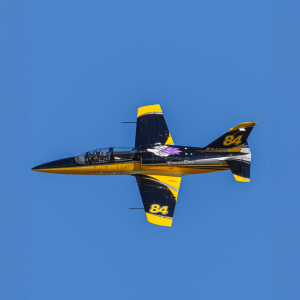
Jive Kerby, a retired Air Force lieutenant colonel, races a black L-39C Albatros dubbed Ivan. He sits at a table outside a large RV, wearing a ball cap and a polo shirt with an air racing logo. Now in his late 60s, the veteran fighter pilot and frequent air show performer has been flying for more than 50 years. But his inaugural National Championship Air Races was in 2019. Kerby now serves as president and board member for Racing Jets Inc., the organization responsible for governing Jet racing competition.
“It’s not something you make a living at, but it’s certainly exhilarating,” Kerby tells me. “People feel spending the money to do it is worth the life experience that they get.”
STOL drag racers fly at the National Championship Air Races.
Photograph courtesy of the National Championship Air Races.
For the first year, Roswell was logistically moving mountains. “The picnic tables came from Louisiana,” Logoteta says. “Some of the generators just came back here from Burning Man in Nevada. It’s just crazy the reach that it took to get everything out here.”
Despite the challenges and unfamiliar territory, the Friday events have gone according to plan. When the last pilot lands, Logoteta breathes a sigh of relief. It’s been a successful day at the races, with no accidents or injuries. “I’m just really pleased, really excited, and really thankful,” Logoteta tells me as we depart.
But he may have spoken a little too soon. Saturday’s lineup is slated to kick off with Biplane heats at 10:30 a.m. followed by Formula One, STOL drag racing, and more Biplanes. But the only things in the air early this morning are dark storm clouds moving in on gusting winds. While the rain holds off just long enough to squeeze in the first two pylon races and three rounds of STOL racing, the rest of the day is postponed. Attendees get a free ticket for the following day, but after three nights of sleeping in my car at the campground, I decide to head home.
The championship finishes strong on Sunday, with the gold and silver races going off without a hitch. In the Jet class, Kerby’s Ivan eventually ends up third in his gold race, behind McCormack and Farnsworth; mechanical issues doomed Camilleri’s chances. Tom Marden takes first in Biplanes. Josh Watson wins in Formula One, with Harris finishing fourth. Chris LeFave proves victorious in T-6. Steve Henry claims the STOL title with an average time three seconds faster than his nearest competitor.
“We had a wonderful Sunday,” Telling tells me afterward. “Perfect weather, perfect races.”
Kerby’s preparation begins well before he enters the cockpit. After a morning meeting to run over safety items, Kerby and his crew prep the airplane and hold a flight briefing. “I’ll try to visualize the course as I’m going to see it,” he says of his mental approach. “I’ll have my hands moving where the stick would be and where the throttle would be.” While winning and losing matters, Kerby’s greatest competition is with himself. “It’s not so much of where I finished,” he says, “but if I executed the race exactly as I wanted to.”
This year, Kerby has consistently ranked in the top three during the Jet races. But as witnessed on Thursday, there’s plenty of stiff competition. Kerby has been energized by the new Roswell course carved out of the desert with few restrictions. “It’s a dramatic difference,” he says. “We’ve got a wide-open space out there.” More than the track, Kerby has appreciated the city’s welcoming attitude. “Everybody you meet in town, they say, ‘Thank you for being here,’ ” he says.
His sentiments are shared by all the racing staff I encounter. “The experience has been great,” says TJ Conyers, Roswell’s special events supervisor, whom I meet in the city’s extraterrestrial-themed tent in the merch area. “People have been friendly,” she says. “They’re excited for Roswell.”
And it’s not just the locals who are raving. Tony Logoteta, the Reno Air Racing Association president and chief operating officer, takes me along for a golf cart ride as he makes his rounds. Logoteta’s job is to ensure all the moving parts of the event run smoothly. So we crisscross the 84-acre grounds, meeting with various staff and answering the inevitable questions that come with an unfamiliar location. “There were 60 years of institutional knowledge and experience in the town that we were in,” Logoteta says of Reno. Now, those inner workings must be updated to fit Roswell.
Get close to the action on the ground.
Photograph courtesy of the National Championship Air Races.
IN JUNE, I CALL TELLING AND KERBY TO SEE WHAT they’ve learned from the inaugural event and what’s coming for the 2026 National Championship Air Races, held September 16–20. “Last year was a really important learning experience for us, for the town, and for everybody else,” Telling says.
He applauds the staff, pilots, and fans for making last year happen. Although there were fewer pilots and two classes missing, the races drew more than 56,000 spectators and hundreds of volunteers. Just as importantly, everything went off safely. But his excitement grows as he begins to talk about this September, as all seven racing classes have signed on for 2026. “This is the full races on display,” Telling says.
Both the Unlimited class, one of the Air Race’s oldest and most popular, and the Sport class, filled with cutting-edge, experimental planes that represent the future of air racing, were sorely missed last year. For the first time since 2019, the U.S. Air Force Thunderbirds are returning to perform their signature aerial demonstrations. Other improvements are targeted at the fan experience, Telling says, including additional shuttles to haul people across the long distance between the parking area and the grandstands. And after Saturday’s heavy rain last year, which caused some flooding, additional drainage has been added.
But Kerby spills what might be the biggest news—a new course debuts in 2026. The 11.3-mile route showcases the power and speed of the Jet class and potentially allows planes to eclipse 600 mph. “The Mach course is the fastest course that’s ever been put together in air racing,” he says. Kerby also notes that nearly twice as many jets are expected this year. After his third-place finish last year, he and his team have made a few tweaks on Ivan. “We think it’ll be a little bit faster,” he says. “So we’ll see what we can get out of it.”
Telling feels like the National Championship Air Races might be ready for takeoff too. “We have all the elements in place now,” he says. “We’re back.”
Julian Dossett also covers airplanes, rocket ships, astronauts, and distant planets for space.com.
CLASS ACTS
Get to know the planes flying at the National Championship Air Races.
Jet. First appearing at the National Championship Air Races in 2002, these military training jets race at over 500 mph.
Formula One. These lightweight custom-built planes with identical engines, fixed landing gear, and a single fixed prop showcase pilot skill.
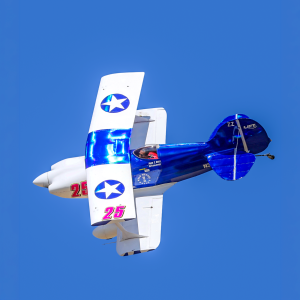
Biplane. Flying at 200 mph, the small, acrobatic double-winged aircraft are built for maneuverability.
T-6. Featuring classic World War II–era trainer aircraft, the “Pilot’s Class” race with precision.
Sport. The experimental, kit-built aircraft push their limits on the course, reaching speeds of 400 mph.
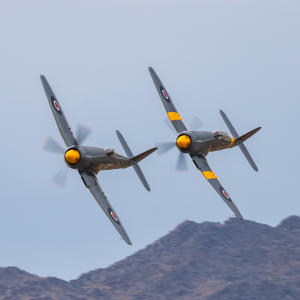
Unlimited. The beloved class showcases heavily modified World War II fighters such as the P-51 Mustang and P-47 Thunderbolt.
STOL Drag Race. The bush planes race head-to-head close to the ground on a straight track.