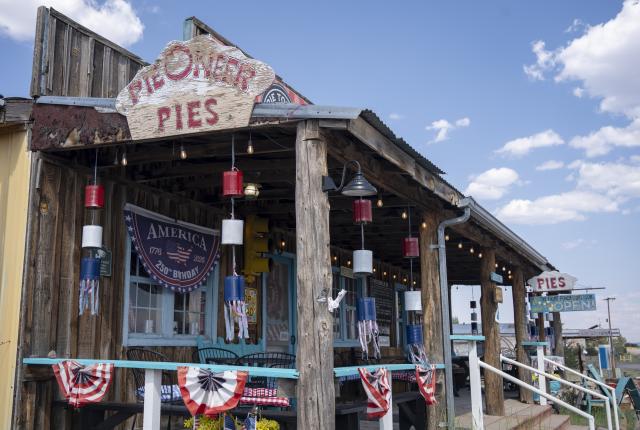
THE RELATIVE WELL-BEING of the state of New Mexico can be measured by the amount of pie there is in Pie Town.
That’s the heartwarming notion that strikes me at the 43rd annual Pie Town Pie Festival, always held on the second Saturday in September, where a kids’ pie-eating contest is in full swing under true-blue skies and gusty afternoon winds. While a lady in front of me is wearing a Tupac T-shirt and one child is unfortunately losing some blackberry pie into his barf bag, the scene otherwise resembles a Norman Rockwell painting.
It’s also not far removed from the famous images of 1940-era Pie Town residents that are preserved in the Library of Congress. Taken by Farm Security Administration photographer Russell Lee, the collection of 620 Kodachrome and gelatin silver prints shows the Catron County homesteading community at the Great Depression’s tail end, when there were fewer pies to be had. But Lee’s images show the same dark denim, cowboy hats, 4-H kids, and American spirit present at today’s festival, 85 years later, where the essence is also the same: neighbors who have weathered hard times in this wild and free place getting together for some old-fashioned fun.
“Arrived here about noon today and found Pie Town getting all set for its annual fair,” Lee wrote in September 1940. “It is a small one but there is a fine spirit here.”
The Gatherin’ Place II specializes in apple, green chile, and piñon pie.
After its beloved 25-year-old pie shop, the Pie-O-Neer, shut its doors in 2020 and the festival took a Covid-19 hiatus, Pie Town’s on the upswing again. The close-knit unincorporated community is in its finest form at the annual fest, where the lineup—including a Friday night spaghetti dinner and dance before Saturday’s “PiK” run; a horseshoe tournament; kids’ three-legged, spoon, sack, and horned lizard races; live music and vendors; the Pie Festival King and Queen crowning; a pie-baking contest; a silent auction for award-winning pies; a pie-eating contest; and an evening dance—doesn’t change. Nor does the fest’s goal, which is aimed at raising funds for scholarships and community projects, including a new playground and pavilion on the festival grounds.
On a non-festival day, however, you’d only know Pie Town is thriving if you stop at the blink-and-you’ll-miss-it group of buildings that make up its presence on US 60, 83 miles west of Socorro and a few miles from the Continental Divide. Try the New Mexico Apple with piñon and green chile at the Gatherin’ Place II, which specializes in what many consider to be the unofficial state pie, and eavesdrop on the coffee talk of the local ranchers. Or pop into the Pie Town Pie Company, where Lee’s vivid 1940 photographs are on prominent display along with a dizzying abundance of up to 75 pies a day and made-from-scratch Sunday dinners served on a tin tray. Taking a seat at these old-time eateries—alongside Continental Divide Trail (CDT) hikers and bicyclists, local small talkers and first responders, and RV-toting families and motorcyclists, who are all forking up rhubarb, pecan, tart cherry, or coconut cream—means you’re marinating in a Pie Town experience that stretches back more than a century.
The Pie Town Pie Company sells as many as 75 pies a day and custom-makes special orders.
“IT’S NOT LIKE I’M COMING INTO A wealth of fortune, making pie,” says Sarah Chavez, owner and operator of the Pie Town Pie Company. The cafe sits inside an 85-year-old clapboard building she bought from Pie-O-Neer owner Kathy Knapp in 2021. “It’s just going to be that labor of love for the next wave of folks who want to keep it going.”
Pie Town’s hospitality began with cowboys who needed catering to along the Magdalena Livestock Driveway. Every year from 1885 to 1971, sheep and cattle were driven along the “hoof highway” between railroads at Springerville, Arizona, and Magdalena, an hour east of Pie Town. Drovers stopped for rest every 20 miles or so at towns along the way, from Quemado to Pie Town to Datil to Magdalena. In the town’s most repeated origin story, a Texan prospector named Clyde Norman began selling dried-apple pies to customers on the Driveway after his mining claim didn’t pan out in the early 1920s. By 1927, the “Pie Town” moniker he’d stenciled on a sign was made official by the designation of a U.S. post office—powers that be had tried to argue for a more conventional name, but the residents were resolute.
Most of the farming and ranching families Lee photographed had come from Dust Bowl–ravaged places like Maud, Oklahoma, and Dimmitt, Texas, growing the Pie Town population to 250 by 1940. Lee’s photographs of Pie Town’s way of life represented what one shop owner told him was “the last frontier.” In the waning days of the Homestead Acts, it was still a place where a migrant could spend their last 30 cents on nails to build a dugout house covered with local pine and make good on a promise to the government to fence it and dig a well. That’s all you needed to make a patch of land yours.
The Toaster House hostel welcomes Continental Divide Trail travelers.
Lee’s photographs reveal the grit and grace it takes to make a living off the land in a high-desert outpost with howling coyotes and rugged, piñon- and ponderosa-covered peaks in every direction. The images conveyed the hardscrabble spirit of Pie Towners to the rest of the country. In 1985, Lee reflected, “It seemed to me this was the sort of place that had unalterably molded the American character.”
Pie Town’s current crop of locals comes from the same mold. There’s Chavez, who moved here with her husband in 2018 to pin down a longtime dream of living off the grid. Although she originally opened a secondhand shop on the highway, she was pulled into pie-making when pandemic shutdowns threatened the availability of pie and hot meals in town. Hikers and bikers on the CDT are especially reliant on Pie Town as a crucial refueling stop that’s 100-plus miles from the next-closest one in Grants. Like many of the transplants I meet in Pie Town, Chavez has also become an EMT, and her cafe is a hub for Catron County emergency personnel.
Despite the many challenges in running the Pie Town Pie Company over the last five years, Chavez’s attitude remains sanguine. “You might not have much in the checking account this week, but everybody got paid,” she says. “The lights are on, and we’ll make it happen like we always do.”
Marilyn Monnier and Paul Rader at the Gatherin’ Place II.
The individuals make the town tick. Penny Carroll’s pioneering spirit manifests itself in Pie Town Rising Stars, the committee in charge of the pie festival. As director, she oversees a group of volunteers that begins making pie shells in June, as well as a 24-hour baking operation the day before the fest that produces 500 pies for sale. Her husband, Jay, who owns a construction company, hauls away the community’s waste in the Stool Bus, a septic truck painted like a school bus complete with “stool-children” in the windows.
Writer Uncle River, whose books about Catron County are sold at the Pie Town Pie Company, says he was looking for “the least populated place in the country with a nice climate” when he first moved to the area in 1982. For 20 years, River has lived off the grid with a stunning view of a long ridge called the Pie Town Dike, which makes up the north rim of the Gila Caldera. “Many of my neighbors say they were guided here,” he says.
River describes the general outlook of Pie Towners as “You take what you get, and you work with it.” Pie Town Volunteer Fire Department chief Megan Bartasevich originally came from New York to wait tables at the Pie-O-Neer; she now coordinates fundraisers, plays in a band, and spearheaded an effort to roll out an all-new fire truck and ambulance. And residents Monika Helbling and Paul Thomas recently opened the Bunkhouse, a hostel and campsite for CDT backpackers that sits beside a newly constructed metal building that serves as the town’s dance hall.
Astronomer Michael Robinson at his observatory.
The Bunkhouse’s predecessor is the legendary Toaster House, which provides a glimpse into a hand-built Pie Town residence that’s now a donation-based and volunteer-managed hostel. Since 1982, it’s been the subject of CDT trail buzz, owing to the generosity its late owner, Nita Larronde, showed travelers by opening her home to them, as well as to the motley assemblage of busted toasters that decorates the house’s entrance.
Meanwhile, at the Gatherin’ Place II, owner Paul Rader carries on Larronde’s Trail Angel tradition by lending some hikers his P.O. Box number. “We can pick up a package and bring them here,” Rader explains. “So if they want to get it and continue on without having to stay the night, they can.” Manager Marilyn Monnier keeps track of on-the-way hikers on an app. “We’ll stay open late if we know they’re coming, so we can cook for them,” Rader says.
A Russell Lee image of the Pie Town fair, October 1940.
Photograph by Library of Congress/Russell Lee.
PIE TOWN VISITORS IN THE KNOW WILL opt to stay the night. A cosmic ocean of darkness, gilded by the brightest stars you can see in the Western Hemisphere, descends after dusk.
The skies above what is known as the Highway 60 Dark Sky Corridor are classified as Bortle 1, which means they are the darkest that exist in the continental United States. I learned of their magnetism at Pie Town’s newest annual event, the Dark Sky Gathering, this past May. Sponsored by the Continental Divide Trail Coalition in partnership with the local Dark Sky Land organization, the second gathering showcased the community of astronomers, astrophysicists, astrophotographers, and astro-artists that centers around Magdalena, Datil, and Pie Town with a weekend of lectures, films, conversations, and community meals—plus pie. It’s all aimed at the awareness and protection of these uniquely unpolluted skies.
The main events happen after dark, of course. Two nights of star parties present rare opportunities to examine Saturn’s rings and bask in the eerie shadow the Milky Way can cast on the evening of a new moon. After a picnic-table supper of green chile stew, a group of attendees drifts out to an open field, everyone sporting the requisite red headlamps for night observation.
Kids battle it out at the 2025 festival’s pie-eating contest.
There, among the telescopes available for viewing the cosmos, Pie Town astronomer Michael Robinson is playing a set of atmospheric electric guitar. The music radiates the kind of star power that dancer Elke Rindfleisch, from the Dark Sky Land artist residency program, needs to perform a tribute to the rise of Venus in the evening sky. Clad in a glowing white bodysuit with a light-up cape, Rindfleisch elegantly undulates to the invisible rhythm of the night.
In 1999, Robinson was among the first wave of astronomers to settle in Pie Town and build a private observatory. “The first thing I noticed here was the landscape, and the light, and the color,” he tells me after the performance. Astrotourism is on the rise everywhere, he says, owing to a post-pandemic yearning for more remote places. But he sees Pie Town as an epicenter. “Since the inception of the first observatory, which was my place, now there’s just one after another built here every year,” he says.
Robinson points out the Vega star, which he calls “a 600-nanometer blue-green star that corresponds to the healing colors that even the Tibetans use.” After the music, the mood at the star party is muted. The audience seems lulled into awe by the grandeur of the night sky; they might also be feeling its purported healing powers.
“Some of the stars have a very powerful effect on the psyche,” Robinson says. “When people come to a star party, it’s like getting therapy.” The pie we all had for dessert seemed to help too.
Managing Editor Molly Boyle is upping her pie game this holiday season.
FOR A SWEET AND SAVORY STAY
EAT PIE.
The Gatherin’ Place II serves breakfast starting at 8 a.m. every day as well as lunch. Keep an ear out for German or Japanese speakers when you dine here—this cafe is a hub for international travelers on the CDT, who value the space for its Trail Angel hospitality, a resident cat named MK2, and a shaded portal with hay bales to relax on. Specialties include house-smoked pastrami and pork, hand-cut French fries, and New Mexico apple pie, plus several other rotating types of pie. Open five days a week, the Pie Town Pie Company serves many varieties of chilled and room-temp pie, available by the slice and whole to go and for shipping. Enjoy a daily lunch menu and Miss Mary’s Sunday Dinners in a rustic, nostalgia-tickling setting that offers down-home-but-no-nonsense service and Americana-style decor. For a complete schedule of the Pie Town Pie Festival, held on the second Saturday in September, go to pietownrisingstars.org.
SEE THE SKY.
Pie Town astronomer Michael Robinson works for the SKYPi Remote Observatory, located along the Highway 60 Dark Sky Corridor, which offers students and the general public remote access to telescopes for deep-sky imaging and planetary observation. Learn more at skypionline.com.
The Continental Divide Trail Coalition and Dark Sky Land’s annual Dark Sky Gathering in Pie Town takes place every May, with an emphasis on community meals with ample pie opportunities. Find information at cdtcoalition.org/dark-skies and darkskyland.us.
SLEEP TIGHT.
Accommodations include free camping at Jackson Park Campground and by-donation digs at the CDT hostels known as the Bunkhouse and the Toaster House. At Pie Town RV Park, owned by Jay and Penny Carroll, the three rules are: Have pie, relax, and enjoy the quiet.