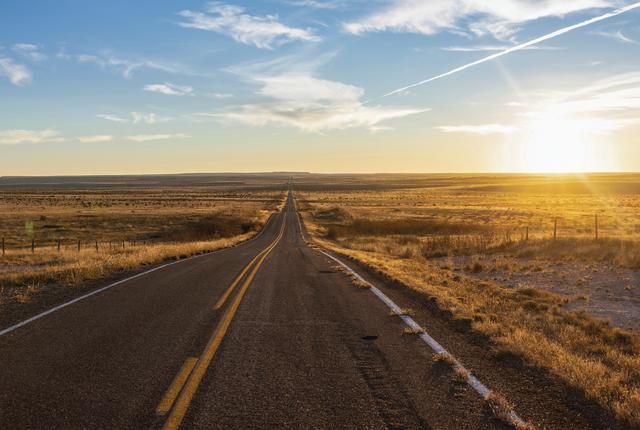
Often called the Mother Road, Route 66 is a youngster compared to the Native communities along its path in New Mexico. Over its first century, the famous highway has absorbed, changed, and connected the Indigenous cultures that live beside it.
But mothers, I’ve learned, are complicated. They bring us from one world into another, they guide us, and they thrust us into the future, even when it’s uncertain.
IN NEW MEXICO, THE MOTHER ROAD arrived late to a landscape that knew roads long before she did—paths pressed into the earth by Indigenous feet, by Pueblo and Navajo traders, by centuries of movement that did not require pavement to be real. As New Mexico state historian Rob Martínez reminds us, Route 66 was never an origin story but “another chapter of trails and roads that have changed us and changed our cultures and our economies.” Route 66 is a piece of living history. It reminds us that the United States is a country of migration for some and invasion for others.
Long before the Mother Road learned our names, Indigenous peoples had mapped the land through use and memory. Spanish, Mexican, and U.S. travelers followed those same veins, repurposing Native pathways into royal roads, trade routes, and finally highways. When Route 66 followed those corridors through Laguna Pueblo, Acoma Pueblo, and parts of the Navajo Nation, it layered 20th-century ambition onto land already thick with its own mythology. The Mother Road didn’t ask permission to absorb the children of this land.
Diné master weaver Kathy Marianito at her loom.
Photograph by NMTD.
She brought opportunity with her, the way a mother might bring food home after a long day—necessary, imperfect, transformative. Cars meant commerce. Travelers meant money. Pueblo and Navajo families sold pottery, jewelry, textiles—objects already rich with story, suddenly reframed as souvenirs of the Southwest. “It changed their economies,” Martínez notes, allowing Indigenous communities to commercialize parts of their culture to survive within American capitalism. During the Great Depression and beyond, that income mattered. It fed families. It carried art from kitchens and community spaces into national consciousness.
Tourist demand flattened complexity. It rewarded the expected, the stereotypical, the familiar. Visitors wanted culture they could recognize at a glance, culture that fit neatly into a glove compartment. But culture cannot be leveled, and stories cannot be squashed between a car title or registration certificate and a packet of tissues.
When you look closer, when you take the time to sift this soil through your fingers, breathe the kiss of piñon in the air, and contemplate the galaxy winking at you above a quiet campout, you will realize that the original artists of Route 66 never compromised the narratives their art forms held; they only simplified and condensed them for foreigners looking for a souvenir. In this, their art was a gift, a taste, a tiny offering to strangers. And eventually, their generosity led to deeper exploration by other newcomers.
from left
Zuni Olla Maiden dancer Kimberly Dewa balances a pot. A moment during a dance at the Indian Pueblo Cultural Center, in Albuquerque.
Photographs by NMTD and Jen Judge.
Pueblo storyteller dolls have always showcased Indigenous communities, while also acknowledging foreigners coming into the area, such as circus performers and priests. Even today, depictions of such newcomers can be seen in the early work of artists Virgil Ortiz (Cochiti) and Kathleen Wall (Jemez), whose dolls tell stories from past and present dialogues. Less commonly, Navajo rug weavers incorporated pictorial designs reflecting postcards, automobiles, highways, and other new arrivals from the Anglo world.
While non-Native traders often controlled prices and access to buyers, Indigenous makers fueled and influenced the market with their imagination, artistry, and ability to meld real-life narratives into traditional art forms. One school of thought says the Mother Road’s love came with conditions: What could be shared was shaped by what would sell. The Indigenous perspective is different: During a tumultuous time, the market found family matriarchs, and through skills they were raised to perfect, they fueled that market and supported their communities.
Even cultural expression felt the Mother Road’s influence. Public performances—like those at the Gallup Inter-Tribal Indian Ceremonial—became sites of negotiation between survival and sanctity. “Route 66 changed us, just like the Santa Fe Trail changed us,” Martínez says. “It brought different technologies and people, and it can’t be stopped.”
Hispanic communities along Route 66 felt her presence differently but no less deeply. In towns like Tucumcari, Santa Rosa, Albuquerque, and Gallup, the Mother Road connected families to a national bloodstream of people, ideas, and possibility. Martínez places Route 66 in context alongside the Camino Real, the Santa Fe Trail, and the Old Spanish Trail. Along these routes came foods, faiths, technologies, and institutions that reshaped daily life. “Route 66 is one of the many ways that change has arrived in New Mexico,” he says.
“Long before the Mother Road learned our names, Indigenous peoples had mapped the land through use and memory.”
Hotels bloomed. Restaurants stayed open late. Service stations became gathering places. Along Central Avenue in Albuquerque and Coal Avenue in Gallup, architecture itself learned to blend—Pueblo Revival was softened by Art Deco curves at the KiMo Theatre, in Albuquerque, and El Morro Theatre, in Gallup. These buildings were never meant to be monuments, Martínez says, but they became symbolic anyway—proof that when cultures meet under pressure, they don’t disappear. They transform.
Still, the Mother Road was not gentle. Construction carved through farmland and sacred spaces with little consultation. Noise, pollution, and disruption followed. For Pueblo, Navajo, and rural Hispano communities, whose identities are bound to the land, these were not abstract losses. They were daily. Tribal lands, such as Acoma, Laguna, and Navajo, were sliced by Route 66 and later I-40. Today New Mexico’s stretch of I-40 is a high-risk area for missing Indigenous women and girls; it has been given the moniker Highway of Tears.
Evening comes to the 1928 El Morro Theatre, in Gallup.
Yet Martínez situates this within a longer truth: New Mexico’s people have survived centuries of conquest and colonization by learning when to resist and when to adapt. When I-40 arrived, the Mother Road was quietly sidelined. Traffic thinned. Businesses closed. The same mother who once demanded constant attention now moved on, leaving communities to grieve and regroup. And yet, in that absence, something softened. The pressure eased. The story became ours again.
As we mark Route 66’s centennial, I find myself less interested in mythology than honesty. “It’s unifying,” Martínez says. It connects Gallup to Chicago, Albuquerque to Los Angeles, Tucumcari to Flagstaff. But unity doesn’t mean sameness. The Mother Road reminds me that change is reciprocal. “The people who conquered were also changed,” Martínez notes. No one passes through New Mexico untouched.
Route 66 didn’t just guide our growth. We raised her too—fed her stories, shaped her meaning, resisted her when we had to. Like any mother, she is both shelter and scar. And like all good inheritances, she leaves us with a choice: to repeat the story she told or to tell it better.
Read More on Route 66
Ungelbah Dávila’s essay is excerpted from Road to Enchantment: A Century of Route 66 in New Mexico, alongside writing by magazine contributors Lynn Cline, Gwyneth Doland, Madison Garay, Nathaniel Tetsuro Paolinelli, and Alicia Romero, plus striking photography by Jen Judge from across the state’s 465 miles of Route 66. Buy the collectible book at nmmag.us/route66book.
See More on the Indigenous Mother Road
Through March 7, 2027, at the Museum of Indian Arts & Culture, in Santa Fe, Route 66 Is Indian Countryconcerns the parts of the Mother Road that run through the pueblos of Cochiti, Santo Domingo, San Felipe, Santa Ana, Sandia, Isleta, Laguna, Acoma, and parts of the Navajo Nation. The exhibition examines how Route 66 transformed, and was in turn changed by, these Native communities.