WE APPROACH WHITE SANDS NATIONAL PARK from Las Cruces on I-70, climbing up and over the jagged Organ Mountains. The desert is stark out here, beautiful but ominous. After passing military installation after military installation, it suddenly begins: Out of the barren brown landscape, shimmering white dunes of gypsum seemingly appear out of nowhere.
As a visitor and lifelong New Mexican, my anticipation builds as we draw closer to the park gates. But as a trained archaeologist, seeing this 225-square-mile expanse that was once home to the continent’s earliest inhabitants feels even more profound. I’ve come here to walk in the footsteps of the people who left their marks in the surrounding lake bed of Ice Age–era Lake Otero some 23,000 years ago.
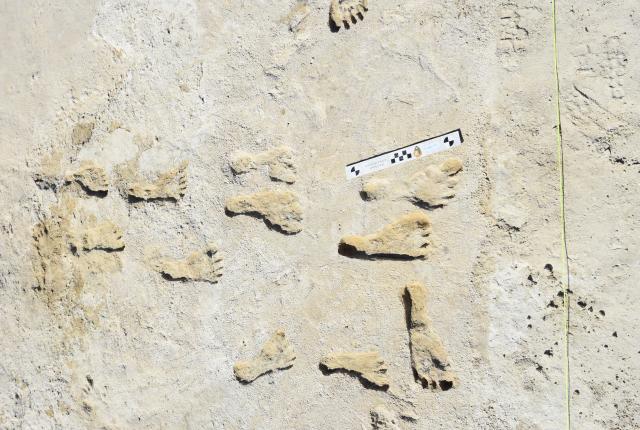
Scientists have known about fossilized footprints at White Sands for roughly 80 years. But a 2005 discovery of dark spots in the lake bed led to the uncovering of both mammoth and camel footprints. A few years later, the tracks of a dire wolf were found. Then, in 2017, the fossilized steps of a young girl—and a small child—changed everything.
Now, the story of those discoveries and their impact on how we view human life in North America are detailed in a new book, Those Who Walked Before, by Matthew R. Bennett, David F. Bustos, and Daniel Odess, due out this month from University of New Mexico Press. The book, which doesn’t confront any of the controversy surrounding the dating of the footprints, takes a more personal approach to the science, following the researchers who have studied the ancient traces, the formation of the team that continues to work on the site, their collaboration with Indigenous people and nations, and what the trackways themselves tell us about the human condition 23,000 years ago.
David F. Bustos, the park’s integrated resource-program manager.
“The discovery of ancient human footprints at White Sands National Park has caught the imagination of the public, especially when they were dated recently to the height of the last ice age,” the authors write in the book’s foreword. “This pushed the antiquity of human presence in the Americas back far beyond previous estimates.”
My journey begins in the park’s Works Progress Administration–era visitor center, complete with 1930s tin light fixtures, handmade New Mexican furniture, and thick adobe-style walls. At the center of the building, museum displays detail the expansive grasslands, woolly mammoths, and other creatures that existed here before the dunes. As I wander through the exhibits, however, something catches my eye. Behind the welcome desk, resting near the cash register and tucked behind glass, sits a fossilized human footprint—not a cast replica of a footprint, but the real thing. Ancient earth shaped by our ancestors, right there in front of me.
When I point it out to my partner, we both just stand in awe, silent, for far too long while other tourists bustle around us. Such is the power of these footprints. I know I am a grown-up scientist, but in that moment, I might as well be eight years old again
A visitor looks at the Sands of Time display in the White Sands National Park visitor center.
OUTSIDE THE VISITOR CENTER, IT’S WHITE. Everywhere are white, rippling dunes, outlined in blue sky, marked by desert grasses that thrive in the alkaline soil—bushes that cling tight to the ever-shifting sands in clumpy outcrops and yuccas that reach toward the sky as signs of survival.
As my partner and I enter the dunes, it becomes difficult to emote. While both chatty by nature, we freeze in a kind of stunned silence. The only thing our Homo sapien brains can equate the landscape to is snow, but it’s 65 degrees outside.
While we adults find it difficult to process the 4.1 billion metric tons of gypsum in the Tularosa Basin, the kids around us have no problems knowing what to do. They run up and down, to and fro, screeching, sledding, grabbing handfuls of the stuff to toss in the air or at one another, leaving tracks of the discs and sleds they are using all over the dunes, temporarily marking their territory. Imagine, if you will, the perfect snow day when you were a kid, but it’s like this every day of the year.
Volunteer Joe Elsen leads a sunset hike.
That’s the same kind of excitement Bustos must have felt back in 2005, when the White Sands National Park wildlife biologist and resource program manager first spotted what he thought was a recent print left by a cowboy boot. “It was strange that they were so far out on the salt flats,” Bustos, this tale’s hero, recalls in the book. “I thought nothing more about it at the time, but the discovery nagged at me for years. Fifteen years later, these tracks would become part of the longest fossil footprint trail in the world.”
While that feeling lingered, Bustos became adept at identifying the tracks made by long-extinct megafauna, creatures that Alfred Russel Wallace described in his 1876 book as “the hugest, and fiercest, and strangest forms,” left in White Sands’s Alkali Flats. But he also knew he needed help. So he reached out to Odess, who was working as assistant associate director of cultural resources for the National Park Service in Washington, D.C. Bustos understood these were no ordinary finds, and Odess had the kind of influence that would be necessary to advocate on behalf of the science.
“He called me out of the blue,” Odess recalls of that first contact in 2012. While there’s a traditional chain of command in the federal government, Bustos had skipped over all the bureaucracy and protocol. As they talked, Bustos sent Odess photos of what he’d found on the long, shimmering playas of White Sands.
White Sands ranger Cecilia Calvert holds a cast of fossilized children’s hand and knee prints.
“I was speechless,” Odess tells me while doing field research earlier this year in New Mexico. “It looked like a long string of pizza-pan-size impressions along the desert floor. They had to be mammoth tracks.” Indeed, they were.
Animals like mammoths and giant ground sloths seemed to have been walking the shores of Lake Otero, leaving evidence of their meanderings in the mud tens of thousands of years ago. And it wasn’t a matter of a track here or a track there—some of these impressions went on for miles, allowing those that followed their path to learn how these animals were interacting with their environment, including in relation to one another.
The duo had plenty of other help too, thanks to a paleontological program set up through the National Park Service and mapping support from the U.S. Geological Survey. But not until a young boy accidentally got lost in the park, leading searchers out toward the center of the ancient lake bed—to a place Bustos had been assured no prints could exist—were human footprints part of the picture.
“I had become familiar with the tracks out on the salt flats,” Bustos recalls in the book. “They would appear and fade with changes in the weather, ghostlike. There was something walking upright on two legs (bipedal), and in places I was sure that a mammoth track overprinted the tracks.”
A family sleds down the gypsum dunes.
NEW MEXICO IS NO STRANGER TO archaeological discoveries. Three of the world’s most significant finds in the past 150 years carry the monikers of the towns they were most adjacent to: Folsom being one (putting humans on this continent between 12,800 and 12,200 years ago) and Clovis (even earlier at 13,400 to 12,400 years ago) being the other.
Both discoveries involved tool technologies—projectile points used for hunting large mammals—that define the earliest marks of material culture and delineate the periods to which these early hunters belonged. Both Clovis and Folsom discoveries did what White Sands was about to do 100 years later: completely upend the timeline of how long humans had been on this continent.
But to do that, Bustos needed more proof. So in 2017, he invited Odess, human footprint expert Matthew Bennett, and a team of researchers out to view the trackways at White Sands—only to be thwarted by a January storm that washed away almost all traces of the tracks they had identified.
Ranger Marie Owens speaks with visitors in the park’s museum.
When Bennett returned a few months later, Bustos took him back out to the site and showed him a ghost print of a giant sloth. As he slowly brushed away at the dirt, a deep track, about seven inches deep with a nice rounded heel, started to appear. “At the bottom, there was the faint outline of a set of toes,” Bennett recalls in the book. The print was typical of a human walking on soft mud. “It was perfect, in fact.”
It was just the beginning. They found big ones and little ones. Ones moving at a hurried clip, and ones that meandered slowly across the landscape. Some doubled back on themselves, giving the impression that this journey had a distinct purpose. Just like the other mammals that revealed themselves to the team, there was not one print here and another there, but thousands littering the playa.
“Trackways are amazing, because unlike just one print, which one can think of as a snapshot, when you get long trackways with hundreds of prints, you are looking at the equivalent of a Pleistocene video clip,” Odess says. “It is not just one moment in time, but the entire sequence, including stopping, starting, setting down a kid, picking up another, or interacting with a giant sloth—as is the case with one set of trackways.”
The fossils not only showed how these humans were interacting with one another as a group, but how they reacted to their environment: toddlers splashing in a mammoth-footprint-created puddle; a caretaker slipping in the mud as they lifted an infant; a small child kneeling on the ground, grabbing fistfuls of sand.
Turning the clock back 23,000 years was an unimaginable step—one scientists continue to work through. But for Odess, something even more profound than the number was how it fit with Indigenous understanding of our past.
Members of 14 tribal groups have been among those engaged in the scientific research at White Sands, contributing both their understanding of the natural world and their oral traditions. “When 23,000 years was the date we kept coming up with over and over, I thought, That sure sounds like forever to me,” Odess recalls. “But as we spoke to tribal members, one thing rang clear to all of them: The date did not shock or surprise them, as it seemed to [for] everyone else.”
“The discovery of these living repositories of early human migrations is not only exciting, but also reinforces tribal beliefs that people have inhabited the region since time immemorial,” Bustos says in the book. “What is truly exhilarating is the realization that countless stories remain untold, stories hidden in the mud that await someone to reveal and read them.”
Hikers walk the Alkali Flat Trail.
BACK IN THE DUNES THIS JANUARY, everyday life is happening. Families are enjoying a picnic, tucked into the space-age shelters, colorful kites soar overhead tethered to earth by just a thin string, wildlife especially suited to this environment scurry about, and rangers guide hikes as the sun begins to set over the waves of gypsum.
But life is fragile. And so is the past life.
“These tracks are disappearing,” Odess tells me. Even as the documentation process continues, valuable information is being lost. White Sands’s harsh environment doesn’t discriminate. “Once they are gone, that is it,” he adds.
That’s also why places like White Sands are so important. “What our national parks do is protect extraordinary places,” Odess says.
As we leave the park, I once again see the expanse of white stretching out, waiting for its stories to be uncovered. It makes me think about that ancient toddler being taken off the hip of a caretaker and placed lovingly on the edge of a muddy lake shore, where they play and splash about in the muck and the water. Because like on my visit, kids seem to know exactly what to do—and maybe always have.
PARK PASS
Make your visit complete with these spots.
EAT. Stop by Brown Bag Deli, in Alamogordo, to get sandwiches (try a Cubano or a green chile chicken club) for a picnic lunch in a setting unlike any other. After a day of exploring, sit down to a relaxing meal at D.H. Lescombes Winery and Bistro, in Alamogordo, which offers a menu ranging from schnitzel to lasagna and wine for dining in or to go. No trip to Alamogordo would be complete without a visit to McGinn’s PistachioLand. Take a picture with the world’s largest pistachio, sample one (or a few) of the 18 flavors, and indulge in a scoop of house-made ice cream (pistachio, of course). Tours run daily from 10 a.m. to 4 p.m. Can’t get enough nuts? Just down the road at Heart of the Desert, George and Marianne Schweers have been growing pistachios for more than 50 years. Pair some kernels with a Pistachio Rosé or one of their other award-winning wines. Quaff a sotol cocktail at the Tularosa Distillery’s Tumbleweed Lounge while you contemplate the mysteries you saw that day.
DO. White Sands National Park offers guided Sunset Stroll hikes in the evenings Friday to Sunday. Full Moon Night programs coincide with the lunar cycle from May through October with special events and extended hours. Moonlight Hikes are offered March through November on nights surrounding the full moon. Rangers share the area’s geologic story on the monthly Lake Lucero Tour November to March. For a full calendar of events, visit nmmag.us/ws-events. In Alamogordo, New Mexico Museum of Space History features exhibits on rocketry, New Mexico’s contribution to space exploration, and the International Space Hall of Fame. The Tularosa Basin Museum, housed in a Pueblo Revival building from a similar era as those at White Sands, helps tell the story of the basin, its inhabitants, and the connection with the Works Progress Administration and Civilian Conservation Corps. Kids will love the Alameda Park Zoo, which has a butterfly area and 90 species of animals.
STAY. You’re just a hop and skip to the park at the Classic Desert Aire Hotel, in Alamogordo, featuring Southwestern flair. Or splash down with the entire crew at Hotel Encanto de Las Cruces, where 11 patio rooms overlook the long rectangular pool, nestled among palm trees and Spanish-style gardens.