


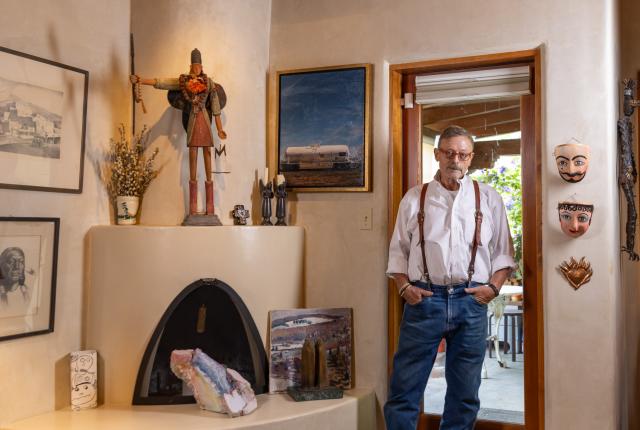
AT AGE SEVEN, standing before Picasso’s Guernica at the Museum of Modern Art in New York, I felt a lightning bolt straight to my gut. Years later, it happened again in front of Mark Rothko’s vast, immersive fields of color. That second strike became my collector’s blueprint: I buy art only when I feel that same unmistakable jolt.
Moving to New Mexico in the early 1990s offered a smaller sandbox where artistic connections quickly became deep friendships. Visiting studios as director of the adult education art program at Santa Fe Community College became my familiar rhythm in a new landscape. The real acceleration came during the 11 years I spent handling media relations for the state’s museums and historic sites. Walking journalists through galleries and discussing exhibitions with curators and artists gave me a backstage pass that sharpened my eye. I learned to see as they do, and made education a big part of my process.
Sustaining this community turned passion into purpose. Supporting living, working creators became central to my collecting. I resolved to cap my purchases at $5,000 so my resources could reach multiple artists and galleries.
One of my first regional buys was a painting by Silver City artist Charlie Meckel. A massive sky filled the top two-thirds of the panel, capturing a bleaching midday light so precisely, I could feel the heat on my skin. Meeting Meckel and seeing the full range of his work taught me to look beyond the single piece to understand an artist’s larger vision. Later, at the New Mexico Museum of Art, in Santa Fe, I encountered a series of miniature graphite drawings by Taos artist Marc Baseman, whose work is now part of my collection. His pieces, often composed on a square of a few inches, demand leaning in until your nose nearly touches the paper. This work showed me that scale has nothing to do with impact; a whisper can command a room.

A miniature drawing from Steve Cantrell's art collection rewards a closer look. Photograph by Gabriella Marks.
In New Mexico’s intimate art scene, creators and dealers became my faculty, guiding my growth. As my confidence grew, the pace of buying picked up. Max Baseman—Marc’s son and director of 5. Gallery, in Santa Fe, where I’ve purchased many works—recently reflected to me about my evolution as a collector. “From the first piece you got here—a nervous flirtation—to the confidence of your most recent is a trajectory that makes sense to me,” Max said. It was his father who taught me to simply buy what I love. That lesson is echoed by Taos artist Susan Pasquarelli, who says, “It’s the love that makes you a collector—it’s what gives you permission to call yourself one.”
Raw instinct was just the entry point. La Ciénega–based santero Luis Tapia gave me the vital counterweight. “In New Mexico, art is all around us—we eat, live, and breathe it,” he says. “But is it enough to trust your gut when a piece stops you in your tracks, or do you need to know the heritage and history behind it?” That challenge pushed me to balance instinct with education.
Since I moved from Santa Fe to Taos a few years ago, I now live and breathe the creative process. Daily conversations with artists shape my thinking, becoming intertwined with the art. My eye has shifted toward more challenging contemporary work, the kind that Stephen Parise, who runs Santa Fe’s Big Happy gallery, says can alter “the weather of your inner life in some small but undeniable way.”
Max Baseman has a blunt thought about how buying art can change your life: “Collecting and supporting are different things; admiring a tree and helping keep one alive are different as well. But the act of sustaining something transforms how you see it—and how you see the world.”
I recently realized that my purchases now span from my first piece by founding Taos Six painter Rod Goebel (1946–1993) to a newer work by Taos painter Marsha Skinner, who died last year. As I consider the future, I’ve been weighing something Marc said: “The collection builds itself,” he insists. “Your already-acquired pieces will tell you what’s needed, what’s missing.”
My next step is clear: Listen. My collection will reveal what it needs.