OUT ON BULLARD STREET, the Silco Theater’s Art Deco marquee casts a pale neon wash across Silver City’s mostly darkened downtown. Just inside, checkerboard floors catch the low light as I slip into the historic auditorium, the air scented with buttered popcorn. By the time the stark desert begins to unspool across the silver screen, the small but devoted audience has settled into anticipatory silence.
The November night’s feature is No Country for Old Men, the Coen brothers’ neo-Western, in which the vast skies and lonely highways of eastern New Mexico are as vital a character as any man with a badge or briefcase. I’ve seen the 2007 Best Picture Oscar winner before. But watching it here, on a towering screen in a former mining town, sharpens its sense of fate and frontier. This is how movies are meant to be seen: not on a laptop, not alone, but together, in uninterrupted grandeur.
“There’s something mystical about old theaters that are still operating,” says Trux, a fellow moviegoer I met in the concessions line before the show. He’s a member of the Silco Cinema Society, which hosts these Thursday-night classic-film screenings to raise extra funds for the theater. From behind the counter, theater assistant Soozy (who, like Trux, declined to give a last name) adds, “Being the only movie theater in town, there’s a responsibility to carry on the tradition.”
Silco Theater director Kim Ryan and Ward Rudick catch a show in Silver City.
Photograph by Jay Hemphill.
In 2026, the movie house celebrates its 100th year under the Silco moniker, a portmanteau nodding to local silver and copper mining. Built during a post-statehood boom when movie theaters ranked among New Mexico’s most ambitious architecture—rising with ornate facades, glowing marquees, and hundreds of seats—the Silco embodied a faith in movies as both popular entertainment and community tradition.
After sitting dark for decades, the Silco’s recent revival is part of a broader strategy playing out across New Mexico’s small towns. As analog theaters began facing extinction in the digital age, many communities had to decide whether these aging movie houses were sentimental relics or something more essential. In 2013, the New Mexico Historic Theaters Initiative placed a bet: that updated historic theaters could serve as economic and civic anchors to pull people downtown, sustain nearby businesses, and preserve a shared sense of place.
“A historic theater adds a different kind of character to a community,” says Daniel Gutierrez, director of New Mexico MainStreet (NMMS), the state economic-development program that created the Historic Theaters Initiative. “You can’t re-create that by building a new one.”
To date, the program has helped revive 11 theaters, from Clayton to Carlsbad, channeling nearly $4 million from the Local Economic Development Act and capital outlay funds toward technical upgrades, operational support, and survival strategies for single-screen venues in a multiplex world. But despite these successes, and as many towns—and the movie industry itself—continue to struggle economically, a question lingers: When a marquee flickers back to life, does the community around it light up as well?
The Silco stocks concessions from local vendors.
Photograph by Jay Hemphill.
“PINOCCHIO, DUMBO, SNOW WHITE,” says 74-year-old Ward Rudick, ticking off the films he watched at the Silco as a child. “The concession stand had hot dogs and beans, green and red chile, every candy you could imagine.” He pauses, amused. “I never knew other kids had to pay for it!”
Rudick grew up at the Silver City cinema owned by his grandparents Clara and Eddie Ward, who was also a longtime mayor. His father, Moe, managed it, along with the family’s four other Grant County theaters, including the still-dark El Sol across the street, which exclusively screened Spanish-language films. Rudick recalls learning the mechanics of movie magic early, standing on a stool in the projection booth as projectionist Camilo Carrillo taught him and his sister to thread film and execute a flawless changeover.
Like many small-town cinemas, the Silco’s early success faded by the 1960s, undone by the rise of television. For decades afterward, the building was a furniture store, a mini mall, and then a dormant shell. After Silver City MainStreet acquired the property, a lengthy renovation began, and in 2016, the Silco was reborn as a city-owned venue for first- and second-run films, live performances, and public gatherings.
Rudick contributed to the restoration effort when he appraised an upright piano inside the home of a former usherette. “It was the theater’s old piano from the silent film days,” Silco director Kim Ryan says, gesturing to the antique instrument, which now rests near what was once the orchestra pit. On a tour of the turquoise auditorium, Ryan points to other preserved details, such as the Art Deco–era proscenium and sunburst mural, alongside modern upgrades largely obtained through MainStreet’s $640,000 investment: plush chairs, digital projection and sound, and a new HVAC system.
Jose Almeida has a collection of the Odeon Theatre’s old reels.
Photograph by Kate Russell.
Ryan moved to Silver City in 2020, just as the Covid-19 pandemic shuttered cinemas statewide and stalled momentum for projects like the Silco. Even after reopening, challenges persisted. She cites Hollywood flops, the writers’ strike, and streaming services for the global decline in movie-theater attendance since 2019. A proposed Netflix–Warner Bros. merger has also rattled cinema owners, raising fears that fewer films will reach theaters at all. “It feels like the industry is still trying to figure out what it wants to be,” Ryan says.
Running a single-screen theater in a town of just 9,500 people presents a balancing act, she adds. “The way the industry is structured makes it hard to show just one new release. Big family blockbusters pull us through—and they allow us to do more, like our art-house and older movie nights.”
The family movies make sense: National trends suggest younger adults are increasingly returning to small and rural communities, often to open businesses and raise families. “We are seeing people come back,” Gutierrez says, “but they need amenities and a quality of life to come back to.”
Crucially, MainStreet’s work doesn’t stop at the marquee. Through complementary initiatives like the Great Blocks program, theater investments are paired with streetscape improvements, infrastructure upgrades, and coordinated branding designed to make downtowns more walkable and welcoming. “If we’re working on a theater, we’re also improving the district around it,” Gutierrez says. “We’re thinking holistically.”
The Art Deco Cavern Theatre in Carlsbad has welcomed moviegoers since 1951.
Photograph courtesy of the City of Carlsbad.
That big-picture approach matters because survival today requires flexibility. “Movies alone don’t pay the bills anymore,” Gutierrez says. In 2024, Ryan debuted the annual Silver City Community Film Festival to lure artists and cinephiles. Other venues, such as the Cavern Theatre in Carlsbad—the most recent to reopen through the Historic Theaters Initiative—have evolved into multiuse spaces, hosting films alongside performing arts and community events, an approach that has made single-screen cinemas more profitable than once expected.
The Silco’s economic impact is unmistakable at nearby businesses like the Ice Cream Emporium. Clerk Torin Dabbs says audiences routinely flood the shop, which is known for regional flavors like Hatch chile chocolate and prickly pear. Even the theater’s concessions keep downtown dollars circulating by stocking candy from Kneeling Nun Mercantile and pies from Forrest’s Pizza.
The town’s morale boost is harder to chart—but easier to feel. “When our last movie theater closed [in 2013], it was a huge blow,” says Dennis O’Keefe, a 40-year resident and owner of O’Keefe’s Bookshop around the corner. “It just didn’t feel like America anymore.” Since the reopening, the Silco Cinema Society member says he encourages everyone to support the theater so it sticks around. “Everything’s just better on the big screen.”
At the Historic Odeon Theatre, the concession counter is always stocked.
Photograph by Kate Russell.
A WEEK LATER, on a bright afternoon, I grab a creaky but comfortable seat at Tucumcari’s Historic Odeon Theatre for a free showing of American Graffiti. George Lucas’s nostalgic ode to 1950s car culture feels like an appropriate pick for the 90-year-old, neon-adorned cinema just off Route 66.
As the hot-rodding characters rev engines down the strip, two women seated in front of me pull a fleece blanket up to their chins—a sign of regulars. After the credits rolled, they linger in the lobby, chatting with owner Jose Almeida and his teenage son Kalel (named after Superman), who are slinging slices of homemade tres leches cake and cups of elote at the concession stand.
“This theater is an absolute treasure,” says Dena Mericle, who comes most weeks to the Odeon with her daughter, Rebekah. “There’s something about getting off the couch, going to the theater—it’s an experience.”
A local country radio DJ, Almeida bought the Odeon in 2024 less as a lucrative business opportunity and more as a commitment to the town his family adopted seven years ago. “We have a small community,” he says. “This is one of the few places we can gather.”
Oldies music greets customers outside the Odeon.
Photograph by Kate Russell.
When Almeida took over, he was surprised to find a 3D-capable projector and surround-sound system—installed with support from a $50,000 NMMS award in 2017—already in place. “The modern system helps,” he says, “but the historic details bring the nostalgia.”
His approach to preservation is less museum-perfect than lovingly pragmatic: Keep the bones, upgrade what matters, and lean into atmosphere. Before each screening, Almeida pipes in oldies music—including a couple of songs about Tucumcari—so the building itself feels like part of the show. The reupholstered red-and-navy seats are original. A 1954 popcorn machine and the original ticket dispenser sit on display, and Almeida hands out laminated old-style tickets as Route 66 souvenirs. He hopes to reopen the balcony someday, but for now it’s used for storage. It seats just one patron: a plastic skeleton named Boney Stark.
With a historic theater, the upkeep never ends. Almeida recently painted and retiled the facade by hand. In 2023, the neon lights in the Zia-decorated marquee were destroyed in a hailstorm. He hopes to have it restored by the theater’s 90th anniversary this May—a practical project, but also a symbolic one in a town where glowing signage is part of the local identity.
Pecos Theatre general manager Fabian Chavez mans the ticket booth.
Photograph by Kate Russell.
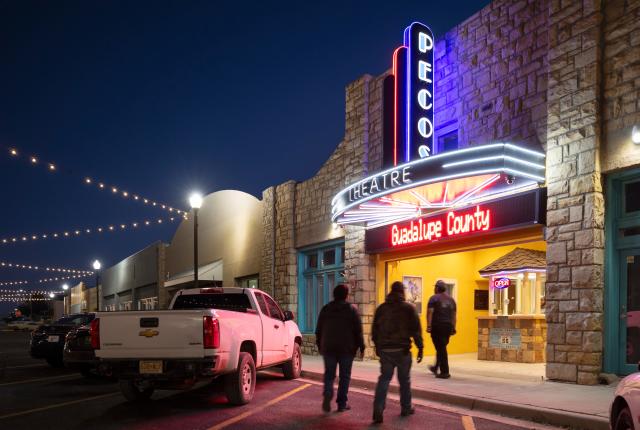
AN HOUR’S DRIVE WEST ON I-40, Santa Rosa’s Pecos Theatre tells a different preservation story. When Guadalupe County purchased the idle building in 2016, officials chose to save the original 1919 Mission-style stone facade—and modernize nearly everything else.
The overhaul wasn’t optional. A natural spring runs beneath the building, causing years of water damage. The $1 million renovation—completed in 2019 for the theater’s centennial—updated the sewer system, digitized the marquee, improved acoustics, and reduced seating to meet accessibility needs.
“It was devastating when they shut it down,” says manager Fabian Chavez, who grew up in Santa Rosa and remembers watching Shrek Forever After just before the theater shuttered in 2010. “When it was closed, Santa Rosa was a very quiet town. There really wasn’t much to do, especially for the youth.”
Today, the oldest theater along Route 66 balances modernity with memory. Black-and-white photographs of the original theater and early-20th-century Santa Rosa line the expanded concessions area, alongside artifacts salvaged from the building, including a row of original seats and a midcentury ticket receptacle. “People come in and say, ‘I remember when I worked here,’ or ‘I had my first date here,’ ” Chavez says.
The Pecos has helped reanimate downtown life, Chavez says, particularly for kids and seniors. When a storm burnt out a key projector component and the theater closed for two weeks last year, rumors spread fast. “People were freaking out,” he says. “They thought we were closing again.” The reaction underscored how fragile—and beloved—the space remains.
El Morro Theatre, in Gallup, is a community hub.
Photograph by Tira Howard.
Not every update is universally embraced. Farther west along Route 66, in Gallup, one of the state’s grandest picture palaces, the El Morro Theatre, sparked a local debate after replacing its traditional marquee with a digital version. The move traded nostalgia for visibility, but it worked.
“We’ve noticed a huge uptick in sales,” manager Jared Alexander says. “People notice it more as they’re driving by.” He says he’s met similar pushback with a proposal to return its Spanish Colonial Revival facade to its 1928 color scheme. “The latest renovation was done in the 1990s. If I change anything from then, people think it’s not historical, but they just don’t know the complete history.”
But these theaters are more than community hubs. With Route 66 hitting its centennial this year, MainStreet is coordinating cross-marketing efforts to encourage travelers to stop and catch a flick. “Historic theaters are attractions,” Gutierrez says, noting that a local marquee is often the brightest sight in town after sunset. “They get people out of
the car.”
“People traveling Route 66 come looking for classic architecture,” agrees Connie Loveland, director of Tucumcari MainStreet. “They seek out the Odeon because of its Art Deco design.” She adds, “We’ve lost so many of our historic buildings. This one feels very important—not just to save, but to keep open as long as we can.”
from left
A 1951 photo of downtown Tucumcari inside the Odeon. The Silco Theater with its glowing neon lights at dusk.
Photographs by Kate Russell and Jay Hemphill.
STORIES ABOUT SMALL-TOWN THEATERS often frame them as elegies. The dying movie house in Larry McMurtry’s Texas-set novel The Last Picture Show (as well as its classic film adaptation) still looms large in the cultural imagination, a shorthand for loss and the inevitability of change in small, rural communities. Here in New Mexico, however, the picture show goes on—creating new memories, one shared screening at a time.
When Rudick attended a sold-out screening of Wicked: For Good at the Silco, he saw how the moviegoing experience has taken hold of his hometown’s newest generation. As he watched the kids’ reactions, he remembers, “I was thinking about what I felt the first time I saw The Wizard of Oz—something I’ve carried with me all my life,” he says. Then the realization struck: “This is their Wizard of Oz. My grandparents would have loved it.”
Read more: With support from the New Mexico Historic Theaters Initiative, small-town screens across the state are shining bright.
Senior Editor Candolin Cook once attended a showing of The Last of the Mohicans at the historic KiMo Theatre in Albuquerque, hosted by its star (and Santa Fe resident) Wes Studi.
GET YOUR FLICKS
Catch a movie at the Historic Odeon Theatre or Tucumcari Railroad Depot during the annual Tucumcari Film Festival, May 1–2. As the theme, “Find Your Route,” honors the Route 66 centennial, this year’s showcase of independent features from around the world also includes film industry panels, workshops, and art exhibitions.