


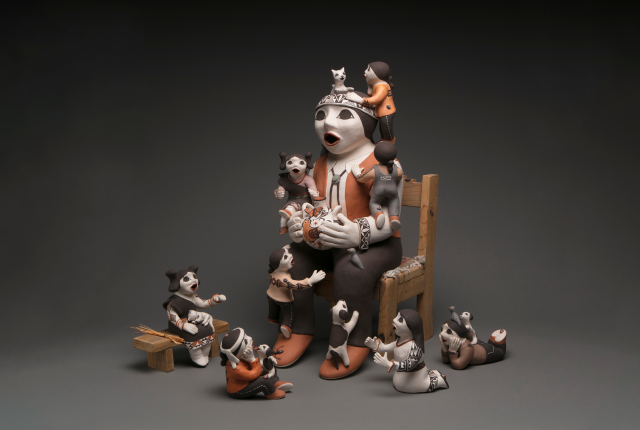
MARIA “LILLY” SALVADOR would know the red cheeks of her late mother’s face pots anywhere. She recognized Frances Torivio’s figurative pieces at the Museum of International Folk Art as soon as she saw them.
“But I’d never seen anything like these,” says the famed 82-year-old Acoma Pueblo potter. “The figures of men and women amazed me. I wondered what made her do that.” Salvador is a guest curator for I Am Clay: Acoma Life in Figures, currently at the Santa Fe museum through November 30. The exhibition, shaped by a team of four Acoma potters led by former pueblo governor and cultural advisor Brian Vallo, is the Museum of International Folk Art’s (MOIFA) contribution to Craft in America’s nationwide semiquincentennial museum initiative, Handwork: Celebrating American Craft 2026.
I Am Clay sets a new standard for the museum’s curatorial relationship with local Pueblo communities, according to Vallo. He has consulted on repatriation and cultural sensitivity issues for the Field Museum in Chicago, the Metropolitan Museum of Art in New York, and the de Young Museum in San Francisco. “There definitely is more opportunity for museums to partner and work collaboratively with tribes and artists themselves,” Vallo says. “This is a really good example of one of New Mexico’s state museums taking an approach and making it their own.”
During a tour of the museum’s archives, Vallo was stunned to discover a huge number of figurative pots that the late benefactor Alexander Girard commissioned and collected from Acoma artists from the 1950s through the ’70s. I Am Clay features more than 100 of these bowls, vases, canteens, and other vessels. Large storyteller figures guide viewers through the exhibition in the Mark Naylor and Dale Gunn Gallery of Conscience, where cases filled with Acoma sand hold objects that are arranged in a village scene: men, women, birds, fish, and fauna. Other items are borrowed from a private collection as well as the Museum of Indian Arts and Culture and the School for Advanced Research, both in Santa Fe, and the Haak’u Museum at Acoma Pueblo. Following its run at MOIFA, the exhibition is scheduled to show at the Haak’u Museum for a year, starting in February 2027.

“I Am Clay” includes Acoma potter Sarah Garcia’s 1960s face bowl mugs. Courtesy of MOIFA, gift of the Girard Foundation Collection.
Acoma pottery, with its thin walls and delicate, intricate black-and-white geometric designs, orange hues, and animal imagery, has been a pueblo income generator for more than a century. Infants take their first baths in clay vessels. According to Acoma legend, these containers are also “the source of our passage into the next life once we leave this Earth,” Vallo says. He calls the first group visit to the museum’s collections archives, with co-curators Salvador, Prudy Correa, Marilyn Ray, and Claudia Mitchell, a moment of “immediate connection.” “They were handling the pieces for the first time, recognizing the creators, and taking moments of silence and pure happiness and joy,” Vallo recalls.
The exhibition experience transports museumgoers to Acoma Village, known as Sky City for its stunning location atop a 367-foot mesa about 60 miles west of Albuquerque. Central display cases contain Acoma sand and an array of beaming figurative pottery with faces that beckon to viewers like long-lost friends.
Each of the four potter-curators contributes a commissioned piece to the show. Salvador’s Butterfly Maiden conjures a figure from Hopi mythology who represents springtime and renewal. Salvador dressed her in Acoma finery and gave her Torivio’s signature red cheeks. The work honors her mother, who Salvador says has come to her screen door many times as a large gray, black, and maroon moth in the two decades since her death.
“It told me to make the butterfly maiden,” she says of her piece for I Am Clay. “While I was painting it, it told me that it was my mom. When I finished it, the big black butterfly said I could let her go, and it flew away.”
MUSEUM CHECKLIST
For more cultural museum experiences, visit the National Hispanic Cultural Center Visual Arts Museum, in Albuquerque (nhccnm.org); the Spanish colonial-era living-history museum El Rancho de las Golondrinas, in La Ciénega (golondrinas.org); or A:shiwi A:wan Museum and Heritage Center, at Zuni Pueblo (ashiwi-museum.org).